The Japan Society Public Lecture Series: January-March 2026
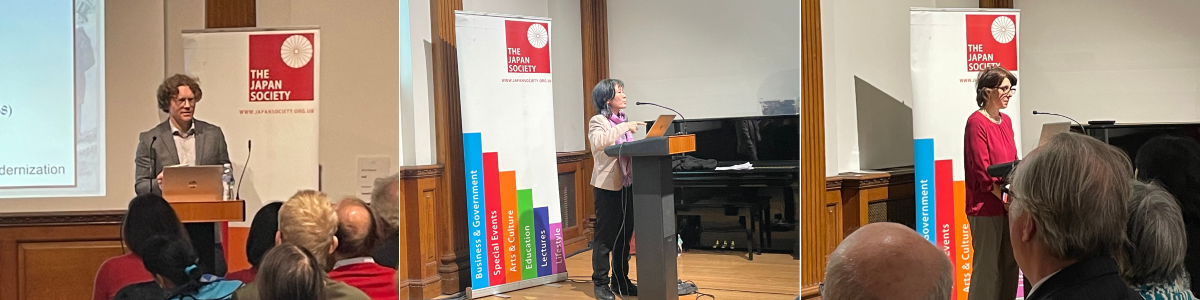
In January, February, and March 2026 we hosted a series of lectures that explored the global evolution of the samurai with Professor Oleg Benesch, human rights challenges with Dr Sanae Fujita, and a reconsideration of the samurai by Dr Rosina Buckland, lead curator of the British Museum’s landmark exhibition Samurai.
We would like to thank our speakers: Professor Oleg Benesch, Dr Sanae Fujita, and Dr Rosina Buckland, along with everyone who attended the lectures. Special thanks to the Toshiba International Foundation for their support.
Below is a summary of the lectures conducted the first three months of 2026.
Click here for upcoming lectures and Join The Japan Society Mailing List to stay informed of future events.
|
Become a member of The Japan Society and have exclusive access to the video recording of most of the lectures and many more events in the "members-only" playlist on our YouTube channel.  |
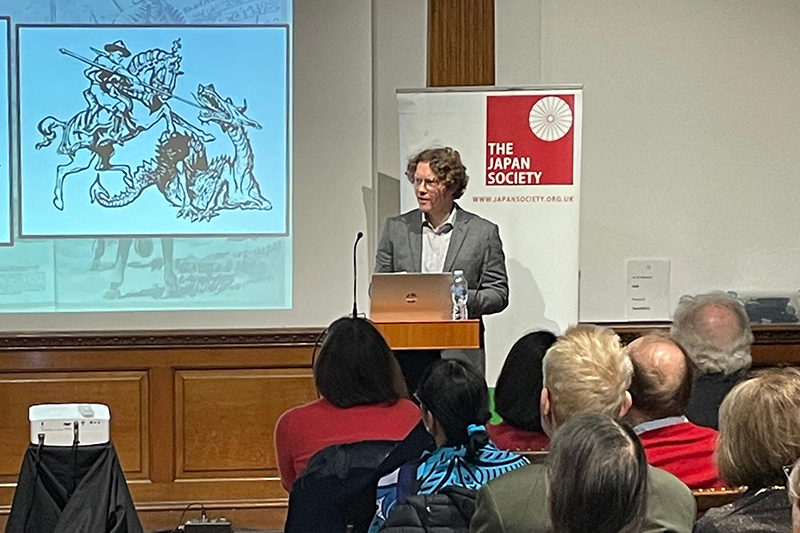
19 January - Japan, Britain, and the Globalisation of the Samurai - Oleg Benesch
Prof Benesch begins by drawing an unexpected parallel between the Japanese samurai and the British Boy Scout movement. He explains that Robert Baden-Powell, who founded the Boy Scouts in 1907, was deeply influenced by 'medievalism', the romantic reimagining of the medieval past to serve modern imperial goals. In his seminal text, Scouting for Boys, Baden-Powell linked the virtues of King Arthur’s knights directly to the Japanese code of bushido. This introduction establishes that the global image of the samurai as a chivalric warrior was not an ancient survival, but a modern 'global icon' heavily shaped by British Victorian ideals and the concept of the 'English gentleman.'
Prof Benesch then shifts to the historical reality of the Meiji Restoration (1868), noting that Japan initially rejected the samurai as 'feudal relics' in its rush to modernise. However, by the 1890s, a 'symbolic rehabilitation' occurred. Japanese thinkers, most notably Ozaki Yukio, rediscovered the samurai after travelling to Britain and witnessing the high cultural status of the 'gentleman'.
Inspired by how the British traced their imperial strength back to medieval knighthood, Ozaki and others recast bushido as a native equivalent to chivalry. This process of 'self-medievalisation' was further reinforced by Japanese students reading Western history textbooks, which allowed Japan to create a modern national identity that appeared ancient and martially superior.
In the final section, Prof Benesch explores how Japan’s military victories over China (1895) and Russia (1905) transformed the samurai into a model for the West. British observers, captivated by Japan's success, began to hold up the 'samurai spirit' as an ideal of self-sacrifice and collectivism that they felt was lacking in their own society. This culminated in significant cultural exchanges, such as the Meiji Emperor being inducted into the Order of the Garter. Prof Benesch concluded by noting that while the martial elements of bushido eventually became a pillar of state ideology leading up to the Second World War, the initial globalisation of the samurai was a collaborative, cross-cultural construction between Britain and Japan.
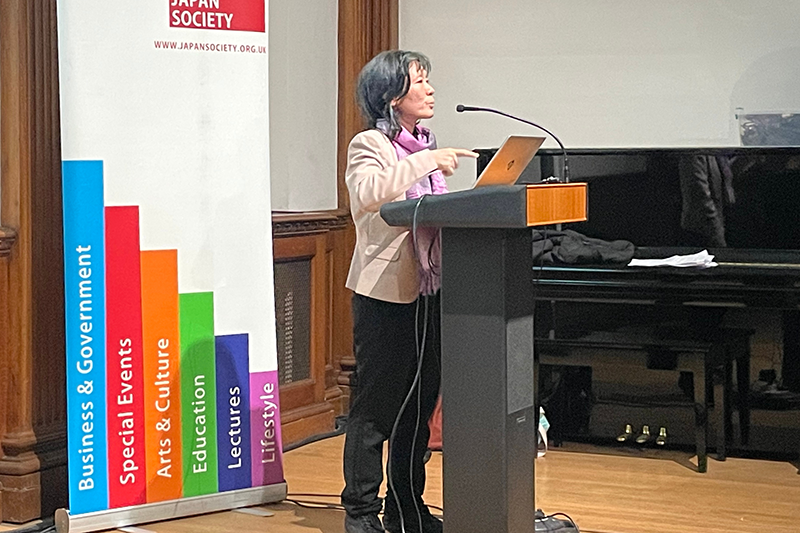
16 February - Human Rights in Japan: Why Does Change Lag Behind? - Sanae Fujita
Dr Fujita highlights the significant gap between Japan’s international human rights commitments and its domestic reality, focusing specifically on the government's failure to establish an independent National Human Rights Institution (NHRI). Despite promises made during the 2017 Universal Periodic Review, the Dr Fujita argues that the Ministry of Justice continues to offer a 'bureaucratic substitute' that lacks the necessary independence to hold the state accountable. This lack of oversight is framed as a critical infrastructure deficit, leaving vulnerable groups - such as children, asylum seekers, and those in mental health facilities - without a 'last resort' for justice.
The middle of the talk explores the deep-seated cultural and political hurdles preventing reform, including a 'hostage justice' system that prioritises confessions and a government that often dismisses international standards as incompatible with each country's circumstances. Dr Fujita notes that while the Democratic Party once attempted to pass an NHRI bill, political instability ultimately derailed the effort.
Furthermore, a sociological challenge exists: a lack of human rights education in schools has led to 'learned helplessness' among the youth, who often feel that voicing an opinion or demanding change is a futile exercise.
In conclusion, the Dr Fujita emphasises that change is unlikely to originate from the government and must instead be driven by a persistent, grassroots civil society network. While the progress is described as a 'very slow process', the success of the speaker's book and the engagement of medical and legal professionals offer a glimmer of hope. By comparing Japan’s human rights infrastructure to using a 'candle' while the rest of the world enjoys modern lighting, the lecture ends with an urgent call to action to build the necessary pressure to modernise Japan’s legal protections for all citizens.
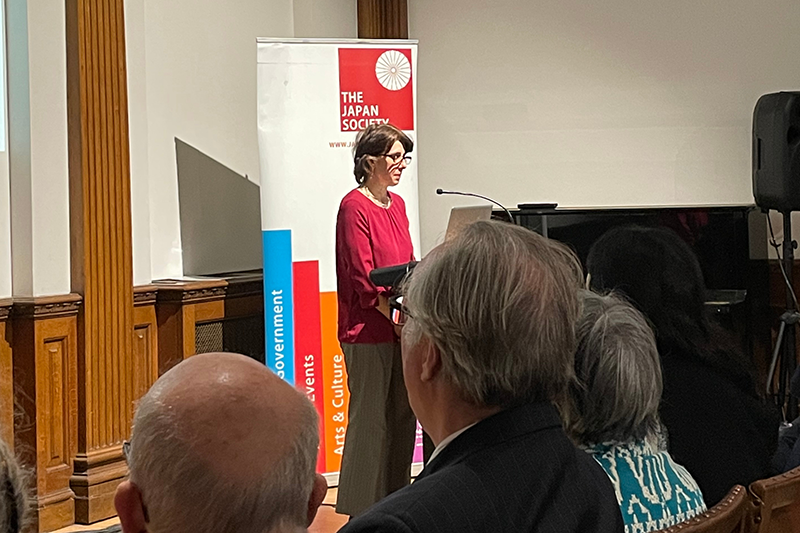
16 March - Reconsidering the Samurai - Rosina Buckland
Dr Rosina Buckland, lead curator of the British Museum’s exhibition Samurai, began her lecture by outlining the curatorial vision behind the exhibition and the rationale for its tripartite structure. She explained that the exhibition was organised into three sections - samurai as warriors, the transformations of the Edo period, and the afterlife of the samurai image in modern culture - in order to challenge simplified or romanticised views of the samurai. By moving from their origins as martial figures to their bureaucratic roles in a time of peace, and finally to their reinvention in global culture, the exhibition invites visitors to understand the samurai as a dynamic and evolving social and cultural phenomenon rather than a static historical archetype.
Dr Buckland explores the Neo-Confucian social structure of the Edo period (1615–1860s), during which the samurai functioned primarily as the state’s 'government functionaries' rather than active combatants. In this era of peace, the class filled diverse bureaucratic roles, serving as tax collectors, land surveyors, and record keepers. Despite the absence of warfare, they maintained their elite identity through rigorous 'military practise,' including swordsmanship and archery. Dr Buckland also details the highly symbolic role of falconry; the training of raptors to hunt cranes was a prestigious pursuit that acted as a visible sign of the Shogun’s patronage and the complex hierarchy of 'connoisseurship' within the warrior class.
A large portion of the talk is dedicated to the often-overlooked 'half of the samurai class that are women'. Dr Buckland details the complex domestic responsibilities of high-ranking women who managed large households and hundreds of retainers. A particularly striking highlight of the exhibition is the existence of female firefighting companies within the women’s quarters of Edo Castle, where men were strictly forbidden. Objects such as a 'female firefighter' garment, embroidered with protective watery motifs and grappling hooks, illustrate the self-sufficiency of these women. This period also allowed for a flourishing of leisure pursuits, ranging from delicate cat paintings by daimyo wives to the established practice of male-to-male sexual relations, which Dr Buckland notes were a recognised part of the social fabric.
In the final section, Dr Buckland examines the 'pure fiction' of the samurai that emerged after the class was officially abolished in 1869. The lecture traces how the samurai image was co-opted for 20th-century militarism before being transformed into a global pop-culture phenomenon. Modern creative works, from the video game Ghost of Tsushima to the whimsical sculptures of Noguchi Tetsuya - such as an 'Archer mounted on a rubber duck'- demonstrate that the samurai image is now an international asset. By concluding with the influence of samurai aesthetics on high fashion, Dr Buckland reinforces the exhibition’s central message that the samurai legacy has evolved into a versatile, global language used to explore identity and human creativity today.
Supported by the Toshiba International Foundation (TIFO)