
The Japan Society Public Lecture Series: April – June 2026
In April, May, and June 2026 we hosted a series of lectures exploring contemporary Japan, from rural sustainability and community resilience with Dr Marco Reggiani, to the human rights challenges facing incarcerated mothers with Professor Laura Abbott, and the role of visual art in Japan's countercultural movements with Dr Marco Bohr.
We would like to thank our speakers: Dr Marco Reggiani, Professor Laura Abbott, and Dr Marco Bohr along with everyone who attended the lectures. Special thanks to the Toshiba International Foundation for their support.
Below is a summary of the lectures conducted during Spring 2026.
Click here for upcoming lectures and Join The Japan Society Mailing List to stay informed of future events.
|
Become a member of The Japan Society and have exclusive access to the video recording of most of the lectures and many more events in the "members-only" playlist on our YouTube channel.  |
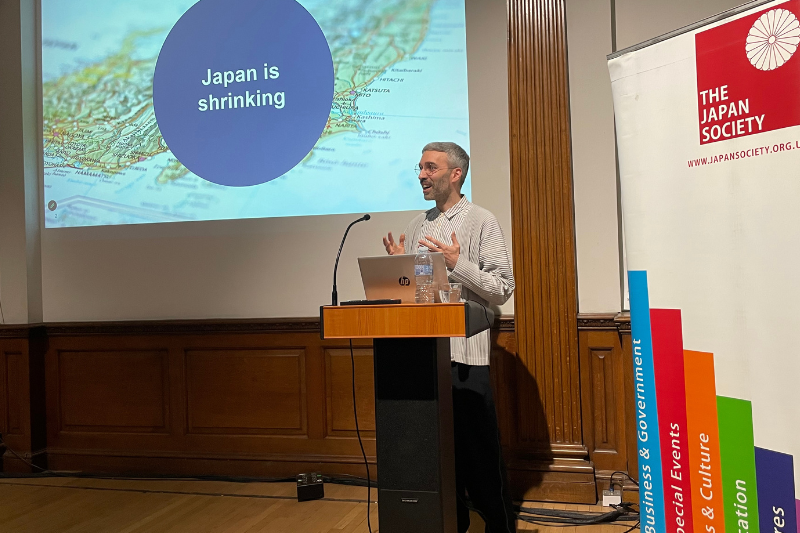
Dr Marco Reggiani, Research Fellow at the University of Strathclyde, opened his talk by confronting an unavoidable fact, Japan is shrinking. Its population peaked in 2008 and is expected to fall by around 20 million by 2050. This decline is uneven, hitting rural and peripheral regions hardest, where shrinking communities, school closures, labour shortages, and abandoned homes have long been visible. He argues that while the narrative of rural decline is grounded in reality, repeating it as the only story risks making it self‑fulfilling by narrowing the imagination of possible futures.
Against this backdrop, his lecture traced Japan’s shifting policy responses. Beginning with the postwar boom and the 1970 designation of severely shrinking regions, he noted that governments invested roughly 110 trillion yen in infrastructure, leaving a clear physical legacy but failing to halt depopulation. A turning point came with the 2014 Masuda Report, warning that many municipalities faced potential disappearance. The government responded by reframing the issue as regional revitalisation, culminating in the SDGs Future City initiative (2018), which selects municipalities with strong sustainability plans and requires them to set measurable indicators and share results nationally.
Dr Reggiani then examined three case studies, Shimokawa in Hokkaido; Suzu in Ishikawa Prefecture; and Kamikatsu in Tokushima Prefecture. These cities are all SDGs Future Cities, all small and shrinking, yet widely cited as revitalisation models. Shimokawa, drawing on its forestry-based sustainability tradition, created a co‑designed “Vision 2030” focused on harmony with nature, circular resource use, and intergenerational well‑being, embodied in the experimental Ichinoashi Village. Suzu leveraged its distinctive satoyama and satoumi landscapes to build a “circulating and ecological sphere” and partnered with Kanazawa University to create a learning hub in a former school, though progress was heavily disrupted by the 2024 Noto earthquake. Kamikatsu, internationally known for its 2003 zero‑waste programme, 45 waste categories and over 80% recycling, formalised its identity in the question‑mark‑shaped Zero Waste Centre, serving as recycling facility, community hub, and hotel.
In these three case studies, Dr Reggiani identified three shared themes, place‑based identity, circular and zero‑waste paradigms, and a shift from growth metrics to well‑being. Sustainability, he argued, helps these towns reinterpret decline not as failure but as a condition shared across post‑growth societies, from northern England to rural Italy and Spain. He acknowledged limits, selective SDG engagement, persistence of growth‑oriented tools, and vulnerability to external shocks, but suggested that the central challenge is no longer restoring growth, but learning to live meaningfully with less, a lesson these towns may be pioneering for the wider world.
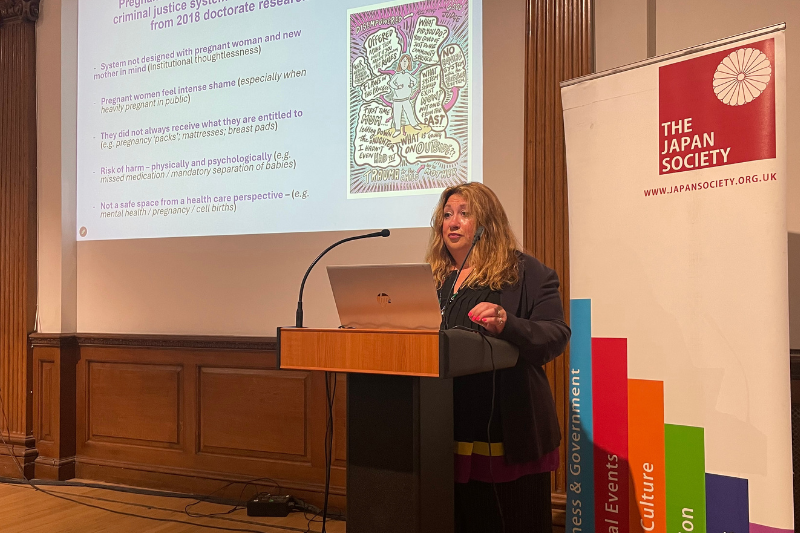
Prof Laura Abbott began by drawing on her professional background as a midwife and her recent research visit to Japan’s Tochigi Prison, supported by the Daiwa Foundation. She highlighted a striking "sensory contrast" between the two prison systems: while she characterized UK prisons by noise and chaos, the Japanese system was defined by absolute silence, order, and strict conformity. Despite these environmental differences, she emphasized that the women in both systems often shared similar backgrounds of poverty, trauma, and histories of non-violent offending.
The lecture explored the concept of "institutional thoughtlessness," where the prison system failed to accommodate the basic needs of pregnant women because it was never designed for them. Professor Abbott discussed the traumatic reality of maternal separation, noting that in Japan, babies were typically separated from their mothers shortly after birth and placed in institutional care. In the UK, while some Mother and Baby Units (MBUs) existed, many mothers still experienced the visceral pain of separation and often "masked" their mental health struggles to avoid further institutional repercussions.
A significant portion of the talk was dedicated to the "Lost Mothers" project, which centralized the "lived experience" of women who had faced separation within the criminal justice system. This collaborative research revealed the "raw and visceral" language mothers used to describe the removal of their children, often feeling like a part of them had been "ripped" away. To bring these hidden stories to a wider audience, Abbott worked with the Clean Break Theatre Company to produce the play Scenes from Lost Mothers, raising awareness about the secondary trauma experienced by both mothers and staff.
Prof Abbott advocated for a fundamental shift toward community-based alternatives to imprisonment for pregnant women and mothers of young children. She pointed out that eleven other countries already avoided incarcerating this group and called for increased funding for mental health support and better coordination between police and probation services. By continuing cross-cultural research and sharing good practices between the UK and Japan, she aimed to foster a modernized legal framework that prioritized the dignity and health of the most vulnerable families.
15 June - Exploring Visual Counterculture in Japan - Dr Marco Bohr
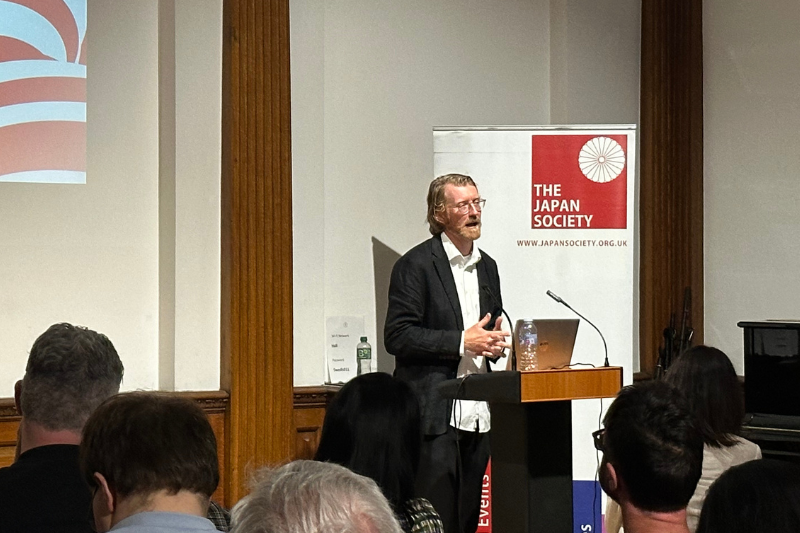
Dr Marco Bohr (MA, Royal College of Art; PhD, University of Westminster) drew on his 2025 monograph to explore the transformative power of Japanese photography and film and how visual culture was used to subvert mainstream narratives within the urban landscape. He begins by explaining his background as a photographer himself and the ways in which he understood the relation between images and reality. Then he moved to his research on Japanese photography focusing on his encounter with the work of female photographers Hiromix and Nakayama Yurie and how they subvert the status quo using photography in different ways.
Marco then explored photography in 1960s Japan when the ideological order was in a state of extreme flux, with Marxism, Leninism, and Maoism converging to challenge the emerging neoliberal capitalist system. In this context he made a distinction between images that merely depict a protest and those where the "image itself becomes part of a protest".
In the lecture, Marco also discussed Tsuchimoto Noriaki’s 1964 film, On the Road: A Document, which was originally commissioned by the police as a road safety film but was transformed by the director into a Marxist critique of hyper-capitalism and labour exploitation. Similarly, in his analysis of the 1962 "Yamanote Line incident," Marco emphasizes the vital role of the photographer (such as Murai Tokuji) whose documentation allowed these transient, absurdist performances to exist as lasting acts of historical subversion.
A significant portion of the talk is dedicated to the "visual counterculture" of Okinawa, a region defined by the tension of continued U.S. military occupation until 1971. Marco examines the work of Matsumura Kumi, who captured a "fly-on-the-wall" perspective of African American soldiers, self-identified as "Bush masters", and their unique engagement with local Okinawan communities. This is contrasted with the Nihon Documentarist Union’s (NDU) radical footage of the "triple colonization" of Okinawa, which utilized the concept of "expanded cinema" to immerse audiences in the sensory and political realities of resistance.
Finally, Marco also addresses the legal and social boundaries of expression through Article 175 of the Criminal Code, Japan's obscenity law. He discusses how artists like Nagashima Yurie challenged gender norms and censorship in the 1990s by depicting nudity and pubic hair, which were then markers of state regulation. By connecting these historical movements to contemporary artists like Yamashiro Chikako, Marco demonstrates that visual subversion remains a primary tool for questioning sovereignty and the security apparatus in modern Japan.
Supported by the Toshiba International Foundation (TIFO)