A Modern Economic History of Japan: Sho Ga Nai (It Is What It Is)
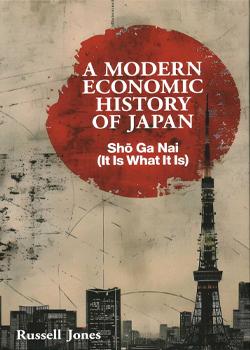
By Russell Jones
London Publishing Partnership (2025)
ISBN-13: 978-1916749399
Review by Sanae Inagaki
Reading this book gave me a clearer sense of how Japan’s economy has evolved from the post-war period to the present. Although I am not an economist, I found it remarkably accessible. The author connects economic developments with social and political change in a way that feels both clear and balanced.
What impressed me most was the way the book highlights key turning points in Japan’s modern economic history. Each period is explained with concise yet well-chosen detail, allowing even readers more familiar with cultural or historical studies to follow the narrative easily. I also appreciated how Japan’s experience is placed in dialogue with more recent global challenges, making the book relevant to today’s world.
Among the chapters, the one dealing with major disasters left the strongest impression. Chapter 8, ‘Out of the Frying Pan…’, carefully explores how the Great East Japan Earthquake of 2011 influenced national policy and the broader idea of reconstruction. The author traces the government’s ten-year recovery programme and its unprecedented fiscal scale, showing how it was implemented through a series of supplementary budgets. The discussion captures the administrative weight and social complexity of recovery efforts, reminding the reader that reconstruction is not only about rebuilding infrastructure, but also about enabling communities to move forward again.
Chapter 9, ‘Abenomics and After’, adds a contemporary layer to the long historical arc of the book. Even for readers unfamiliar with the details of economic policy, it clearly shows how political decision-making and social expectations interact. The analysis of Abenomics conveys Japan’s characteristic caution—seeking growth through stimulus while avoiding excessive risk.
The section on the Covid-19 pandemic also feels particularly timely. The author explains how, under the constraints of Japan’s post-war constitution, the government was unable to impose curfews and instead relied on voluntary restrictions and public awareness of hygiene. The book also outlines the delayed but accelerated vaccine rollout, and the fiscal measures aimed at employment retention and corporate support. These passages illustrate Japan’s distinctive institutional capacity to coordinate and adjust under pressure. The pandemic is presented as yet another major test of national resilience.
Chapter 10, ‘Broader Lessons’, asks what Japan’s modern and contemporary experience might teach the world in 2025. The author argues that even capitalist economies with significant state involvement can demonstrate remarkable resilience and adaptability over time, though such strength ultimately depends on sound institutions, political stability, and balanced policymaking. From the asset bubble of the late 1980s, we are reminded how financial overconfidence can lead to deep and lasting stagnation.
The book also discusses Japan’s demographic challenges—ageing and labour shortages—as issues that all advanced economies now share. The author organises these into a set of practical priorities: strengthening childcare provision, expanding labour market policies, promoting women’s employment, managing immigration where appropriate, and maintaining education and international openness.
What I found particularly thought-provoking was how the author seems to view Japan’s future not as a return to past growth, but as a question of how to manage decline with order, invest in technology and education, and sustain steady reform. This attitude is not pessimistic; rather, it reflects a quiet trust in Japan’s long-standing traditions of patience and adaptability.
For someone who has mainly studied Japan through the lenses of culture and art, this economic perspective felt refreshing. It reminded me that economic history is not merely about numbers or policy, but about how people adapt, recover, and imagine their future.