

Summer at Mount Asama
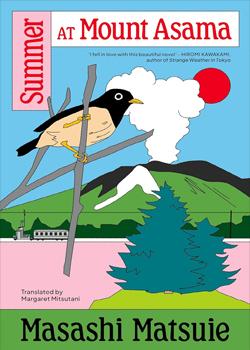
By Matsuie Masashi
Translated by Margaret Mitsutani
The Indigo Press (2025)
ISBN-13: 978-1917378000
Review by Tabitha Carver
Summer at Mount Asama is the prize-winning debut novel by Matsuie Masahi (1958), first translated into English in 2025 after its original Japanese release in 2012.
Before its publication, Matsuie worked as an editor for many of Japan’s most successful authors such as Murakami Haruki, Ogawa Yoko, and Yoshimoto Banana. Having won the Yomiuri Prize, an award rarely given to debut novels, this work confirms Matsuie’s literary talents in his own right.
In the book, we accompany the newly graduated Sakanishi Toru as he joins the esteemed Murai architectural agency established by the man we come to know as Sensei, the fictional Murai Shunsuke, a former student of the nonfictional pioneering architect Frank Lloyd Wright (1867-1959).
Every year, the architectural agency team makes their way to a small village at the base of Mount Asama, an active volcano. There, they live and work together against the backdrop of a changing village, once an active artist’s colony, as it deals with modernization and the realities of an aging population in rural Japan. While the central narrative revolves around the production of the agency’s entry into a competition to build the new National Library of Modern Literature, the essential currents that carry this novel are its philosophical ponderings on life, nature, beauty, art and creation.
Lovers of architecture as well as those with no prior knowledge of the craft will enjoy learning about key tenets of modernist architecture. This occurs both through the fictional work of Sensei and our protagonist (the ritual of pencil sharpenings at the company, the intricate creation of blueprints, the deep and rich description of a fictional church hidden in the depths of Tokyo) and insights into the historical trailblazers of Western architecture: notably, the aforementioned American Frank Lloyd Wright, as well as the Swedish Gunnar Asplund.
Wright had a huge influence on modernist architecture in Japan, where his modernist and organic approach complemented Japanese architectural traditions - he leaves behind not only his own material legacy (most known perhaps, the Imperial Hotel in Tokyo), but the philosophies carried on through the apprentices he trained in Japan and beyond.
In Summer at Mount Asama, Sakanishi, our protagonist, is equally concerned with the legacies left behind by architects, in particular, those of his own sensei, under whose tutelage he begins to gain confidence in his craft.
Sakanishi sleeps in a library at the Summer House, surrounded by books on architecture. It is the cemetery designed by Asplund that leaves a lasting impression on him. Asplund’s clear thoughtfulness on the choice of materials and placement of structures is mirrored in the in-depth considerations of what an accessible, lasting, national library structure should look like and who it should serve.
In that sense, it is not insignificant to hold this book while reading. As we learn about detailed considerations for appropriate bookshelf height in the National Library, ventilation to avoid mold, which exact material will age well to preserve the content of the books on the shelves, the reader cannot help but contemplate the importance of archiving ideas - you may even find yourself treating the very pages in your hand with a little more care. The material explanation around preservation again invokes questions of legacy - what it means to create, leave behind, and maintain.
Throughout the novel, our fictitious architect grapples clearly with what the legacy of an architect can and should be. What responsibilities might an architect bear in the construction not only of a National Library, but in that of a church or cemetery? When the architect has passed on, who can make delicate repairs when the materials used are tested against time?
This question of legacy and preservation is crucially not isolated from the perpetually present forces of nature, reminding us that we can never fully control our environment. While there are smaller narrative examples of this (a damp stain in wallpaper to be fixed in a previously constructed house in the village), the most striking example of this is the shadow of Mount Asama itself: an active volcano, whose unpredictability, its showers of enveloping ash, loom over the book.
However, despite nature’s might, these reminders aren’t always threatening: In fact, it is the sprinkle of bird calls, the rich descriptions of the origin of certain plants, the katsura tree outside the summer house (which seems to grow and mature in tandem with our narrator) that reminds us: there is beauty in the coming and going of life.
In one example, we meet with the potential for human legacy in a beautiful scene, as volcanic ash is cleared to make way for the discovery of preserved pottery of the Jomon perido (14,000-1000 BC), known as the earliest known pottery tradition in the world.
In addition to the deep philosophical questions examined in this novel, its sincere exploration of work, family and romantic relationships in 1980s Japan is equally insightful. A western reader will be interested in learning about certain Japanese customs, for example how formalities interplay with intimacies that may seem surprising (one must at once be extraordinarily mindful of how to speak to one's elders and consider comfortable attending a nude hot spring with those same elders).
While our narrator is often reserved, we discover alongside him the surprises of first romance, the importance of community and the true expansiveness of what family means, as this group of architects live together, create and negotiate life at the base of Mount Asama.
The threat of the unknown looms over the narrative, explored through unexpected challenges and the unpredictable forces of nature around them. However, Summer at Mount Asama ultimately tells us it is precisely the impermanence of life itself - the marching on of time and history - that makes possible humankind’s persistence in building structures, art, love, and relationships across generations.