Exhibition - Samurai
at British Museum
Review by Vittorio Cimino
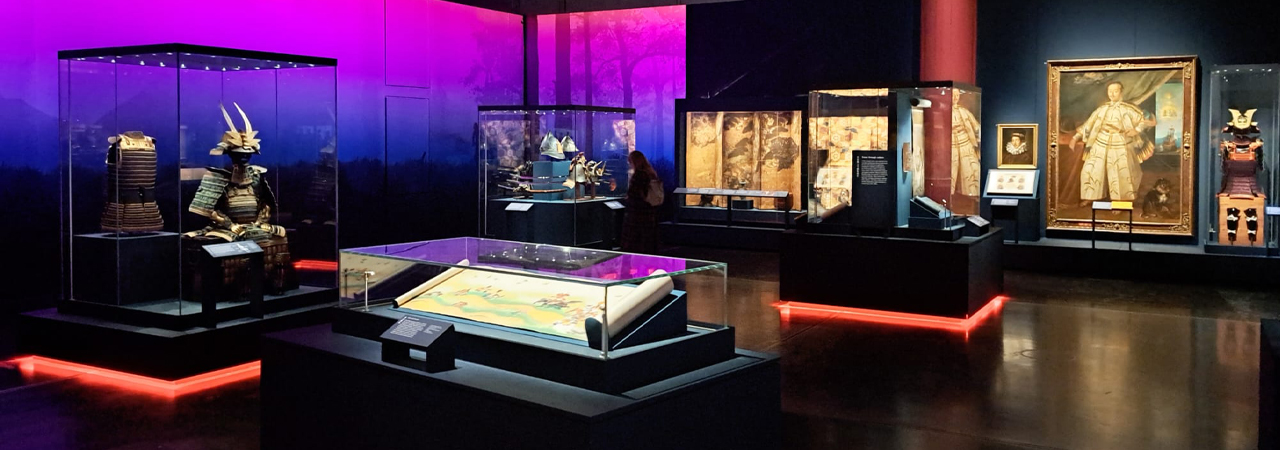
Photo by Vittorio Cimino
Who were the samurai? For centuries, Western imagination has fixed them as solitary, almost superhuman warriors, figures defined by unwavering honour, exceptional swordsmanship, and ritualised violence. Popular culture has reinforced this image, reducing the samurai to a romanticised symbol of combat and sacrifice. British Museum’s exhibition Samurai challenges this narrow perception by presenting a far more complex and nuanced portrait. Rather than isolating the samurai as warriors alone, the exhibition reveals them as political strategists, administrators, cultural patrons, diplomats, and eventually global icons. Structured chronologically, the exhibition traces how the samurai shaped Japan’s social order, cultural identity, and international presence over nearly a millennium.
The exhibition begins by exploring the emergence of the samurai in medieval Japan, roughly from the twelfth to the sixteenth century, a period marked by political instability, civil war, and the fragmentation of imperial authority. As central power weakened, regional military families rose to prominence, managing land, enforcing order, and forming loyalty networks that became the foundation of Japan’s feudal system. In this context, the samurai were not simply fighters responding to chaos; they were strategic power brokers who navigated shifting alliances and political rivalries. Their authority rested on a combination of military skill, land control, and symbolic legitimacy. This historical narrative is conveyed through a rich collection of artefacts drawn from institutions around the world. Exquisitely preserved objects underscore how warfare, status, and identity were deeply intertwined. Refined swords, with their pronounced curvature and exquisite craftsmanship, illustrate how weapons functioned not only as tools of combat but also as markers of rank and prestige. Early suits of lamellar armour, constructed from lacquered iron and leather, demonstrate the technical sophistication required for mounted warfare while also revealing aesthetic choices in colour, ornamentation, and clan insignia.
Beyond martial objects, the exhibition also presents items from everyday life, such as folding screens, sutra scrolls, and tea ceremony utensils, which illuminate the complexity of the samurai’s role within a refined and highly developed society. These objects reveal that medieval samurai culture extended far beyond strategy, political legitimacy, and physical force, encompassing literature, religion, and ritual. Together, they demonstrate how samurai identity was shaped by multiple layers of Japanese cultural life rather than by warfare alone.
The exhibition further challenges assumptions about Japan’s historical isolation by highlighting early global connections. Paintings such as the portrait of Ito Mancio by Tintoretto, one of the Japanese envoys who travelled to Rome in the late sixteenth century to meet the Pope, testify to Japan’s diplomatic engagement with Europe. Such works complicate the notion of a closed Japan and position the samurai within a wider global context.
The exhibition then moves into the Edo period (1600-1850), when Japan experienced more than two centuries of relative peace under Tokugawa rule. With large-scale warfare suppressed, the role of the samurai underwent a profound transformation. No longer defined primarily by the battlefield, samurai became bureaucrats, legal officials, scholars, and moral exemplars within a rigid social hierarchy. Their authority now derived from education, discipline, and service to the state rather than military conquest.
This shift is vividly reflected in the objects on display. Alongside swords and armour, the exhibition presents everyday items such as kimono, calligraphic scrolls, and woodblock prints by artists such as Kuniyoshi and Kyosai. These, together with numerous ukiyo-e prints depicting urban life, place the samurai within a broader social world that included merchants, artisans, and performers. Tea ceremony utensils, lacquerware, and poetry manuscripts further highlight the samurai’s role as cultural patrons deeply invested in aesthetics and refinement.
Importantly, this section also addresses perspectives often overlooked in traditional narratives, particularly the role of samurai women. Through household items, textiles, and prints, the exhibition acknowledges women’s responsibilities in managing estates, preserving family honour, and defending the household in times of danger. These artefacts expand the understanding of samurai life beyond male-dominated martial ideals, presenting a more inclusive and socially complex picture.
The final section of the exhibition begins in the mid-nineteenth century, a moment of dramatic rupture marked by Japan’s forced opening to the West and the rapid modernisation of the Meiji era. Following the Meiji Restoration of 1868, feudal structures were dismantled and the samurai class lost its hereditary privileges. The abolition of samurai status in the 1870s, alongside the creation of a modern conscript army, marked the official end of the samurai as a social class. Yet rather than disappearing entirely, samurai identity was reshaped and reimagined within the framework of a modern nation-state.
Key artefacts reveal how the image of the samurai was mobilised during Japan’s emergence as an imperial power in the late nineteenth and early twentieth centuries. Samurai values such as loyalty, sacrifice, and discipline were incorporated into nationalist ideology and later invoked during both the First World War (1914-1918) and the Second World War (1939-1945). Although the historical samurai no longer existed, their symbolic legacy was used to legitimise military service and national unity during periods of global conflict.
The exhibition also traces the afterlife of the samurai in modern popular culture, demonstrating how their armour, ethics, and visual language continue to influence cinema, fashion, and design. A striking example is the influence of samurai armour on the design of Darth Vader in Star Wars films, whose helmet and silhouette echo traditional Japanese forms. Through such examples, the exhibition shows how the samurai have become global cultural symbols, detached from their original historical context yet powerfully resonant.
Throughout the exhibition, artefacts function as windows into the layered and evolving world of the samurai. Each object contributes to a broader narrative in which identity is not fixed but constantly reshaped by historical, political, and cultural forces.
Ultimately, Samurai is more than a historical display; it is an invitation to reconsider legend and reality. By presenting the samurai as adaptive figures who responded creatively to war, peace, and modernity, the exhibition dismantles romantic stereotypes and replaces them with a richer, more human story. The samurai emerge not as timeless warriors frozen in myth, but as complex individuals and communities who helped shape Japan’s political structures, cultural traditions, and global image. In doing so, the exhibition frames the samurai as a metaphor for Japanese culture as a whole: a complex, stratified tradition that evolves over time, absorbing change while refining and reimagining itself.
Although the exhibition closes on 4 May, its content remains accessible through the catalogue edited by Rosina Buckland, Lead Curator of the Samurai exhibition, and Oleg Benesch, Professor and Head of the Department of History at the University of York. This 300-page volume brings together a rich selection of high-quality colour images, allowing readers to revisit the objects and themes of the exhibition well beyond its physical run. The catalogue balances visual appeal with clear and engaging historical analysis. Organised into three thematic sections:Rise of the Samurai, The Long Peace, and From Reality to Myth; it traces the development of the samurai while exploring their changing social, political, and cultural roles over time. The objects featured in the exhibition are woven throughout the text, grounding the narrative in material culture and guiding the reader through the broader historical story. Overall, the catalogue functions both as a lasting record of the exhibition and as an accessible interpretative study, placing the samurai firmly within their historical context while reflecting on how historical realities have evolved into enduring cultural narratives.