Yone Noguchi. The Stream of Fate
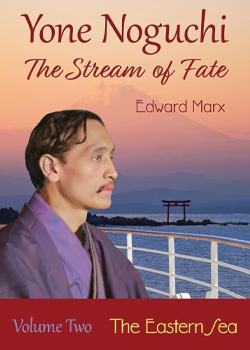
By Edward Marx
Volume two: The Stream of Fate
Botchan Books (2025)
ISBN-13: 978-1939913104
Review by Peter Kornicki
This, the second volume of Edward Marx’s comprehensive biography of Noguchi Yonejirō (1875-1947), who was known in the West as Yone Noguchi, covers the period of his life between his return to Japan in 1904 and the year 1921 (see the review of the first volume here). Presumably, a third volume will cover the remainder of his life. This is sure to be the definitive biography of this enigmatic man, who is in no way an attractive figure. We are in fact reminded early on in this volume that he was a cad. After 11 years abroad, Noguchi returned to Japan in late 1904. He left behind not only his secret wife, Léonie Gilmour, whom he had abandoned and who was pregnant, but also his new fiancée, Ethel Armes, who was expecting to join him in Japan. Neither Léonie nor Ethel was aware of the other’s existence. With the help of Ethel, who typed up the articles he sent from Japan and tried to place them with American publishers, he continued to write for American journals. One of the first pieces he sent back was about his attempt to meet Lafcadio Hearn. This article was, as Marx notes, full of what can only be described as untruths and inventions.
When he returned to Japan, the Russo-Japanese War was in progress, and it seems that he was expected to provide readers in the United States with accounts of the progress of the war. This he proceeded to do, but American readers would have been well advised to take anything he wrote on the subject with a pinch of salt. He claimed to be writing from the battlefields of Port Arthur and to have discussed the war with assorted famous people, but it was all sheer invention. ‘Noguchi sought maximum literary effect with minimum exertion’, explains Marx, ‘disregarding such common concerns as truth, accuracy, objectivity, responsibility and integrity’ (23). Nevertheless, he was appointed to teach in the literature department at Keio University; he was feverishly writing in Japanese, too – he published four books in 1905 alone. He was still expecting Ethel to join him in Japan, but his American life was beginning to catch up with him. A newspaper reporter visited the hospital where Léonie had given birth to his son, the future sculptor Isamu Noguchi, and the story broke in the press. Ethel, learning that she had been deceived, naturally broke off the engagement: needless to say, she was no longer willing to act as Noguchi’s unpaid typist and publicity agent.
Noguchi led a busy life in Japan, both professionally and personally. He was constantly writing books and articles, both in English and in Japanese. In 1907 he published Ten Kiogen in English, a collection of translations of kyogen plays, and, in a journal, a translation of Hyakunin isshu (One hundred poems by 100 poets), but unfortunately Marx hurries on to the next topic with pausing to provide an assessment of these as translations. Noguchi also published Lafcadio Hearn in Japan and a book of poetry titled The Pilgrimage, among other works. He rarely responded to contemporary political events, though he did criticise the growing racism in California and the increasingly intrusive literary censorship in Japan.
As for his personal life, in 1907 Léonie arrived in Japan with their son, Isamu. Noguchi found her some private English teaching to provide an income and publicly acknowledged that she was his wife, but they lived apart. Noguchi lived for a while in the Engakuji temple in Kamakura, but his official residence was another house where he had installed a young woman named Takeda Matsuko, who seems to have originally been one of his house maids, and their growing family.
In late 1913 he travelled to London, where he mixed with the many of the best-known writers of the day, including Edmund Gosse, Max Beerbohm, John Masefield, poet laureate Robert Bridges, George Bernard Shaw, Yeats, and Ezra Pound. On 14 January 1914 he gave a lecture on ‘Japanese poetry’ at The Japan Society: this drew some critical comments afterwards, but Noguchi seems not to have responded to any of them. And on 1 April he gave a second lecture, this time on the ukiyo-e prints of Yoshitoshi. Robert Young, who was the editor of the Japan Chronicle, considered that Noguchi’s success in London merely provided evidence of the British public’s ‘inexhaustible appetite for pidgin English’ (193). Pound, on the other hand, described him as ‘an interesting litterateur of the second order’ (221). The high point of his visit, which lasted five months, was a lecture on Japanese poetry at Magdalen College, Oxford, before a large audience, which was subsequently reported in The Times. Presumably the income he derived from his writing made such a long sojourn in London possible. He was, after all, an inveterate publicist, constantly writing in Japanese and English and seemingly having no trouble getting his writings published. While in London he put together The story of Yone Noguchi (1914), a random collection of previously published essays illustrated by Yoshio Markino, the Japanese artist living in London.
Marx’s research is impeccable. He has combed the English and Japanese periodical press assiduously and has uncovered letters, photographs and other materials. As a chronicle of Noguchi’s life, his new book is exhaustive and meticulously documented. After Noguchi’s return to Japan from London in June 1914, Marx takes up his response to the outbreak of war in Europe, to Rabindranath Tagore’s visit to Japan in 1916 (escorted on arrival by the artist Yokoyama Taikan and, inevitably, Noguchi), his essay introducing T. S. Eliot to Japan in 1918, his lecture tour to the USA in 1919-20, Arthur Waley’s trenchant criticism of Noguchi’s poetry in 1922 and Noguchi’s attempts to reinvent himself as a writer of Japanese poetry. There is no denying that Noguchi was acclaimed for his writings in English and his reach extended further than he ever knew: his writings on haiku were taken up by the Russian film director, Sergei Eisenstein (342), and even by Urdu poets (see Jennifer Dubrow, ‘The Imagist Ghazal: Urdu modernism and Japan’, Modernism/Modernity 32 [2025]: 409-435). Yet Noguchi is now largely a forgotten figure, and it is hard to account for the appeal he had for English and American readers until they turned against him in the 1930s. Sometimes Marx seems puzzled himself and perhaps he will address this issue in the final volume.
As I mentioned in my review of the first volume, it is irritating that Marx rearranges all Japanese names to suit Western order, especially as he does not do that with Chinese names: thus, we encounter Yuan Shikai but Hirobumi Itō. Again, like the first volume, the second lacks an index. I hope at least that Marx will provide an index to all three volumes in the final volume.