

Exhibition - Kenji Yoshida: The Meaning of Life
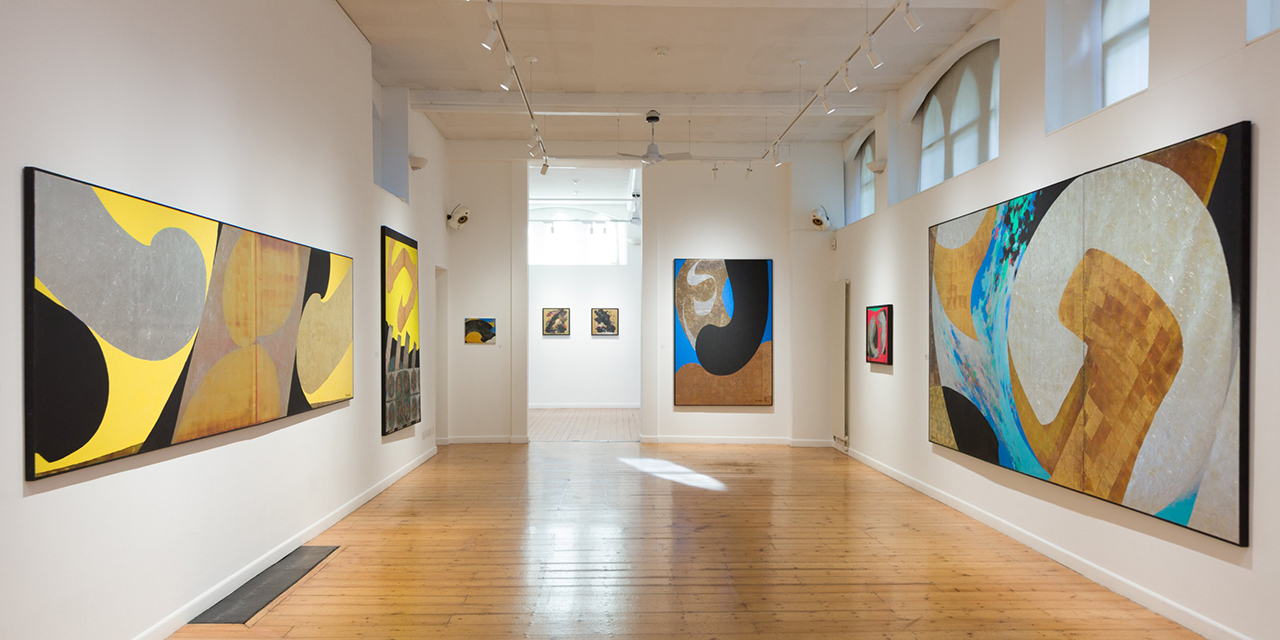
at October Gallery, London
Review by Vittorio Cimino
In a world increasingly defined by conflict, reflecting on life itself can feel both urgent and delicate. The ongoing wars in Ukraine and the Middle East remind us daily of how fragile human existence is. Against this backdrop, the exhibition The Meaning of Life at October Gallery resonates deeply. The works on display are by Yoshida Kenji, an artist whose life and career were profoundly shaped by the experience of war and survival. Rather than depicting violence or loss directly, his art explores a more fundamental question: what does it mean to live?
Yoshida Kenji was born in 1924 in Ikeda, near Osaka. He began studying art at Ikeda Normal School before the Second World War interrupted his education. In 1944, he was conscripted into the Japanese Navy and trained as a kamikaze pilot, though the war ended before he was deployed. That early confrontation with mortality left an indelible mark on him, quietly shaping his artistic vision. After the war, Yoshida returned to civilian life, working as an art teacher in Osaka and later in Tokyo, while continuing to paint privately.
A decisive moment came in 1964, when Yoshida moved to Paris to pursue art full time. There he joined Atelier 17, the influential printmaking studio founded by Stanley William Hayter, a hub for international artists experimenting with abstraction and graphic techniques. Paris offered him a vibrant environment to explore European modernism while retaining a connection to Japanese visual traditions. This blending of cultures gradually formed the distinctive abstract and luminous style for which he became known.
From the late 1970s, many of Yoshida’s artworks carry the title La Vie (“Life”). During this period, he also began incorporating gold, silver, and platinum leaf into his compositions, drawing on centuries of Japanese artistic tradition while applying it in a modern, abstract context. Light interacts with the surfaces, shifting perception as the viewer moves through the space. Within these glowing fields float simple, curved shapes that suggest seeds, droplets, or even celestial bodies. Yoshida avoids direct representation, allowing the forms to evoke movement, growth, and the continuity of life rather than literal objects.
The October Gallery exhibition brings together a selection of Yoshida’s artworks spanning several decades. Rather than following a strict chronological order, the display emphasises the continuity of his artistic focus: life as a universal and evolving force. The rhythm of the gallery, moving from one work to the next, encourages viewers to notice subtle variations in shape, colour, and texture, and to engage contemplatively with each piece.
Yoshida’s work is striking for its quiet, reflective tone. In contrast to the fast-moving imagery of contemporary life, his artworks invite a slower, more measured form of attention. The simplicity of the compositions draws the eye not just to the forms themselves but to the surrounding space – the delicate balance between presence and emptiness that gives the works their meditative quality. Behind this abstraction lies the weight of his personal experience: the memory of having once faced death directly, and the resolve to celebrate and preserve life in all its fragile beauty.
The exhibition also illustrates Yoshida’s broader significance in modern art. He occupies a unique position at the intersection of Japanese artistic tradition and European abstraction. By combining metallic surfaces, luminous colour, and simplified, floating forms, he created a visual language that transcends borders. This cross-cultural dialogue reflects wider currents in twentieth-century art, in which ideas and techniques moved fluidly between East and West.
The Meaning of Life offers more than a chance to encounter Yoshida’s work. It provides a space for reflection, inviting viewers to slow down and consider what it truly means to exist. The artworks do not provide answers but instead offer an experience of life’s fragility, resilience, and luminous energy. Within the quiet gallery, surrounded by surfaces that catch and reflect light, Yoshida’s message is clear: life is precious, fleeting, and worth contemplation.
In a contemporary context marked by uncertainty and conflict, Yoshida Kenji’s art is unexpectedly timely. His luminous forms and softly glowing surfaces remind us that, even amid destruction, life continues to unfold. The exhibition leaves visitors with a simple but profound question: what is the meaning of life? And in confronting it, we are encouraged to see not only the fragility of existence but its enduring beauty.