Six Months of Dreaming
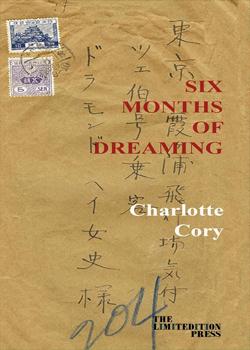
By Charlotte Cory
The Limitedition Press (2025)
ISBN-13: 978-1739511388
Review by Maxine Stacey
In Six Months of Dreaming (2025), contemporary multimedia artist and author Charlotte Cory balances creative and archival curiosity through an imaginative reconstruction to revive the almost-forgotten ambitions of an innovative Japanese neck-tie designer, Kajikawa Yutaka. The rediscovered designs by Kajikawa form the premise for the novel, and their visual depiction combined with historical archival research, result in a work that inhabits the space between fiction, historical inquiry and artistic homage. Through this creative exploration, Cory delivers a work that challenges the boundaries of archival research and artistic storytelling, highlighting new perspectives on how histories can be re-imagined.
Within Six Months of Dreaming, the accompanying visual materials provide a historical and design-focused backgrounding to the narrative, giving a unique and compelling contribution to the re-imagining of Kajikawa’s life. The historical fictionalised account of Kajikawa’s life establishes itself in the late 1920s, aligning the storytelling to a letter to Lady Grace Drummond-Hay, an aristocratic journalist visiting Japan during a global voyage on the LZ 128 Graf Zeppelin airship. The letter details the aspirations of Kajikawa, and tightly stuffed in the same envelope were 14 “Jazz Age” neck-tie designs showcasing his work deemed too outlandish and Western for Japanese markets. Cory imagines the life that may have unfolded around that moment of hope. As such, the work alludes to the barriers facing designers ahead of their time through the consideration of identity and belonging in a world facing rapid globalisation.
Cory’s narrative presents Kajikawa not just as an individual but as a representative figure of the interwar period’s cultural exchange between Japan and the West. The book explores themes of artistic ambition, modernity, and the optimism of creative labour. Kajikawa’s letter becomes the symbolic centre of the work, embodying both the promise and uncertainty of international artistic networks in the early 20th century.
A key part of this work that I thoroughly enjoyed was Cory’s acknowledgement section, written 95 years to the date of the arrival of the Zeppelin in Japan and the deliberate choice of the Zeppelin font. It is these small details and significant research and consideration conducted by Cory that truly make this an enjoyable read. I believe that the extensive attention to detail can and should be deeply appreciated when reading this work. It demonstrates Cory’s passion and interest and links the two creatives, Kajikawa and Cory, beautifully. If I were to offer some criticisms to the work, there are often overly long sentences, that at times, can cause difficulty with reading the work. Additionally, the speculative narrative of the life of Kajikawa needs to be considered before reading this book. If you are seeking a well-documented creative exploration of Kajikawa’s life, and particularly those with an interest in art and design, you will enjoy Cory’s work. For readers seeking a non-fictitious account of Kajikawa’s life, Cory’s re-imaginative account may not meet your expectations.
With the current global interest in Japanese arts and culture transcending mediums through digital platforms, this book deserves wider recognition and readership. It is a truly enjoyable read for those with an interest in fashion, history, design or Japan. Additionally, whilst there has been a one-off exhibition of Kajikawa’s real designs, there is clear scope for these designs to be exhibited more widely in the future.
Ultimately, Six Months of Dreaming is an engaging experimental form of creative writing that through the research efforts and imaginative writing style makes it an enjoyable light read at just 224 pages. Cory brings an artistic approach to archival writing and that is what makes this work particularly distinctive.