

The Typing Lady and Other Fictions
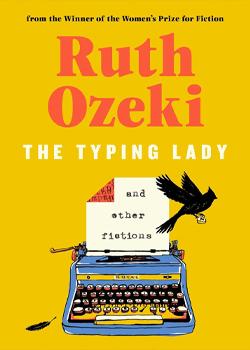
By Ruth Ozeki
Canongate (2026)
ISBN-13: 978-1837261598
Review by Azmina Sohail
My admiration for Ruth Ozeki’s work is confined to a time capsule. When the world descended into lockdown, my own expanded into the metaphysical realm of A Tale for the Time Being with Tokyo city, Zen Buddhism and a peculiar diarist. Soon the “feminist” within me was intrigued by My Year of Meats and thus began an interest in this acclaimed writer.
We often say that novels speak to us so you can imagine my surprise when upon opening The Typing Lady and Other Fictions, Ozeki herself greeted me, saying that the book was ‘For you. Who else?’ (dedication page), as if she had since been standing on the periphery of lockdown, tapping her foot impatiently.
She wastes no time in introducing me to The Typing Lady in the first story, ‘The Typing Lady: An Author’s Note,’ a woman in ‘her fifties or sixties, Asian-looking with black-framed glasses and gray-streaked hair’ (p.1) who was typing and scanning the room. No doubt, this is Ozeki herself – or a version of her. The writer.
Do I wish she withheld this physical description so I could’ve guessed? Yes. Do I continue reading and literally suspend my disbelief? Absolutely.
The Typing Lady is being observed by the narrator, who, I presume is Ozeki as well. She has a pattern of including herself in her work and for a moment the two conjoin to explain the reason for this book’s existence – a new challenge for her, shorter attention spans and technology’s effect on ‘reading skills’ (p.5). The honesty is admirable.
See this is not just a collection of short stories (a new genre for Ozeki) but ‘it had to be autofiction’ (p.7), a combination of autobiography and fiction.
I began perusing through the stories and noticed a thematic pattern; each one involved at least one of the following: academia, birds, etymology, race, mortality or the act of writing. Their constant reappearance and level of detail made it clear to me that these were potentially part of her autobiography; ideas which have occupied her mind, body and soul.
She has attempted to blur the lines of fiction and reality before but, in my view, is now taking it a step further and trying to break the fourth wall. I reflect that it is possibly this type of skill that has awarded her literary accolades.
There are messages behind each of the stories either for Ozeki herself or for us as readers. The characters and their lives feel so close to reality that they must, in my view, signify a meaning to real lives being lived. Whilst they don’t always evoke a sense of excitement, they encompass realism not unfamiliar to her style.
‘The Anthropologist’s Kid’ details the fractured friendship of two students against a background of childish mistakes and cultural difference. ‘Ships in the Night’ is a story of an unsuccessful writer and the effect on family life that leaves you with a sense of sadness but belief in stoicism for the next generation. ‘Where Ambition Goes to Die’ is an unusual second person narrative analysing the push and pull of inspiration.
But the story which stood out to me was ‘Leafblower’ about Mel, a writer and inadvertent carer of her landlords, the Professor and his bed-bound wife, Dr. Fae.
Mel is not where she wants to be in life and spends her time writing, taking instructions from the couple’s real daughter and stealing and selling the Professor’s books, all against the backdrop of the neighbourhood leaf blowers, ‘the Lawn Kings’ (p.54).
I couldn’t help but dislike her, primarily for stealing. In fact, despite being the most able-bodied character, she is the least honourable. That would be attributed to the Professor, who is a lot more cognizant than at first appears, telling Mel ‘we’ve been asking too much of you’ (p.99).
As her responsibilities increase so do the signs of mortality; Dr. Fae becomes fixated on a red cardinal that appears at her window commanding her attention; a symbolic image of spirituality and death. A long-living, family rhododendron is cut down and the risk of fatal elopement becomes all too real.
The sense of mortality is what left a lasting impact on me. Ozeki takes a microcosm of three separate lives and forms a tether through the notion of impending death. As the mundanity of suburban life goes on and the leaf blowers continue, the disappearance of life becomes inescapable. Mel, the Professor and Dr. Fae are almost lifted from the page and placed in front of us to scream the reality of their situation. It leaves us with no choice but to recognise the truth of human life and how fragile, unexpected and certain it is.
These are the types of stories, I feel, where Ozeki shines; those that leave us stuck between wanting to know more and moved by her observation of humanity.
Overall, this collection is not what I expected. Instead of a world of Japanese cities, Zen Buddhism and strange writers, I have been presented with the heart and soul of Ruth Ozeki herself. She has become emboldened and more reflective of who she is, both as a writer and as a human being. Her skill is still apparent but now takes on a personal angle and in a new style of writing.
What I’ve learned is that not every story can be like A Tale for the Time Being or My Year of Meats and nor should they be. What stories and writers should do is evolve and The Typing Lady and Other Fictions has certainly proven this. My fondest memories of Ozeki’s work may be locked in a time where the world stood still but that doesn’t mean my expectations should be too. Ruth Ozeki has transformed and skilfully evolved through the passage of time and likewise so should we.