Alone in Japan: A Journey to the Future
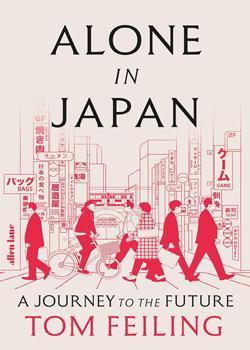
By Tom Feiling
Allen Lane (2026)
ISBN-13: 978-0241640913
Review by Laurence Green
Did you know that in Japan, in some workplaces - the childcare sector is particularly prone to this - female employees have been known to have to “schedule” when they give birth, all mapped out by a supervisor because ‘work gets backed up if four or more people take time off at the same time’, and that ‘selfish behaviour will be subject to punishment’?
Or how about this? In Japan - if someone commits suicide by jumping in front of a train, their family is liable to pay a fine equivalent to £46,000 to cover the cost of the clean-up, and the disruption to passengers’ journeys.
It’s a grim picture - and anecdotes like this are all too frequent in this powerfully compelling new book. When author Tom Feiling arrived in Tokyo in the early ’90s, Japan felt like the future; it was wealthy, stable, unstoppable. Decades later, he returned to find something more troubling: no longer a model for the world to follow, but a warning.
Travelling from rural villages to vast cities, he uncovers a distressing transformation. Japan remains prosperous and peaceful, yet fewer people are forming relationships or having children, and the population is set to shrink dramatically over the coming decades. Through both personal encounters and sharp analysis, Feiling reveals a society drifting toward solitude, with a big question at the heart of it all: is Japan an exception, or a glimpse at what lies ahead for us all?
This unflinching treatment of the delicately intertwined issues that form what many feel to be Japan's current social malaise, not only encompasses suicide and the shrinking birth rate, but also the hikikomori issue - as more and more of the country seems to be falling into a particularly isolated kind of living. Is it selfishness, a symptom of workplace burnout, or a cocktail of problems uniquely inherent to Japan's post-boom economy?
What Feiling’s book does best is its pin-point, relentless dissection of these issues from every angle - blending interviews, observation and up-to-date stats. And while the result is firmly rooted in reportage, it’s told with such conviviality and personality that you often forget you’re reading a non-fiction book - it’s that gripping. Of course, all this very much forms part of a longstanding trend of ‘Westerner in Japan’ books, deciphering the country as both sage and interlocutor (think Alex Kerr’s classic Lost Japan).
There are only a handful of moments where the personal reflection feels like it goes too far, when the book, full of deep-reflection of the notion of what it means to be alone, tips toward a kind of eerie self-lamentation of the author's own loneliness. A particular scene where the author revisits night haunts from their youth, only to find young revellers staring right through them, sticks in the mind. But it always manages to pull itself back from the brink.
It's also hard to come to a consensus on whether this book is actively contributing to furthering tropes about Japan, or seeking to unpack them. It does at least seem aware of the continuing trend for foreign news media like the BBC to pander to techno orientalist narratives about Japan. With sensationalist documentaries like No Sex Please, We’re Japanese airing on the UK’s national broadcaster, we have to question what stories we tell ourselves about other countries, and how this comes to shape our image of what those places are like. Feiling’s book, at least, is nuanced and sensitive in a way these kinds of mass-market documentaries, confined to short run times, rarely are.
This is easily one of the most compelling readable books about Japan in recent years, but also one of the saddest. The subject matter is relentless and asks us to constantly question our own values and what we’re looking for. What is a good life? How close is our own to that? Do we have the right to judge anyone else’s life choices? And what happens to a country if collectively people just decide to stop having kids?
The book's ability to present both problems and potential solutions with meticulous detail yet in a breezy, conversational tone makes this a must read for those wanting a snapshot “state of the nation” look at Japan, right here, right now. There are resignation and despair here, certainly - but hope too, those fighting back, moving back to the country from the overpopulated cities - these may amount to a drop in the ocean against the wider trend, but they show at the very least an increasing desire for alternate lifestyle models in Japan, and a re-embracing of rural living.
These questions are some of the most vital the world faces as it moves deeper into the 21st century - and Japan, we could say, is both cursed and blessed by being the first to face them, really face them, head on. The impacts are showing already, at every level of society, and they can be painful in the extreme, as the earlier examples show. The flippant answer: Who’d want to bring up a kid in this kind of society? But this also means that Japan, more than anywhere else, is able to show us a way forward. The canary in the mine perhaps, or simply, a journey to the future.