

Jackson Alone
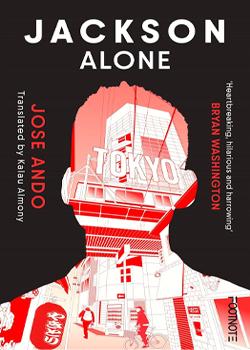
By Jose Ando
Translated by Kalau Almony
Footnote Press (2026)
ISBN-13: 978-1804442838
Review by Hester Mullen
‘But this was Japan, and here in Japan, it was Jackson alone who looked like this and was treated this way’ (p. 1).
Jackson Alone, a darkly comic and provocative novel by Jose Ando, follows its mixed-race, openly gay protagonist Jackson as he navigates a world that persistently defines him by his otherness. It’s an exciting introduction to Ando, who won the 172nd Akutagawa Prize for his most recent novel DTopia. Hopefully it’s only the first of his books to be translated into English.
As a sports massage therapist, Jackson is fetishised by colleagues, and subjected to constant scrutiny by the local police, who profile him as a likely thief. He wears a shirt to work one day with a black and white pattern that, unbeknownst to him, hides a QR code. His colleagues discover that the code leads them to a violent, pornographic video of a mixed-race gay man. As rumours spread that the man in the video is Jackson, he must search for the video’s real origin alone.
But Jackson isn’t alone for long. This is the first of many ironies Ando plays with in Jackson Alone.
He soon meets three men who have also been exposed by the video. Jerin, a store clerk and drag performer, is being blackmailed by a colleague. He sends the video to pornstar Ibuki, asking him to post it as his own. Ibuki’s friend X (ekkisu in the original Japanese) berates Ibuki for sharing the video, and seems to know more than he says about its origins. All four men find each other at the scene of the original video. They are so alike that Jackson refers to them mentally as the ‘Jackson Four’ (p. 41). While searching for the real origin of the video, they also discover that by posing as one another, they can seek revenge for the implicit and explicit racism that defines their lives. But in doing so, they find themselves playing into the very stereotypes that confine them.
As a Tokyo native with African-Asian heritage, Ando seems to dare you to compare him to his characters, perhaps as the missing member who could make it the “Jackson Five”. He ambushes you in the opening page of his novel with the ‘cocoa skin, the devilish eyes, too big, too bright’ of the victim in the pornographic video (p. 1) who screams out in pain while ‘tied to a bed’ (haritsuke, which can also be translated as ‘crucified’) (p. 8).
As soon as he sees the video, Jackson immediately relates to this mixed-race man. He even recognises the hotel room in the shot as a popular location for gay hook-ups that he’s been to previously. Despite having no memory of the abusive scene, he wonders if it could be him, as his colleagues assume. This feeling intensifies when he poses as the victim to gather information, and realises that ‘everything he was saying was, in fact, the truth’ (p. 20). Jerin also takes on the persona of the victim when he contacts Ibuki, embarrassed to explain how he came to be associated with the video. And Ibuki and X both publicly claim the video as their own, causing further embarrassment. All four men are trapped between two identities: the fake victim of the violence in the video, and the real victim of speculation from their peers.
No one exemplifies this more than X, whose name even traps him between multiple identities. You learn later in the novel that he’s named after ‘a famous Black American hero’, perhaps the civil rights activist and proponent of violent resistance Malcolm X (p. 121). We learn too that his name is written with the kanji for ‘cross’ (juuji) which recalls the violent crucifixion of the man in the video. But all four characters have been the targets of aggression, whether physical or social, and they struggle to trust each other despite their shared victimhood.
This creates a fascinating tension between the four men, as they chafe against the assumption that they are the same, homogenous victim. In one scene, Ibuki mocks the uncritical racism of manga: ‘“This white part is skin. A human, just like us!”’ (p. 60). But Jerin and Jackson disagree. For Jerin, anime offers a world where protagonists can transform into different forms, escaping an identity defined by aesthetic appearance. In the English translation, Kalau Almony uses male pronouns for Jerin, but in the original Japanese pronouns are easily avoided, and references to Jerin’s ‘sports bra’ and his drag shows could hint at differences between the four men that go beyond popular culture (p. 57). Although they are all accused of being the same victim of violent objectification, the Jackson Four are distinct individuals.
Yet they find power in pretending. Hitting a dead end in their search, they hatch a plan which demonstrates Ando’s aptitude for irony: They can call out the discrimination forced upon them by posing as each other. What starts as humorous hi-jinks soon takes a darker turn. A plot to take revenge on Jerin’s manipulative co-worker-turned-boyfriend ends with X assaulting him. Jackson, also posing as Jerin, gets stopped by a police officer in a familiar stand-off to check his bicycle registration, only this time he doesn’t have Jerin’s identity card to prove he’s not a thief. And their attempt to shame the man who implicated Jackson in the video also backfires, when they are unable to force him to admit any remorse. By becoming each other, they have only reinforced the pressures of conformity and shame forced on them by others.
These pressures are amplified by technology, through hidden QR codes, the smartphones that activate them, and the screens that follow the characters through the novel. Ando embeds the QR code into the narrative, daring you to take on the role of voyeur yourself. Scan it, and it will take you to a website, ‘blackmixroom.org’, and a message reading ‘THIS WEBSITE IS NO LONGER AVAILABLE. ACCESS DENIED :)’ (p. 7). Presumably, whoever hosted this fictional forum no longer pays for the domain. But in the novel you learn that it is a community of men who share pornographic videos of mixed-race men, emboldened by the ‘120,000 likes’ they receive for increasingly violent content (p. 92). But the conspiracy goes deeper still, as Ibuki learns in the final pages of the novel.
That’s a lot for 150 pages, and Jackson Alone rushes to an off-kilter conclusion, its final conspiracy difficult to unpack. Meanwhile, all the characters ultimately remain trapped by the same forces. Although it’s an odd and even unsatisfying conclusion, it feels appropriate considering that questions of diversity and acceptance are still far from settled in Japan today.
In Jackson Alone, Ando captures the frustrations of anyone caught in the trap of an identity policed from all sides. It’s a darkly comic primer on the intersection of race, sexuality, and personal identity in Japan with real bite. And hopefully, there will soon be more of Ando’s novels in translation to sink our teeth into.