

Exhibition – Threads of Life by Chiharu Shiota
at the Hayward Gallery, Southbank Centre, London
Review by Vittorio Cimino
The Threads of Life exhibition by Chiharu Shiota is structured not as a sequence of artworks to look at, but rather as a continuous environment to move through, almost like entering a shifting psychological landscape where memory, emotion and material presence are constantly reassembled. From the moment the visitor steps inside, the work resists any stable point of view: it is not something to decode, but something to move within, where every step slightly alters perception, and where the space itself seems to breathe through threads, objects and absences that quietly redefine what it means to be human.
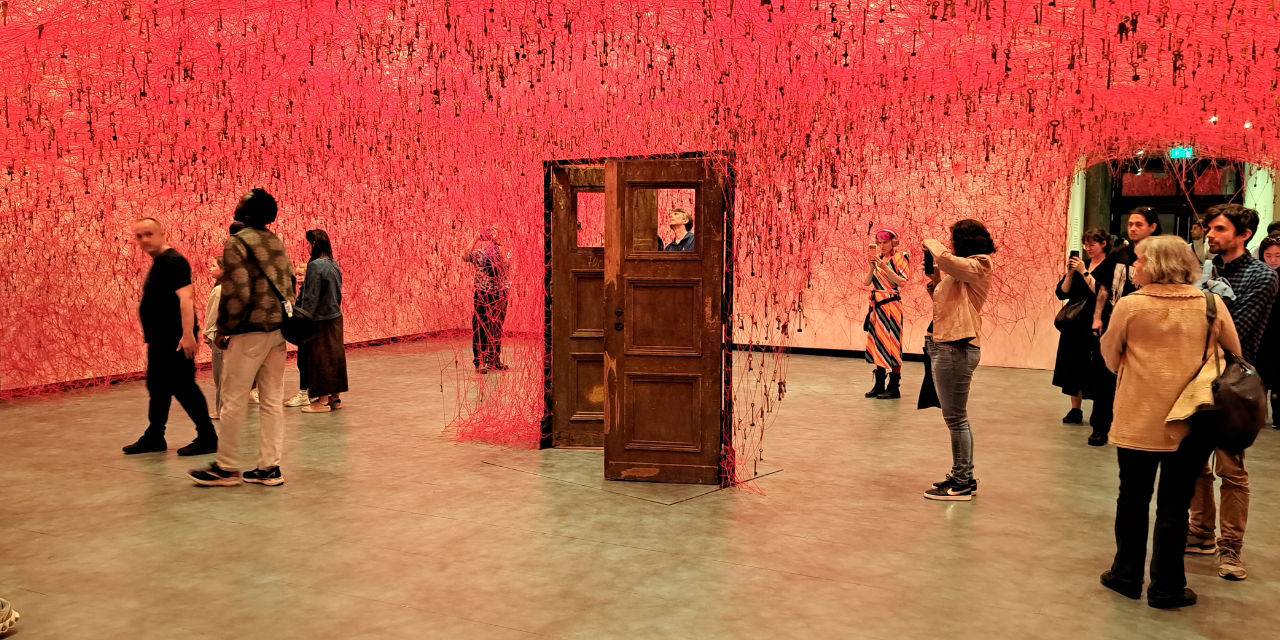
At the core of Threads of Life there is a sequence of installations, each approaching the same question from a different angle: how do we exist in relation to others, and how do we live with the memory of what is no longer present? The journey begins with the vast room of red thread, where the installation Threads of Life unfolds as an overwhelming network stretched across the entire space, binding hundreds of suspended keys and drawing them toward a door that appear almost unreachable. Moving through this environment feels like walking inside an invisible system of relationships, where nothing is isolated and every object is part of a larger, unreadable structure. The keys suggest personal histories, lost connections or unopened possibilities, while the door operate less as functional architecture and more as threshold of transformation. In this dense entanglement, life itself is experienced as something non ,linear, made of intersections that cannot be planned in advance, where meaning only becomes visible in hindsight, if at all.
From this accumulation of connections, the exhibition shifts into State of Being, where a suspended dress constructed within a metal frame appears caught in a fragile balance between presence and disappearance. The absence of the body is not a void but a continuation of the human existence where the fabric of the clothing absorbs memory like a second skin, accumulating gestures, emotions and lived time. In this suspended form, the dress becomes a layered structure of existence, a shell that holds the impression of a human presence without fixing it into identity. What remains is neither life nor death in a strict sense, but a state of being in which existence is stretched across time, quietly suggesting that presence can persist even when the body is no longer there.
The exhibition then leads into a space filled with stitched paper, where sheets are suspended from the ceiling and connected through delicate threads in an installation often referred to as Letter of Thanks. The experience feels like entering a kind of suspended forest made of writing, where language itself becomes material and fragile. Originally conceived in Kochi, on the island of Shikoku in Japan, where Shiota’s family comes from, the work grew from a personal reflection on gratitude and on the difficulty of expressing what often remains unspoken in everyday life. Over time, it became collective, as visitors from different countries contribute their own letters, transforming the installation into an accumulation of voices that stretch across geographies and personal histories. Happiness, loss, disappointment and gratitude coexist within the same fragile structure, suggesting that human connection is sustained not through clarity, but through shared vulnerability and the simple, often underestimated act of saying thank you.
From this suspended field of words, the exhibition transitions into During Sleep, a powerful installation where metal beds are engulfed in dense black thread, forming structures that feel both protective and suffocating. Shiota reflects on her early years in Germany, when repeated house moves left her disoriented and unable to recognise where she was upon waking, and how she began wrapping thread around objects and around herself as a way of creating a sense of space and belonging, as if drawing a shelter in the air. In the installation, the beds become sites of psychological tension, where rest is never entirely peaceful and where the boundary between safety and entrapment remains unstable. Sleep itself is positioned between states, between dreaming and waking, while existence appears as something that constantly shifts between presence and absence, continuity and disappearance.
Seen as a whole, Threads of Life is significant not because of its scale or visual impact alone, but because it refuses to simplify what life is. It resists the idea that human experience can be fully explained through logic, systems or cause and effect thinking, something particularly resonant in a contemporary world increasingly shaped by artificial intelligence and algorithmic structures. Instead, Shiota’s work insists on complexity: on the fact that human beings are formed through unstable connections, through memory that shifts over time, and through relationships that cannot be fully controlled or understood while they are happening. The exhibition leads the visitor not to a conclusion but a condition: that to be human is to exist within networks of meaning that are always forming, always dissolving, and never entirely within our control.