

Kokuho
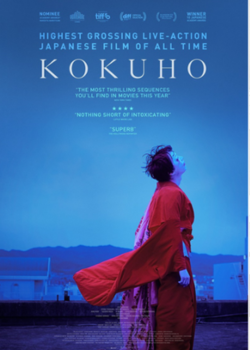
Directed by Sang-il Lee (2025)
In cinemas across the UK from 8 May 2026
Review by Rachel Pratt
Raw, captivating, and deeply moving. It has been a long time since the hauntingly beautiful visuals of a film have left such a lasting impression on me. Based on a novel by Yoshida Shuichi, who spent three years working in a kabuki theatre to truly grasp the world he was writing about, I can see why director Sang-il Lee’s Kokuho was Japan’s choice to send to the 2025 Oscars. It became the highest grossing live action film in Japan, effortlessly enchanting the Japanese public and not stopping there. I believe the films widespread appeal is due to the excellent casting choice, striking visuals, soulful musical score, and gripping narrative. It offers an unrestrained glimpse into some of the most euphoric and destructive parts of the creative soul, revealing a heady mix of vibrant drama and fluid beauty. Its sensitive and dynamic themes are skilfully navigated by incredible performances from the two lead actors, Yoshizawa Ryo and Yokohama Ryusei. I can only hope that Kokuho achieves even more of a global recognition than it already has.
The story begins in 1960’s post-war Japan following Kikuo, the young son of a Yakuza boss at a time when extravagant parties, power conflicts and territorial disputes went hand-in-hand. Kikuo’s talents capture the attention of famous kabuki actor Hanai Hanjiro (Watanabe Ken) and from this moment on, Kikuo’s life unfolds through gruelling rehearsals and difficult life lessons. Through Kikuo and his peers, the film unapologetically explores the stark reality of a gifted yet broken soul, struggling in a ruthless world of rejection, admiration, jealousy and humiliation. The inextricably interwoven themes of love, tragedy, failure and success are the perfect storm, cleverly conveyed at poignant moments both physically and emotionally through the performance art of kabuki.
Kabuki (for anyone unfamiliar with the term) is a form of classical Japanese theatre that began its journey in the early 1600’s. It has remained a highly regarded art form known for its skilled performers, adept in singing (ka), dancing (bu) and acting (ki). Kohuko’s male leads went through 18 months of training as onnagata (female roles played by men) with the protagonist Yoshizawa Ryo commenting that his exploration into kabuki showed him how ‘deep and extremely difficult’ it was, but when delivered by professionals, seemed simply ‘elegant and natural’. This is a testament to the time and talent invested by these specialised performers.
The title Kokuho translates as “National Treasure”, an official government designation given to prestigious Master kabuki performers considered “Living National Treasures”. It is an alien term for many of us, and a word that the Sang-il Lee dissects for the viewer to reveal the true depth of its meaning. His ability to capture the nuanced beauty of the term Kokuho through Japanese kabuki was mesmerising, with rich theatrical sequences conveying emotions that words cannot do justice.
The actors who accomplished this so elegantly, held my attention from beginning to end. Kurokawa Soya (Young Kikuo), who had an impressive physical prowess and vocal style on stage gave a strong performance from the start. As the film progressed, Yoshizawa Ryo (Adult Kikuo) and Yokohama Ryusei (Hanjiro’s son) each had a unique, turbulent backstory and an intense, watchable presence on screen. Their relationship on the kabuki stage however, was another level of passion and potency. The sensitively crafted performances expressed so much emotion through even the slightest of gestures, I found it impossible to look away.
The narrative of the film outside of the theatrical performances touched on many moments that hold an uncomfortable mirror to one’s face. To feel accepted, even revered, is a human compulsion for many of us, but the cost of pursuing this can be devastating. Within these provocative moments of the story were also notes of rare beauty, found only in those special bonds we can make with another human being. This play between dark and light was perfectly balanced throughout the film.
To explain the impact of the narrative would be incomplete without mentioning the film score. As a lover of music, I found it unusual that I left the cinema only able to recall a feeling, as opposed to a particular melody. I was left with a sense that the music I had heard was inseparable from the narrative and visual experience. It was only after the film, that I was able to pinpoint why the music of Hara Marihiko was so special. His work does not simply categorise as music, but also as ‘soundscapes’, seamlessly blending and wrapping sound around the emotions of a scene and gifting it to the viewer. Mr Hara explained to me in a personal email communication that he allows himself time to deeply ‘absorb the atmosphere, emotions and underlying concepts of a work’, which then allows him to ‘compose through body and mind’. I realised that I was not just viewing a piece of cinema, but also feeling it. This is something that I had never experienced before and gave me a new appreciation for what a composer is capable of achieving.
If I were to critique any part of the film, I would have to say that the number of time skips was a little disengaging. Although well-delivered and necessary for story progression, the frequency of this editing choice pulled me away from the emotional connection I was building within each scene. Thanks to the quality of the performances and the captivating story however, I was always able to continue my journey with the characters and walk away at the end of the evening feeling like I had witnessed something truly special.
This was a humbling and thought-provoking experience, leaving me eager to learn more about Japan and Japanese art and cultural expressions. It is definitely a time investment at almost 3 hours, but it was absolutely worth it to be moved, even enlightened, whilst being immersed in Japan’s artistic heritage. Both challenging and painfully real, as well as stunningly beautiful and almost magical, Kokuho brings together an intoxicating marriage of music, theatre, dance, drama and cinematography. I would urge anyone interested in Japanese culture to watch this film and I would highlight it as a must-watch for lovers of theatre. I would also implore anyone who has the opportunity to watch a kabuki performance to do so. There is something to be appreciated by everyone; Vibrant costumes and make-up, bewitching tales and exquisite dancing, you don’t need to understand Japanese to be able to read the language of a perfected art.