

Madame Chrysanthème
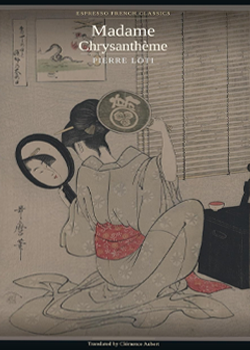
By Pierre Loti
Translated by Clémence Aubert
Espresso French Classics (2026)
ISBN-13: 9798183841541
Review by Miki Hosaka-Green
Well before Puccini created his tragic heroine Cio-Cio-San in the enduringly popular opera Madama Butterfly (1904) - which has been played over 12,400 times around the world in the 21st century alone, Pierre Loti's “autobiographical journal” Madame Chrysanthème (1887) had already been born in novel form. Set in Nagasaki - a Japanese harbour city - a naval officer from the West “marries” a temporary Japanese wife, until the day he leaves to his country for good.
Loti’s imagery of Japan has been passed down to many subsequent works. Modelled on Loti, the short story Madame Butterfly (1898) was written by John Luther Long, emphasising the tragedy of the heroine. The short story was adapted into David Belasco’s one act play Madame Butterfly: A Tragedy of Japan (1900), with a dramatic turn that highlighted the narrative after the officer left the port, with the heroine left longing for his return. This stage version in turn inspired Puccini to create the most well-known version, the opera Madama Butterfly.
While all of these works feature a similar setting evolved from Loti’s original Madame Chrysanthème, the underlying tone of voice ultimately shifts from its original nuance in the novel. This can be read chiefly through the portrayal of the relationship between the protagonists - the naval officer and the heroine - and how the officer himself is characterised.
In the opera, Cio-Cio-San appears to be granted a greater personal voice and emotional depth, in comparison to Loti’s Chrysanthème who exists as an objectified being. The reader of the novel has no real sense of her internal discourse - whereas in the opera, she was transformed into the core of an intensely dramatic tragedy as a submissively innocent Japanese woman who sacrifices herself for love. The story of an exotic young woman who sincerely loves a Western man, is betrayed because of that love, and ultimately chooses death, was such an emotionally compelling narrative, and for the purpose of theatrical effect required Cio-Cio-San to wholeheartedly believe in the romance. As Cio-Cio-San sings the beautifully iconic aria Un bel dì, vedremo (One Fine Day), longing for Lieutenant Pinkerton’s return, the audience knows the cruelty of Pinkerton declaring from the start of the opera that he intends eventually to find a “real wife” in America. The opera is clear in its depiction of a Western man who toys with a young woman’s unwavering devotion, turning her into something to be consumed.
By contrast, Loti’s treatment is far more detached. Although the man likewise intends from the beginning that she will be only a “temporary wife,”’ he does not appear to regard Chrysanthème either as a person or as a wife in any meaningful sense. She is described like an observable item - through her clothing, hairstyle, gestures, voice, and small physique - while her emotions are rarely presented in the text. The narrator is unable to assign meaning to her behaviour, and she is instead represented as something resembling a doll, a cat, or a child. This is particularly evident in the scene of her first appearance. Having rejected the first woman presented to him for marriage, the male narrator remarks that he would prefer ‘one who was yellow, for a change’ (p.46), selecting Chrysanthème for her skin colour. The scene reads almost as though he were selecting a flower to decorate his home.
While Chrysanthème in this story does not express her feelings directly, it is unclear whether her apparently submissive personality is due to an actual deficit of emotion on her part, or rather that the narrator lacks the ability to perceive her emotions. Indeed, he may not even have had any intention to understand her to begin with.
Whereas Cio-Cio-San believes in a future with Pinkerton without a doubt, interestingly, the narrator in Loti’s novel mentions that Chrysanthème behaves as though she knows that the marriage will not last long. Likewise, Loti’s narrative does not especially depict any romantic involvement in Chrysanthème’s behaviour towards her “temporary husband”. Does this suggest that she deliberately refuses to participate in the Western man’s romantic fantasy, or that the narrator’s failure to communicate with her prevents her from participating in it? Because her own intentions are never articulated in the narrative, the whole story remains fundamentally one-sided, written as a travelogue of Japan through Western eyes. This produces a distinctly dry sense of realism - Chrysanthème is not constructed as a tragic heroine, but as a woman whose presence is defined, above all, by the terms of a temporary arranged marriage that eventually terminates.
In Puccini’s opera, Pinkerton himself is also exoticised and reduced to a stereotype - a young, aggressive, and consumptive embodiment of “American masculinity”. Loti’s self-insert narrator, on the other hand, may be considered a valuable character precisely because he exposes, with unsettling vividness, the prejudice and unconscious viewpoint of people when encountering Other cultures; fundamentally separating them from one’s real life, and treating them as something you can only objectify. This is why Loti notices almost everything about Japan except the internal voices of the Japanese people around him.
When we consume sushi, matcha, and kimono in our contemporary life, how different are we from Loti asking for a “more yellow” woman, as though selecting the particular flower he wishes to possess? The internalised Orientalist gaze underlying this novel may still persist in contemporary ways of seeing Others. The work’s present-day value lies not in teaching us about an authentic Japan, but in revealing, in an almost unguarded reality, how the “West” constructed an alluring and consumable image of “Japan” that still attracts many people today, offering a raw and candid expression of attitudes that contemporary society would hesitate to acknowledge openly.