

The Cinema of Kinoshita Keisuke: Films of Joy and Sorrow
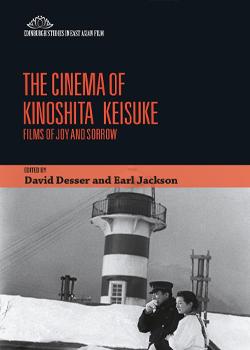
Edited by David Desser and Earl Jackson
Edinburgh University Press (2025)
ISBN-13: 978-1399523363
Review by Electra Pappa
Kinoshita Keisuke (1912-1998) was a beloved film director in Japan and among the most recognisable names of the Golden Age of Japanese cinema, directing an astonishing fifty feature films between 1943 and 1988. He began his directing career in 1943, in the same year as Kurosawa Akira, whom he was close friends with, but to this day he has received relatively little recognition outside his home country. This collection of essays by leading scholars from the US, Australia, the UK and Japan is the first book in English to discuss Kinoshita’s work, which makes it an important step into his wider recognition outside Japan.
The book consists of thirteen essays and offers fascinating insights into multiple aspects of Kinoshita's filmmaking. Each contributor handpicks films among the director’s extensive oeuvre and approaches them through a specific lens, ranging from his use of camera techniques and long-term collaborators, to recurring themes that emerge throughout his work.
The book opens with an essay by Lauri Kitsnik, who focuses on the Kinoshita-gumi, the group of collaborators Kinoshita surrounded himself with. This chapter provides an excellent introduction to Kinoshita’s work by offering an in-depth account of the Japanese studio system and the nurturing relationships that Kinoshita fostered with his collaborators, which sets him apart from the often unhealthy work environments associated with that generation of filmmakers. Kitsnik emphasises Kinoshita’s role as a mentor and teacher to his crew, an observation that is later echoed in other chapters.
Understanding Kinoshita’s personality provides a clearer picture of the auteur and allows us to appreciate the sensitivity with which he approached his subjects. Several essays in the collection focus on the director’s critique of war, which is sometimes subtle and others not so much.
Considering that Kinoshita began directing during World War II, it is unsurprising that his first four films were wartime propaganda. Yet even in these early works, his unfavourable view of the war is evident.
Notably his fourth film, Rikugun (Army, 1944), passed the censorship during preproduction but was met with a lot of criticism after it’s release, and even deprived Kinoshita of his licence to direct films until the end of the war. This was because of it’s final scene, which shows a tearful mother seeing her son off as he heads to battle. It was great to see a few of the scholars in this book discuss this film by taking distinct approaches to the film and by extensions Kinosita’s indirect criticism to the war. I found Daisuke Miyao’s chapter especially compelling. Drawing on filmmaker Yoshida Yoshishige’s discussion of Rikugun, Miyao presents an extraordinarily detailed analysis of shot duration and camera composition, arguing that the camera itself becomes a vehicle for conveying an anti-war message. As he notes, the extended takes in the film’s final sequence exist “beyond the political enforcement of the period, the economic request from the company, and the expectation from the audience of a war-propaganda film” (p.84), which helps explain how the script was able to pass censorship as pro-war propaganda, but the camera managed to communicate a different message.
An interesting addition to the collection is Jennifer Coates’s study, which serves as an epilogue to the book. Coates draws from a broader ethnohistorical study of cinema-goers to examine the role that Kinoshita’s films played in shaping the political and social attitudes of post-war Japanese audiences during their formative years. Out of the one hundred participants interviewed, several participants attributed their pacifist views to watching Kinoshita’s films in their childhood, while many mentioned his work as inspiring their broader interest in cinema. I found this chapter to be a valuable addition in a volume of film criticism, as it shifts the focus away from the perspectives of scholars and instead describes the experiences of audiences themselves.
One of the book’s greatest strengths is the way the essays seem to be in conversation with each other. Rather than functioning as isolated studies, they complement one another while also offering different perspectives, which lead to a more rounded understanding of Kinoshita’s work. Although a few of his films naturally receive more attention, the collection succeeds in discussing the majority of his oeuvre. And even when the contributors do discuss the same films, each approaches them through a distinct critical lens.
Ultimately, David Desser and Earl Jackson have done an excellent job assembling this collection of essays, demonstrating the richness of Kinoshita’s cinema. By bringing together a wide range perspectives, the volume makes a compelling case for Kinoshita’s inclusion alongside his better-known contemporaries, such as Kurosawa and Ozu Yasujiro, and represents an important step towards greater recognition of his work internationally.