

Exit 8
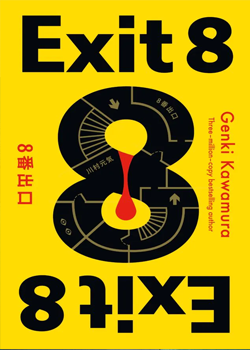
By Kawamura Genki
Translated by Sameeha Anwar
Ithaka Press (2025)
ISBN-13: 978-1806173907
Review by Conor Hodges
After getting off the last train home from Kyoto, I would walk through the quiet corridors and caverns of my local station and feel watched. Perhaps it was because I felt like an interloper in the desolate, pristine silence punctuated only by my footsteps. I’d find myself being hypervigilant, waiting for someone – or something – to turn the corner and remove me from my isolation. Nothing would come, and then, as if transported, I’d ascend the steps and feel completely normal, as if nothing had happened at all.
Thus, The Exit 8, a tight, mechanically sparse horror video game about traversing an empty corridor in a Japanese subway, released in 2023, it felt tailor made to me and my fears. In it, you are a faceless, voiceless protagonist who must spot “anomalies”, fissures in reality that tweak the environment in ways both large and small. One anomaly might be a poster that continually grows in size, and another could be a doorknob out of place. Others are more deliberately malicious and amp up the creepiness: a staff door is ajar with a grinning face peeking through the crack at you, or, at their most cruel, a humanoid figure textured to match exactly the wall tiles bolts out at you full-speed, just as you thought you were safe.
When I heard that the game would be adapted into a film and a novel, I was sceptical. Much like with the concept of most “liminal spaces”, most ubiquitously the “backrooms”, the allure comes from the quotidian being deformed in a slightly unsettling way, either through magnifying the space to impossible scales, or by hinting at Escher-like architecture that loops in on itself like an ouroboros. With The Exit 8 game and its invisible playable character, you could feel as though you really were navigating this warped simulacrum of a Japanese subway station. The consequences for failing to spot an anomaly, sending you tumbling back to the start of your run, force you to be vigilant lest you lose all your progress, and because they are happening to ”you”, the jumpscares feel a little more real. In this regard, reading the novel Exit 8 fell flat when compared to my time playing the game.
The novel’s main character, the Lost Man, is an everyman. He rides the train and scrolls his phone with a vague sense of dread, is avoidant of stressful social situations, and commutes back and forth from home and work feeling vaguely unfulfilled. He watches a salaryman castigate a mother for not controlling her crying baby, and does nothing, refusing to step out of his headphone cocoon. The salaryman then chastises his onlookers, saying that he’s ‘just saying what everyone else is thinking!’ (p. 2) Then, off the train, his ex-girlfriend calls to tell him she’s pregnant, and that he’s going to be a father. Just as he prevaricates on what to say – a trait she has never liked about him – his signal dies, and he finds himself in an empty subway corridor.
After traversing the same corridor a few times, watching a man with a briefcase stride through on repeat as if on rails, the Lost Man begins to realise he’s in a loop. He notices a set of rules pinned to the wall, saying that he must spot anomalies and only progress forward if the corridor is clear from any oddities. If he does this correctly eight times, he will reach the titular exit 8 and, presumably, his freedom.
Some anomalies from the game, such as blood oozing from air vents, signs with moving eyes, and the walking man’s usually emotionless face being pasted with a malevolent grin appear in the first section of the novel as Kawamura attempts to create dread. However, the anomalies themselves aren’t interesting enough to read about on their own; their mundanity works fantastically in a spot-the-difference game, but not so much in a slim novella that moves at breakneck speed.
Like the setting itself, the writing is repetitious, and is not infused with the claustrophobic dread or rising panic that such a bizarre space needs. In Susanna Clarke’s Piranesi (2020), a house with colossal statues and crashing tides is described by a man trying to map out his surroundings, and Clarke’s writing is so evocative of the place that I still think about how such a structure could be possible years after reading the novel. Kawamura does not do his corridor the same justice, perhaps hoping that most people who read the book would already be familiar with the game and its environment. Even I found it hard to visualise what was happening where, for which the map at the start of the book was incredibly helpful – never a good sign.
The characters too, are archetypal and uninteresting. The Lost Man follows the arc of a timid man gaining confidence as he comes to understand what the subway is asking of him, but he is clearly a blank slate, a faceless protagonist infused with a moral purpose to find his way out of the endless loop. The perfectly timed phone call informing him of his life-changing news forces him to reckon with fatherhood almost immediately, taking up the mantle of responsibility so quickly and certainly that I found hard to believe, especially because he and his partner had just broken up (in large part because of his indecision!). The other two characters, the Walking Man and the Boy, are not distinctive enough to warrant their own chapters, and the boy in particular is saccharine and cloying in his relationship with the main character, his existence in the story seemingly existing only to facilitate the apotheosis of our protagonist.
Kawamura does have some interesting ideas about apathy and expresses them well. I found his description of a social-media feed, thrown in at the start, particularly charming, where the protagonist sees an advert for a shooting game and can ‘no longer tell whether these images were real or just part of a game’. (p. 3) Likewise, the Lost Man remembers how his horror upon seeing his hometown destroyed by a tsunami faded into indifference ‘like it was something happening in a different world entirely’. (p. 37)
Much like the movie Backrooms (Kane Parsons, 2026) did with its setting, Kawamura frames the tunnel of Exit 8 as a personal purgatory, using people’s fears against them. In one scene, the Lost Man sees his ex-girlfriend and hears the distant cry of a baby, whereas the Boy sees his mother beckoning him to her side. Likewise, the Walking Man in a headstrong moment rushes up a false set of stairs believing himself to be free, but is clearly consumed by the space and recycled as a mindless automaton destined to walk the corridor forever.
Traversing the mobius strip is also an act of pedagogy. It tells the characters what they fear and forces them to forge on regardless in an attempt to break the cycle. It tells them that they spend every day as if they were the same. They are trapped in a loop. The subway and whatever malevolent force controls it tortures its victim with enforced repetition and, if they prevail, gives them a chance to turn back the wheel of time. Thus, upon reaching an exit, the Lost Man is transported back to the start of the novel, with an angry man screaming at a mother and her baby. Will he act differently this time?