

MAN WOMAN – A Butoh Fairy Tale by Vangeline
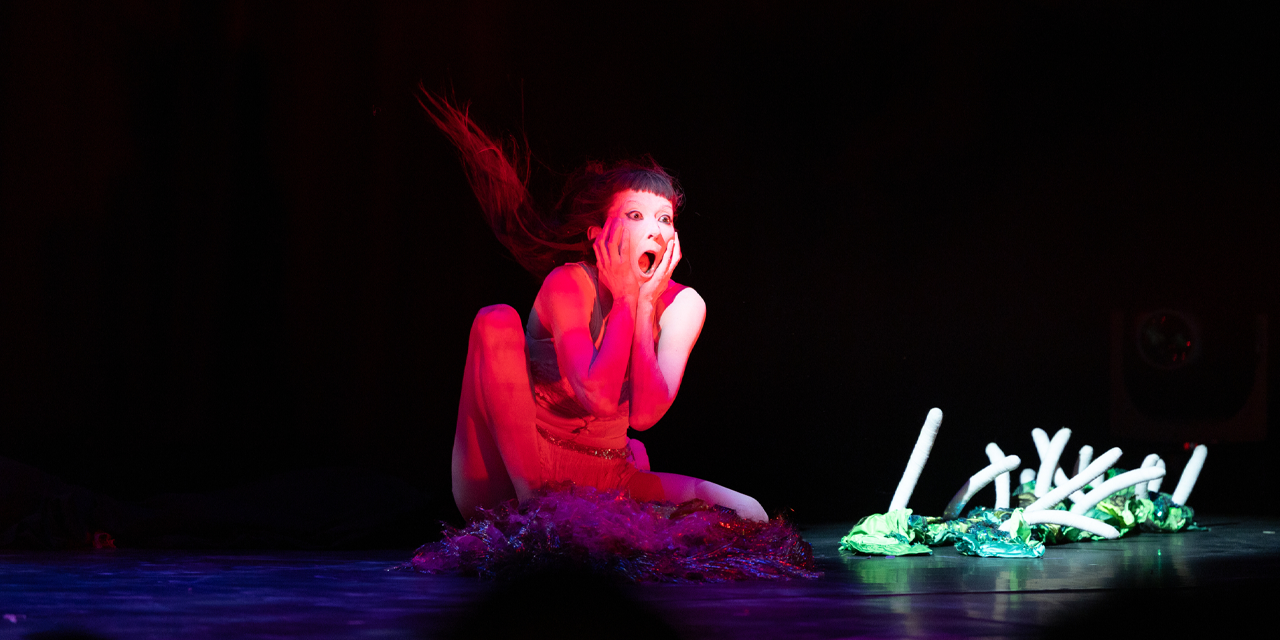
Image by Oxford Atelier
Schwarzman Centre, Oxford
16 September 2026
Review by Alice Baldock
At the beginning of MAN WOMAN, the latest offering from New York-based butoh dancer Vangeline, her costume begins to swell and bulge around her body. The Bakhtinian manipulation of the human form moves at a snail’s pace, elevating the grotesque into the otherworldly. We do not know if it is hand or foot that starts the movement, or if some invisible puppet master is lifting the comically huge dress into small mountains.
Slowly rising up to full height, the dancer appears like a decorated bird, adorned with feathers and a huge, plumed headdress. Woman as decoration. Slowly, one hand rises and unclasps the headdress. With its removal, the body on stage moves to confront constructions of masculinity and femininity; at some points through a caricature of these roles, at others through de-gendering of that body. At first, sinking to the floor as the opening music – created by Ray Barragan Sweeten - fades to a heartbeat, and a darker piece of music accompanies the dancer’s transformation into a rebellious creature-woman.
At points in the first act, the caricature makes clear the hilarity of gender constructs, especially when the dancer uncovers a pile of phallic objects wrapped up in green. The exaggerated facial expression fades to a welcoming of them, as she tiptoes carefully between each one, losing her balance, accompanied by light-hearted sound, jeering high-pitched voices layered underneath. Eventually, the green fabric wraps around her feet without her noticing, binding her. When she escapes, she places one finger to her lips: sshhh, quieten down. The motion is not angry or violent, but it affirms she is not defined by these objects any longer.
As the dancer loses the attachments weighing her down, her movements become more frenzied. Her body begins to collapse like a rag-doll, embodying the Noguchi “hanging body” and echoing works such as Yoshioka Yumiko and Seki Mineko’s Zero. The dancer’s facial expression becomes something horrifying as she gazes from between bent legs. In her gaze, we can see flashes of the original women butoh dancers, the smirk of Ashikawa Yoko.
She exits half-way through, and returns, clad in white, for the second act. Here, the movements cease to be comic and move towards the sublime, parts reminiscent of Vangeline’s repertoire. The knee balances reference The Slowest Wave and a moment, balancing only on the sit bones, can be seen as far back as her early 2000s work Fireflies. These movements are at once a total, peaceful surrender of muscles and a maintenance of chemical tension, captivating audience members with their simultaneous simplicity and impossibility. The music, too, is soft but with a build of tension throughout – taking us into a ‘fairytale’.
The piece was originally conceived as a duet, and the second act retains that feeling of a close relationship playing out between dancer and negative space, but especially between the dancer and the antlers, another prop created by Machine Dazzle. The antlers and dancer have a fizz of electricity between them on the stage; as the dancer glides over and across those antlers, a gentle sigh of relief seems to accompany her. When she places the antlers on her head, a new crown and a departure from the headpiece of the first act, the two bodies join together into something creature, something genderless. The ending is quiet – silent, even - it does not have to reach a crescendo to create magic.
The piece itself takes its name from Otoko to Onna (おとこと女), a 1960 photo series from avant-garde photographer Hosoe Eikoh, who captured the relationship between dancers Motofuji Akiko and her husband Hijikata Tatsumi. In those images, the negative space builds the relationship between their bodies: sometimes intimate and loving, at others violent. That same photographic tension can be seen onstage in MAN WOMAN, where Vangeline’s dramaturgical choices at points lead us to a series of still-life images, both moving and not-moving. Although myself and other scholars have worked to reveal the relevance of early women butoh dancers, it has been the men, Hosoe and Hijikata, whose names are usually remembered. Vangeline intervenes into this historical injustice, placing a discussion of the power imbalance in these relationships at the centre of her performance.
Throughout, light (created by Saegusa Ayumu ‘Poe’ and put onstage at the Schwarzman Centre, Oxford by Nagai Nao) also carries the dancer’s body through this fairy-tale forest. Deep pinks and reds oscillate with a light glow, like light filtering through water or the leaves of a tree canopy. The lighting works to illuminate the dancer’s expressions; we can see her delight, her shock, and her serenity.
Overall, MAN WOMAN is both an urgent feminist conversation and a masterclass in producing butoh solos in a large venue.
Audiences should watch for future European and US tour dates by Vangeline at Vangeline.com.