

Murder at Mt. Fuji
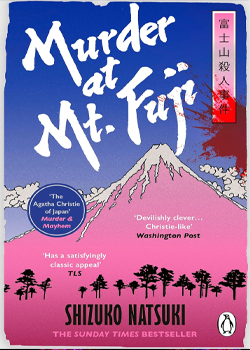
By Natsuki Shizuko
Translated by Robert B. Rohmer
Penguin (2026)
ISBN-13: 978-1529155105
Review by Rio Julian
Jane Prescott was an American exchange student as well as an English teacher and friend to Wada Chiyo, a beloved member of the prestigious Wada family. In the process of writing her thesis, Chiyo requested Jane’s help in reviewing her English writing. Jane accepted and went over to the Wada family villa, located deep in the vicinity of Mount Fuji. There, she met the eight main members of the Wada family. Merry family time ensued and went on until a scream was heard. Everyone ran over and found the patriarch of the family, Wada Yohei, stabbed to death. Chiyo was right next to him, crying with bloodied clothes and a fruit knife within reach. Instead of contacting the authorities, personal circumstances and interests drove the family into devising an intricate cover-up plan. As Chiyo was sent to Tokyo and the police started being involved, it was up to the family members to keep up the prolonged charade. Jane Prescott found herself in the middle of this and with her perspective as an outsider, she became key in determining the fairest outcome.
The picturesque environment one would expect from a story taking place near Mount Fuji is delivered palatably. Natsuki’s imagery work takes its time in setting the stage, painting a clear background in each act. The book establishes this style early on as ‘light snow was swirling and dancing around the seedy plaza in front of the station. A row of real estate offices and small inns lined the far side of the plaza. Sacred straw ropes marking the holiday season hung looped beneath the eaves of the inns and fluttered indifferently in the cold wind’ (p. 2) set the scene. While there is a lot of that sort of outright description in the narrative, Natsuki also utilises her imagery work in informing the readers of the curtain rising, like ‘after that, no sounds at all reached them from the outside. Darkness shrouded the house while large, feathery snowflakes continued to fall and accumulate on the ground.’ (p. 29). Although her thoroughness undoubtedly slows down the pacing of the narrative, I personally enjoyed having my senses engaged by Natsuki’s imagery work.
Jane Prescott, being the character who drives the plot for the most part, I found a tad flat and a good deal implausible. Her reactions to the situations she was put in never quite convinced me, considering her status as an American international and the supposed distance between her and the Wada family – apart from Chiyo, they were by and large strangers. Staying silent or even proactively participating in a cover-up plan with a group of strangers after witnessing a murder would never cross a foreign international’s mind, yet Jane never kicked up a fuss and even felt guilty for some things she thought she didn’t do well. While Natsuki does provide some reasoning for Jane to take part, such as the family members gazing at her ‘like a pack of wolves; their eyes cold, suspicious, and vigilant’ (p. 47) and that ‘certainly Jane loved Chiyo as much as the other members of the Wada family did’ (p. 51), I still found Jane too eager with her status in mind. This oddness itched me into some extratextual research, and it turns out that Jane Prescott was a translatory add-on by Natsuki to ‘make the book a bit more appealing to foreign readers, by giving them at least one character they could relate to’. Natsuki’s attempts to mould the original Japanese character into Jane Prescott include references to her American hometown and Japanese knowledge gaps, but I felt they weren’t enough to sell her character as an American international with the events that followed. Admittedly I’d never encountered this phenomenon prior to this book – it simply never occurred to me as a possibility considering the translated books I’d read being largely modern. A deeper dive into translated works from that era would presumably make for an interesting paper on the changing status of translated literature, which couldn’t possibly be covered in this review.
Another driver of the plot is Detective Nakazato, whose perspective I found more interesting. I felt as though Nakazato’s probing into the mysteries behind the murder displayed the best of Natsuki’s sleight-of-hand talent in crime writing, especially with the clever structure she employed on this story. Nakazato was introduced ‘sat stroking his belly with one hand, while the other reached for the pack of cigarettes on his desk’ (p. 88), which immediately presented an unsuspecting policeman archetype. Throughout the story however, Nakazato displayed perceptiveness and even empathy while uncovering one clue after the next – of course, only as far as Natsuki allows. Natsuki’s ability to always have one thing hidden when we think things are clearing up is the magic of this book, and it works best through Nakazato.
The structure of this book is certainly a highlight. As opposed to how you’d conventionally expect a crime novel to be structured, where the reader would work through the clues alongside a narrator or character(s), Natsuki presents the intricate execution of the crime first. Surprisingly, the thrill thereafter is not lost – Natsuki has this ability to prevent the reader from feeling in the dark when they actually are. Most of what we get from Nakazato is the retracing of the steps that we’ve gone through with Jane, providing a false sense of grasp that is there to be betrayed in a good way. With that said though, Natsuki does tend to repeat the clues unnecessarily and this fixation on reminding the readers hurts the pacing at times. Furthermore, there were parts to the ending that I felt were heavily underdeveloped and thought that some of the word count would’ve been better off spent on them. I didn’t buy the ‘romance’ and couldn’t care much about the phantom person’s motive, but the multiple twists in the ending did positively catch me by surprise.
In some measure, this book has something to offer thematically too. Though presented quite on the nose for modern eyes, the narrative paints the realities of life under a patriarchal rule where women suffer the most in the affairs and failings of men. ‘All the men in the Wada family have an uncontrollable lust for young ladies’ (p. 43) that they framed as a matter of course, unaware of the power structure that they inherited. This created rifts in the family and even sexual assault attempts, which facilitated the plausibility of the phantom person’s plan. The women were thus conservative, holding onto what they had to the point of moral greyness. There isn’t much to unpack beyond the text on this front, but it is worth noting.
Murder at Mt. Fuji is a crime novel that wouldn’t look out of place today – a decent cozy read. Equipped with evocative imagery and an interesting structure, it shines as a story that assumes the reader to be on board with the crime-novel nature of it. It has its issues, mainly in underdeveloped characters, but there is a ride to go on in this book if you enjoy the guessing game.