
100 Years of Turkish-Japanese Relations
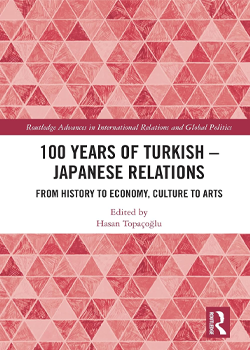
Edited by Hasan Topaçoğlu
Routledge (2025)
ISBN-13: 978-1040365335
Review by Gergely Tóth
The volume meets basic quantitative expectations for an anniversary publication, with sufficient length and a large reference base. However, despite its scale, it suffers from structural overreach and fragmentation. Attempting to cover a full century of Turkish-Japanese relations in a single edited collection results in shallow treatment of most topics. A two-volume structure (Ottoman/early Republican period vs. post-1950s period) would likely have produced greater analytical clarity. The book is further weakened by its format as an edited collection rather than a coherent monograph, limiting methodological consistency and analytical depth. With a majority of contributors drawn from Turkish academia, the volume also reflects broader constraints in the current Turkish academic environment, including ideological pressures and limited critical reflexivity. Some chapters lack methodological transparency or self-awareness regarding bias. Although the editor claims the book fills a major scholarly gap through a comprehensive and interdisciplinary approach, the result is instead a loosely connected set of essays with uneven quality. The emphasis on breadth over depth becomes the central structural weakness of the volume, the contents of which will be briefly introduced and reviewed below.
This opening chapter by Selçuk Esenbel is presented as a definitive overview of a century of relations but is too compressed to provide meaningful depth. It lacks methodological reflection and does not engage critically with the author’s positionality. It reproduces established and uncritical narratives, including problematic Nihonjinron-style assumptions about Japanese cultural homogeneity. Key historical issues are treated superficially: the impact of the 1905 Russo-Japanese War in the Ottoman world, Japanese engagement with Ottoman institutions, and early diplomatic encounters are only briefly mentioned. Potentially rich topics, such as Japanese intelligence activity in Istanbul or Ottoman-Japanese institutional learning, are underdeveloped. The chapter favors romantic and emotional framings of bilateral relations, emphasizing ‘special trust’ and ‘emotional connections’ rather than structural or geopolitical analysis. It also largely avoids critical discussion of Ottoman multi-ethnic diplomacy, British and Russian geopolitical contexts, or the instrumentalization of symbolic narratives such as the Ertuğrul story. Complex interwar dynamics, including Japan’s engagement with Pan-Turanism and Pan-Islamism, are mentioned but not analyzed. Important non-Turkish actors, such as Armenians and figures like Diana Apcar, are omitted. The chapter also includes uncritical references to outdated linguistic theories such as Altaic origins of Japanese. Overall, it reads as descriptive and celebratory rather than analytical.
The Second Chapter, authored by Erdal Küçükyalçın, is one of the most readable and engaging chapters, focusing on Count Otani Kōzui and early Turkish-Japanese contacts. It offers interesting narrative detail, particularly around travel history and symbolic sites such as the Ertuğrul memorial in Kushimoto. However, the portrayal of Otani is selective. While his institutional contributions are highlighted, the chapter omits controversial aspects such as financial misconduct allegations, his resignation from religious leadership, his luxurious lifestyle, and his Pan-Asianist ideology. His activities in Central Asia, which attracted suspicion from British and Russian intelligence, are also not critically examined. The narrative-driven approach makes the chapter accessible but limits its historiographical rigor. Broader ideological and political motivations behind Otani’s engagement with Turkey are not sufficiently explored.
Chapter 3 stands out as the strongest academically. His author Ryosuke Ono examines Uchida Sadatsuchi, Japan’s first representative to Istanbul, using a strong methodological framework and multilingual sources from Japan, Britain, and Turkey. It also incorporates contemporary Turkish press reactions. The chapter is well structured, clearly argued, and grounded in diplomatic history. It provides a balanced and empirically solid contribution compared to other essays in the volume.
In Chapter 4, Sinan Levent attempts an ambitious 150-year overview of relations but compresses extensive history into an extremely limited space, resulting in a superficial and rushed narrative. Methodological clarity is lacking, and analysis is minimal. The text relies on Japanese sources, which is a strength, but overall reads as conventional diplomatic history. Major chronological gaps are skipped with little explanation. Later sections become uncritical and formulaic, echoing diplomatic rhetoric about “close relations”. It also reproduces problematic claims about Turanism and Ural-Altaic linguistic theory without critique. These are identified as outdated or pseudoscientific ideas presented without scholarly distance. The chapter is one of the weakest contributions.
Chapter 5 written by Aysun Uyar Makibayashi focuses on environmental policy and offers a comparative perspective on Turkey and Japan. It stands out for its willingness to critically assess Turkey’s environmental record and participation in global regimes. Although not central to traditional diplomatic history, it demonstrates how thematic approaches can enrich bilateral studies.
The Sixth Chapter by Bahadır Pehlivantürk is one of the more methodologically aware chapters. It explicitly addresses analytical challenges in studying multi-causal foreign policy in a complex political context. The structure is clear, and the categorization of arguments is strong. The chapter includes a cautious critique of Turkey’s domestic political system and extends the analysis beyond Japan to East Asia more broadly. Its main limitation is insufficient integration with Japanese foreign policy perspectives, but overall it is a solid and reflective contribution.
In Chapter 7, K. Ali Akkemik provides a data-driven economic historical account supported by statistics and tables. It delivers a factual overview of Turkish-Japanese economic relations without excessive interpretation. While not theoretically innovative, it is structurally sound and informative.
A comparative study of Turkish and Japanese education systems, Chapter 8 by Tolga Özsen is brief and descriptive but supported by statistical data. It functions as a supplementary comparative overview rather than a deeply analytical contribution.
Chapter 9 by Oğuz Baykara analyzes Turkish literature in Japanese translation from 1925 to 2024 using translation studies methods. It pays attention to paratexts such as prefaces and translator commentary, and identifies 52 translated works. Methodological awareness is a strength, though the analysis itself remains limited. The study is positioned as preliminary, with fuller treatment expected in future work. Its broader relevance lies in potential applications for cultural diplomacy and image-building research.
Chapter 10, examines Japanese popular culture in Turkey, as well as comparative reference to Korean Hallyu. Contributor Mutlu Binark also analyzes commemorative stamps as tools of cultural diplomacy. The chapter is more structured than many similar studies in this field, but theoretical engagement with concepts such as orientalism and self-orientalism remains superficial. It introduces relevant topics but does not fully develop them.
A largely descriptive catalogue of Turkish art exhibitions in Japan, Chapter 11 by Minako Mizuno Yamanlar offers minimal analysis and is primarily archival in nature. It would have been better suited as an appendix rather than a standalone chapter.
The final chapter, Chapter 12 by Ezra-Gökçe Şahin is one of the most analytically strong and engaging chapters. It uses frame analysis to examine mutual image-making between Turkey and Japan, highlighting how both countries have historically been shaped by Western orientalist perspectives. The chapter is well written, methodologically informed, and more dynamic in style than most others in the volume. It also demonstrates intellectual independence and occasionally challenges dominant Turkish academic narratives. However, it is not without limitations. Some analyses remain underdeveloped at a deeper theoretical level, and there is an imbalance in emphasis on Western influence versus local agency. Minor editorial issues could also be found in it. Despite these shortcomings, it is among the most compelling contributions in the book.
The volume represents a mixed outcome: a milestone in formal publication on Turkish-Japanese relations, but uneven and often weak in analytical quality. Roughly a quarter of the contributions resemble commemorative or descriptive essays rather than scholarly research. While some chapters provide strong empirical or methodological contributions, particularly those focusing on economics, foreign policy analysis, translation studies, and image theory, others remain superficial, descriptive, or ideologically uncritical. A recurring issue is the lack of methodological consistency, limited reflexivity, and occasional reliance on outdated or contested historical and linguistic narratives. The constraints of the Turkish academic environment, including political and ideological pressures, were very likely contributing factors to this unevenness. The high price of the book is also problematic as it is disproportionate to its scholarly value. Despite its flaws, the volume does contain useful material for researchers of Turkish-Japanese relations, particularly in scattered empirical insights. However, it is recommended more as a supplementary reference than a definitive study.
Turkish-Japanese relations remain a highly complex and intellectually rich field with significant historiographical potential. Yet realizing this potential requires stronger methodological discipline, greater inclusivity, and more critical distance than this volume consistently provides. As it stands, the book illustrates both the promise and the limitations of contemporary Turkish scholarship in this area: valuable fragments of insight embedded within a structurally uneven and analytically inconsistent whole.