

Fuji: A Mountain in the Making
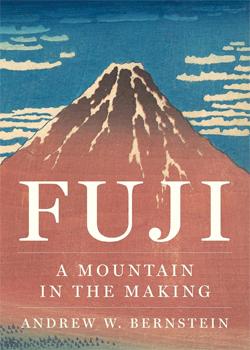
By Andrew W. Bernstein
Princeton University Press (2025)
ISBN-13: 978-069125629
Review by Laurence Green
Mount Fuji has been in the news lately, but then, when has it not? The most recent debacle regarding the mountain comes with the cancellation of the annual Arakurayama Sengen Park cherry blossom festival, which typically attracts over 200,000 visitors to the mountain’s vicinity. Drawn to take a pretty snap of Fuji flanked by the blossoming sakura petals and a five story pagoda, tourists will no doubt be disappointed - just as they were in a similar case a few years’ back when a local municipality had to erect an ugly black barrier opposite a Lawson store to stop people taking photographs after a shot of Fuji flanked by the konbini went viral. Fuji, it seems, just can’t shake its status as one of social media’s biggest star attractions.
The still active volcano is instantly recognisable: a flawless snow-capped cone, a timeless emblem of Japan. But beneath this serene, picture-perfect surface lies a far more turbulent story. Across the centuries, Fuji has on occasion erupted with violent force (most recently, in the 1707 Hoei eruption) devastating communities and seeding terror. Revered as a sacred peak, it has housed shifting pantheons of deities whose meanings and powers evolved with the times. In short, as both an explosive icon of nature, and deeply spiritual domain of the gods, its history is complex, and forever intertwined with the values and beliefs of those living in its proximity.
From ancient times through to the modern age, Fuji has served both as a unifying national icon and as a battleground for economic and political conflict. And while its towering beauty has inspired poets, painters, and pilgrims, its lower slopes have also been claimed by military training grounds and polluting industries. From its deep geological beginnings to its modern designation as a World Heritage Site, in this exciting new book Andrew Bernstein unearths the mountain’s many contradictions, using Fuji’s history to challenge how we understand nature, power, and our entangled relationships with the world around us.
The story that arguably dominates across this particular history of Fuji is an increasing slippage between Fuji primarily as a geological and spiritual site, to one of recreation and tourism. Pilgrims shift to sight-seers, and stories of shrines jut up against meteorological stations, rest stops and toilets. Fuji’s slopes are covered in toilet roll, trash and mountaineers ascend its slopes in carefully timed ‘bullet climbs’ to see the sun rise from its summit. The numbers attempting to climb Fuji before COVID happened - sometimes over 300,000 a year - is simply staggering. While these numbers have since dipped, chiefly through regulatory efforts, many of the issues facing the mountain persist - part of a deep tapestry of competing interests for its space, both physical and spiritual.
As a site-specific study, Bernstein’s book is refreshingly readable - part of this strength clearly stems from the fact that each of its nine core chapters never outstays its welcome. If the mountain’s geological history bores you, then perhaps the legal wrangles about who owns its slopes will grab you, or vice versa. The mountain - which in its monolithic, iconic symbolism, often seems so simple - is actually full of complexities, and the way this book deftly interweaves these to help shape its own story as part of the wider tale of Japan is masterfully done. Each disparate thread is cleanly and carefully woven back into the core of the mountain’s importance, and by the time we reach the end, and the successful bid for Fuji’s status as a World Heritage Site, we understand why even this comes with loaded implications.
Lushly illustrated, and with an approach that strikes the perfect balance between accessibility and scholarly rigour, it’s easy to see the book becoming a foundational reference point for those looking to carry out further work on any of the aspects of the mountain covered here. The field of tourism studies in particular relation to Japan, for example, has seen a startling wealth of output over the past decade, and much of the work here is prime scaffolding to support the perpetuation of this. As we mentioned at the start - it seems like Fuji is never out of the news these days, and whether this is as a symbol of Japan itself, or perhaps more crucially, as a lodestone for many of the keenest issues that face Japan right now, the mountain’s status as both treasure and symbol of the nation shows no sign of dimming.