

The Hotel Hokusai
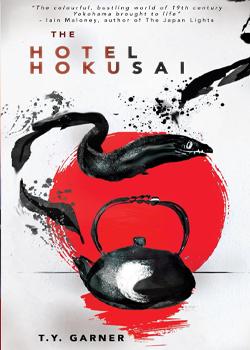
By T.Y. Garner
Ringwood Publishing (2024)
ISBN-13: 978-1901514988
Review by Isabel Mermagen
In the vibrant, bustling melting pot that is the 1893 Yokohama foreign settlement in Japan, T.Y. Garner in The Hotel Hokusai weaves an engaging murder mystery that also explores themes of loneliness, unlikely friendships and the adventures that befall strangers in foreign lands. It also cleverly captures the febrile atmosphere of a place in which foreign traders are given the opportunity to profit from and acquire Japanese trade and culture that had previously been forbidden.
Most of the story is narrated by a young Korean named Han who is duped by his adoptive father, a Reverend Hare, and dispatched from his native country to a “College of Christian Soldiers” that does not exist. Unemployed and alone, the resourceful Han spots an opportunity at the bustling Yokohama quayside when he witnesses an unfortunate eel filleting accident and is soon taken under the wing of the brusque, but warm-hearted eel stall owner, Yamato. Han’s sense of loneliness and dislocation is vividly described. His linguistic abilities set him apart from other Koreans but as he points out: ‘most light-skinned people looked at me and saw only the characteristics of a race to whom they felt superior. I belonged nowhere’ (p.49).
It is whilst he is undertaking the visceral, gruesome act of killing and filleting the eels for his boss that Han meets Archie Nith, one of three artists from Glasgow sent to paint Japanese scenes for consumption back home. These so-called “Glasgow boys” are based on real-life characters (in fact, Garner uses the real names of two of them – George Henry and Edward Atkinson Hornel) who were financed by Alexander Reid to travel to Japan in 1893-4. The artists are colourful, flamboyant characters, but it is with the more sensitive, socialist Nith, that Han forms a particular bond. It is also the fictional Nith whose fate will add to the intrigue of the book.
The young Han dreams of being a writer, and as one of the Glaswegian artists tells him: ‘If you want to write, crime is the thing, and if you don’t know which to choose you ought to go straight for murder’ (p.5). However, it is not these words but Han’s own experience of seeing the body of a young Japanese woman being pulled from the Yokohama docks that impels him to turn detective. Han’s favourite writer is Robert Louis Stevenson and Nith soon introduces him to Sir Arthur Conan Doyle, two influential writers of the period who fire up Han’s imagination. Before long Han and Nith team up to solve the mystery of the murdered girl from the Persimmon House (based on the real-life high-end Nectarine brothel). The truth is as slippery as the eels that Han wrestles with on a daily basis.
Halfway through the book, the narration switches from Han to Nith and here Garner skilfully interplays the seediness and sometimes squalor of a city where foreign communities live cheek by jowl, and the idealised version of a Japan that outsiders are so eager to consume. The artists, for example, are given orders to paint with “Simplicity, Innocence, Restraint”. Nith describes himself working on a painting of two small Japanese children in kimonos: ‘All in all, a delightful image of Japanese domestic life, cosy yet exotic. The fact that the whole scene was not in a real house but at a studio at the Japan Photographic Society won’t matter a bean’ (p.87) The artists also open the window on a world of foreign traders, journalists and diplomats where we are introduced to characters such as the vivacious Arabella Hawk (the author’s nod to the pioneering writer and explorer, Isabella Bird.
The eponymous Hotel Hokusai is not introduced until the last quarter of the book, but it allows the reader (through Han’s eyes) a brief glimpse into life outside the foreign settlement in the countryside between the coast and Mount Fuji. It also provides a unique pivot point in the life of our narrator and it is here that our Holmes and Watson close in on the solution to the mystery.
If you like your crime novels to have a tidy ending then you may be disappointed, but the heart of the novel is our dogged hero and his empathy for those who, like him, are often strangers in a foreign land or used and abused by those in positions of power. I came away rooting for Han, and his determination to embrace the future, as well as being shaped by his past.
As he tells his story on the verge of becoming a father himself (10 years in the future), he wonders what language he should use with his newborn child: ‘There, I have made up my mind. Japanese with Yuki, and at work; Korean – assuming I can remember it – with the baby; and English, until the time seems right, only here, in this story. Call it an experiment in triality’(p.4). This strange mixture of different languages and cultures also reflects the extraordinary fusion that took place in Yokohama at the end of the 19th century that T.Y. Garner brings so successfully to life.