

Ryoji Ikeda: music for choir
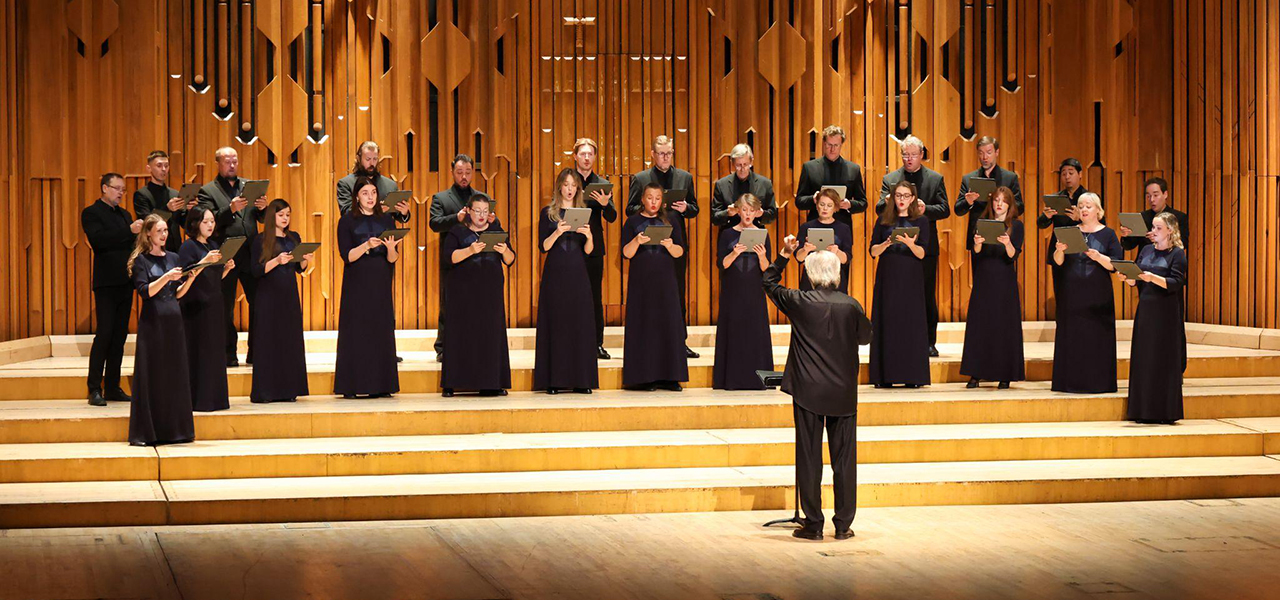
Estonian Philharmonic Chamber Choir conducted by Tõnu Kaljuste
Barbican, London
21 February 2026
Review by Shaun English
The list of artists who, after gaining recognition and respect in their scene, take a left field turn in their creative journey is endless. Avant-garde visual artist and musician Ikeda Ryoji, known for his meticulous and innovative approach to electronic music, joined this list, by gearing up for the challenge of writing a set of works using acoustic instruments and exploring his artistry using outlets and methods he is not used to employing. As presented in the premiere of his most recent work Opuses 15-20 at the Barbican in London, he managed to show that you can take his usual style and equipment away, but you can’t take away his unique musicality.
The wood-panelled Barbican Hall never looked as small as I had felt that night, with a stage stripped bare bar for the Estonian Philharmonic Chamber Choir and their conductor Tõnu Kaljuste. A lot of Ikeda’s shows incorporate visual art with his work, but for this event, it was just thirty or so people dressed in simple black.
After the lights faded, one-by-one, hopeful melodies layered over each other inviting warmth into the hall - fitting the name of a song named The Calling, Opus 15. The coming and going of voices compounded the increasing swells of sound until finishing on one beautiful chord, which led into Panta Rhei (Op 16), a reflective piece with its cascading chromaticism and dissonance being its charm.
Ikeda’s inspiration from nature was evident in all songs, but especially in Little Birds (Op 17) - three short light-hearted tunes about birds and their own chorus in the forests. The fixation on the beautiful, yet quite inconsequential, parts of nature is explained by his writing process, in which he spent in the woodlands of Switzerland in 2024 writing these songs.
The prominence of the thematic physics of nature is ever present in his music across, yet Ikeda explores this only using the thirty voices of the choir. But he saw the “infinite possibilities for expression and nuance” of working with the human voice (in the programme notes, page 10), and challenged himself to write for no other medium but the voice.
It felt like I was given a taste of the natural world - achieved not only with the complex panelling of the wood in the hall, but also with the simpleness of the choir’s attire and the bareness of the stage - at the time I felt that I was separate from the realities constructed by man.
Opuses 18 and 19, Lux et Nox I & II, were the longest songs, and showcased the best of the theme of duality. The lyrics speak of neverending cycles of life, of light and dark (Lux et Nox), night and day but also of hope and fear in life. The four vocal groups - soprano, alto, tenor, bass
- weaving slow and graceful threads into the melodic tapestry in a musical canon as precise and thoughtful as what you would expect from a leading classical composer, not the leading, yet
self-taught, electronic musician, who by his own admission cannot read music notation.
Ikeda’s unorthodox approach to writing music has never been something which has held him back, and even in a playing field like classical music, where music theory and structure reign supreme, he brings his own sensibilities in the songwriting. The result is a set of compositions with chamber and folk music sensibility - the raw sound of vocal lines, which feel like they have been finely tuned, mixed and mastered with precision in real time.
Vox Angelica (Op 20) was the final piece of the repertoire, which showcased the aforementioned precise quality, but combined with the freedom of the two solo vocalists standing on opposite sides of the choir. Like the name of the song, the angelic solos lingering above the choir brought together the grand ending, the sonic collision of sound giving the perfect sensory ending to a majestic performance.
The irremovable core of an artist is never the genre or the instrumentation but the beliefs, approach and influences in making art. In his compositions, Ikeda’s unique approach to art is exhibited even without his usual equipment and genre. But, what I thought was striking was how deep Ikeda went in exploring vocal music to make his own.
There was a section in the programme notes which really stood out to me, in which Ikeda Ryoji wrote: “Voices carry deeper meanings in roles than any context of our contemporary culture”. His prior work which I was aware of had only ever included sampled vocals at the most, yet these pieces saw him break down the voice and expose the natural beauty it offers, the only instrument which is truly unique to each person. His interpretation and usage of this instrument showcased a precise and inventive musicianship, yet an enormous respect for the nature of the voice, showing that what comes naturally shouldn’t be regulated but worked together.
Whilst voices are infinite, words are not, and mine can only do so much in exploring the performance in writing. However, the closeness I felt to nature and music this show brought me is something which I will not forget for a very long time.