

The German Experience of Japan's Treaty Port System
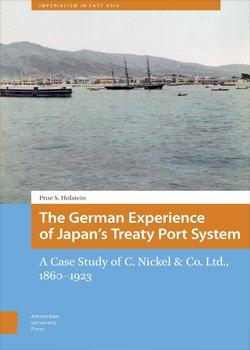
By Prue S. Holstein
Routledge (2026)
ISBN-13: 978-9048560554
Review by Gergely Tóth
Prudence Shaw Holstein, an Australian business consultant with a forty-year career across the private, governmental, and not-for-profit sectors promoting Australian interests primarily in Japan and the United States, spent fourteen years living and working in Japan. She holds a PhD in Japanese Studies from Monash University. Her late husband, Jens Holstein, was a third-generation member of a German merchant family long established in Kobe. Her doctoral research - now published by Routledge as the book The German Experience of Japan's Treaty Port System: A Case Study of C. Nickel &Co. Ltd., 1860–1923 - examines the experiences in Japan, chiefly in the treaty port of Kobe, of two German merchants: Carl Nickel (born 1836) and his cousin and godson Christian Holstein (born 1875), across the pre- and post-unequal-treaties periods.
This seemingly unpretentious book is heavier in substance than a modest pint of mild ale nursed in a quiet corner pub (though it probably merits a finer vessel and rather more specialised company – the sort that appreciates a proper legal-historical vintage).
The book comprises ten chapters organised into four broader chronological sections: the first covers the origins and familial networks of German merchants; the second examines business operations in Japan under the Unequal Treaties; the third traces commercial evolution following treaty revision; and the fourth analyses the impacts of World War I and its aftermath.
The book opens with a brief prologue and introduction, but the substantive content begins in Part I. This section traces the Hamburg merchant families of Nickel and Holstein, highlighting their seafaring, cargo-handling, and inn-keeping roots. It notes how these backgrounds laid the groundwork for early ventures in Japan – ventures that would prove pivotal in establishing their foothold amid the treaty-port world. The narrative relies heavily on one key source: oral history in the form of collective memories passed down through the Holstein family – yet curiously lacks diaries, photographs, or other tangible records for such a long and evidently prosperous lineage.
While it establishes valuable historical links and cooperation between British and German merchants in transnational settings, the chapter feels overstretched, delving back to the 1600s with somewhat peripheral detail that could have been edited more tightly. It reads more as family history than as business history directly tied to Japan, quickly becoming entangled in a "who's who" of relatives; much of this material might have been better reserved for a separate family chronicle.
Part II reveals the book’s true substance, delving into the murky intricacies of early German trade and treaty port life in Japan. While the narrative suggests Japanese "obstructionism" in pre-Meiji Nagasaki, this friction is often attributed to administrative inexperience or sluggish decision-making. The portrayal of a lawless treaty-port frontier – where figures like Carl Nickel first resided in 1860 – is complicated by hints of "sharp practices" and shrewd deceptions that pushed the boundaries of the era’s legal framework. These episodes receive curiously scant treatment, leaving one to wonder if this stems from a genuine scarcity of sources or a more deliberate narrative omission.
The framing of "obstructive" local Japanese officials versus hardworking foreign merchants feels somewhat oversimplified, particularly given a notable absence of original Japanese-language sources. This Eurocentric perspective represents an "epistemological blind spot" that a self-reflective 21st-century historian might have interrogated more deeply. Nevertheless, the section provides an intriguing account of how a merchant could navigate the perilous, ambiguous waters of early port life through extreme diversification.
By the late 1860s, a strategic relocation and the clever exploitation of extraterritorial privileges paved the way for a rapid expansion of Nickel's stevedoring business. Yet, the precise scale of this success remains tantalisingly elusive, as the text provides no quantitative data to illustrate the growth of C. Nickel &Co. Behind the firm’s rise was a complex web of shifting international partnerships and uncompromising management tactics that occasionally invited repercussions.
Ultimately, Nickel remains a tough, abrasive, and intensely private figure – his true character and the exact means of his ascent staying largely in the shadows.
Part III centres on the watershed year of 1899, which saw the termination of extraterritoriality – a shift the foreign merchant community viewed with deep trepidation, fearing that Japanese courts would be inherently biased against their interests. While the scale of C. Nickel &Co. becomes clearer through the first major statistics provided (p. 110), the presentation lacks the broader economic context necessary to judge the firm's true standing.
A significant point of contention lies in the book's treatment of coastal trade rights. The author characterises the loss of foreign cabotage rights as a "subversion" of established entitlements (p. 114), a perspective that arguably betrays a Eurocentric bias. In reality, Japan was merely reclaiming sovereign prerogatives – such as the domestic transport of goods – that were already standard practice in the West. Whether the merchants were truly victims of a legal "sneak attack" or simply guilty of short-sighted strategic planning remains a provocative question for the reader to ponder.
The narrative relies heavily on the local British press to examine post-1899 court cases, missing an opportunity for a deeper legal-historical analysis. However, Nickel’s reaction to this new regulatory landscape was particularly astute. He adopted a peculiar dual-registration strategy across different jurisdictions to hedge his bets – a move that reveals much about his commercial cunning. It is only after the firm's listing on the Hong Kong Stock Exchange in 1902 that we finally see concrete financial records (p. 136). Nickel’s absolute dominance in the stevedoring sector earned him the resentment of his peers, which may explain the curiously terse nature of his eventual obituary (p. 139).
While the chapters detailing chaotic harbour infrastructure and insurance disputes can be dense, they accurately reflect the administrative growing pains of the era. The book’s standout moment, however, is Chapter 6. It offers a visceral, grit-laden look at the Kobe waterfront – a high-stakes environment where the management of thousands of labourers intersected with simmering colonial tensions and systemic friction. This section provides the "real-life" intensity missing from the legal drier passages, though the absence of Japanese-language voices leaves the reader wondering what the view from the other side of the docks truly was.
Part IV focuses primarily on the trials of Nickel’s business partner, Holstein, as he navigates the immense pressures of the First World War. This section also delves into various legal disputes.
Despite being published by a prestigious press like Routledge, the work suffers from technical and editorial shortcomings. Even the physical quality of the print (by: Printforce, The Netherlands) is disappointing, with visible wicking and feathering along the edges of the lettering. Content-wise, the text lacks historiographical objectivity – a flaw seemingly inherited from the book’s doctoral origins, as there is no mention of a formal research methodology. It also represents a missed opportunity for the intimate "micro-history" one would expect, given the author’s personal family connection to the subject.
While the volume remains a usable resource even for myself, an independent researcher of Hungarian–Japanese relations, and is therefore also useful for other researchers of Euro-Japanese transnational relations, and while the book offers a unique insight into the nitty-gritty of foreign merchants’ lives in the treaty ports, the narrative is hampered by excessive repetition and redundant chapter abstracts that should have been excised during a more rigorous editing process.
The methodological rigour is notably thin; the work reads more like a dry chronicle or a collection of legal case studies than a lively, analytical historiography with a clear narrative arch. The prose is meticulous yet frequently didactic and flat, prioritising chronological detail over an engaging drive. Furthermore, there is a palpable sense that the book is intent on validating or even heroising the family’s persistence and business acumen, rather than delivering an objective, evidence-based history grounded in hard factual data. While the introduction fairly acknowledges the scarcity of usable material, it does not entirely excuse the heavy reliance on English-language archival material and treaty-port press reports over a broader, more balanced analysis that includes more than a mere 1% of Japanese-language sources.
The book is the literary equivalent of forking out 140 quid for a day-old, oversalted yet mysteriously flavourless German pretzel. While crunching through crystalline salt shards that could chip a molar, nothing whatsoever happens – no warmth, no satisfaction, just the lingering whiff of quiet regret on a drizzly Sunday afternoon.