The Thorn Puller
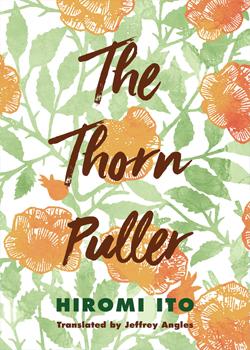
By Ito Hiromi
Translated by Jeffrey Angles
Stone Bridge Press (2022)
ISBN-13: 978-1737625308
Review by Conor Hodges
Ito Hiromi is in a pinch. Just shy of fifty, she lives a life straddled across the Pacific: her parents live in Kumamoto city on Kyushu and her husband – a Brit thirty years her senior – and youngest child Aiko live in California. Over years, she has crafted a precarious balance of sorts, shuttling herself between the two huge commitments of her life – her two families – while trying to stay above water and carve out a living. Her balance, however, comes crashing down once time catches up to her ailing parents and husband and the reality of Japan’s ageing population is brought into a starkly personal focus. She must choose between the Western conception of valuing your spouse and children above all, and the East Asian sense of filial piety and duty to one’s parents. Ito, a mother, daughter, wife, and person stuck between life’s demands, chooses both.
The Thorn Puller, originally published in Japanese in 2007 and in English – with Jeffrey Angles’s fantastic translation – in 2022, is a record of this decision, a part-autobiographical, part-mythological exploration into the external pressures that accumulate as we age and that threaten to explode our lives from the inside. The title references Tokyo’s Togenuki Jizo Kouganji temple, where ailing hopefuls visit in the hopes that Jizo, the bodhisattva guardian of children and those who cannot protect themselves, will pull the thorns (togenuki) of their pain out from them. Ito spends most of the story hoping that Jizo will help her family, imploring him to ‘pull out the deep, deep thorns’ (p. 34) embedded in her mother’s body, her experiences each a ‘needle piercing her flesh’ (p. 47), or to ‘protect my husband … accept him into his fold’ (p. 248). But through her constant care and her vow to sacrifice herself ‘solemnly and silently’ (p. 167), she has embodied the role of Jizo, the remover of others’ pain, herself.
Beyond Jizo, Japanese literary tradition has greatly influenced Ito’s way of thinking. Myths are woven into the fabric of this novel and often invoked in what Ito calls ‘voices’ that she ‘borrows’ from Japanese texts, both classical and contemporary. These include noh plays, books of classical poems and the sermons of Miyazawa Kenji. Every chapter has a ‘notes from the author’ section that detail the ‘voices’ she borrowed from, which helps to contextualise the frequent moments when the prose disintegrates into beautiful poetry or Ito’s mind wanders, imagining these stories bleeding into the reality before her eyes. In one particularly striking example, she imagines her husband, exhausted after being set upon by deranged old women, as a gakiami, a starved spirit that must be dragged on an oxcart in a direct evocation of the medieval Oguri Hangan myth (p. 252). Buddhism, too, permeates the novel, and offers Ito comfort when she needs it most. When she speaks of her chosen home, California, she mentions the Buddhist word saha, meaning ‘the world that must be endured’, helps her to ‘grin and bear it’ (p. 54). Likewise, when she sees her mother, newly hospitalised and essentially unable to move her arms and legs, she sees her as ‘some calm and collected bodhisattva’ who listens to the nurses, who ‘had been coming in with all sorts of personal problems late at night’ (p. 138). Again, the thorn puller himself is invoked.
Perhaps this is a way of asserting her Japanese identity after moving away and feeling more disconnected to her home country than ever. When she arrives in Kumamoto in the height of summer, the weather itself shuns her. ‘I’d grown used to the dry air of southern California,’ she says, ‘and the humidity was sheer torture’ (p. 16). She has to leave the air conditioner on overnight when she sleeps, ‘something that Japanese people never do’ (p. 22). Again turning to legends, Ito imagines that, like Persephone, by eating the fruits of the underworld (cinnabons in America) she has made it impossible for her to return completely to Japan. However, her metaphors speak to a fundamentally Japanese mindset: when she argues with her husband in English, she feels that he is ‘picking up my poor English with chopsticks and dropping it into a sizzling hot vat of tempura oil’ (p. 69).
In what must be particular painful for a poet, someone who so deftly pushes language to its limits and plays with meaning and undertone, Ito is unable to fluently communicate with Aiko. Ito cannot express herself properly in English, and Aiko speaks Japanese blended heavily with her English mother tongue. Ito cannot even communicate effectively using maths, a supposedly universal language, due to the huge differences in the American and Japanese systems of measurement, accidentally telling Aiko that eight metres of rain had fallen in Kumamoto (p. 145). The problem is starker between Ito and her husband, whose failure to even attempt to learn his wife’s language feels almost intentional. He pronounces her name ‘HEE-roh-MEE’ in an unconscious Anglicisation of the flat-sounding ‘Hiromi’, but in the process alienates Ito to the point that she feels that, after ten years of pronouncing her name wrong, he was ‘not really talking about me’ (p. 165). Her husband, never named, becomes the chief antagonist, pig-headedly refusing to understand the Japanese parts of Ito and appearing stubbornly concerned only with himself. When she takes him to see the thorn-pulling Jizo and explains that she believes in the healing power of incense smoke, he scoffs and asks: ‘what kind of dumb religion is that?’ (p. 242).
In these moments, one is reminded that Ito came to prominence in 1980s Japan for vocalising women’s issues and examining the roles of wife and mother in a patriarchal society. Through her fictional self in the book, Ito remarks on the fact that, while dealing with her own work, her daughter’s school, caring for her parents, her pets and her parents’ pets, she has to make sure her husband’s ego is sufficiently massaged. ‘If I could help my husband’s cock – his sense of self-reliance, I mean – then I’d do it’, she says after he lashes out at her due to his own fading sense of self-worth (p. 154). But stuck between spending more time with her increasingly frail parents, who she admonishes herself for leaving to grow old alone, and providing a sense of stability for her youngest daughter Aiko, now in primary school, Ito feels that she is consistently making the wrong choices in impossible situations. When her mother becomes unable to walk by herself and her father grows more and more senile, Ito transfers Aiko into a Japanese school for a term, and Aiko begs her mother for a Tamagotchi because ‘I want to be like my friends’ (p. 28). The guilt compounds. ‘I’m just a middle-aged woman in a little car. Give me a fucking break,’ she implores (p. 27).
Amid cultural confusion and trancelike steps backwards into myths and legend, the twin fears of ageing and dying plague the novel. The precipitator of all the imbalance and strife that Ito feels throughout the novel is her first visit to the hospital with her mother in what soon becomes a ‘pilgrimage’ from clinic to clinic (p. 26). Her mother gets sick and bedridden, her father becomes lonely and senile, and her husband has heart surgery and grows mysterious lumps on his face. But the message that carries through to the end is one of absolute positivity about our limited time on earth. Lamenting her parents’ decline, Ito remarks that ‘nothing stays the same. Everything is impermanent’ (p. 244), but her narrative is so deeply suffused with myth, real-world situations in constant contention with those about which she has read, that the book itself seems to imply the direct opposite. We are in cycles of pain meted out to our ancestors and our progeny, and the best we can do is help ease each other’s suffering. An older poet, one who looks exactly like Ito and who may be a manifestation of an older, wiser Ito herself, confirms this by telling her:
Hands together in prayer…Truly, this is the merit of coming and going.
Use it as the ability to help others.
Use it as the ability to help others.
(p. 267)
Her mantra, therefore, is to be as a certain bodhisattva: in between your coming into the world and your leaving it, do your best to pull the thorns of suffering from others. Only once Ito realises this, she can end her narrative with the repetition of a realisation that she seemed to have denied herself while wading through the death all around her: I’m alive.