The Facepalmer's Husband
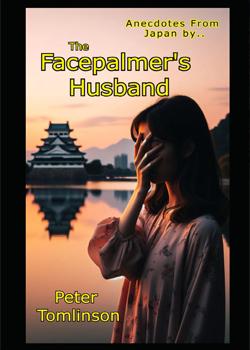
By Pete Tomlinson
Pete Tomlinson (2026)
ISBN-13: 978-8242514508
Review by Halimah Khan
In The Facepalmer’s Husband, we follow Pete Palmer on his journey as he navigates Japanese life and customs, along with the challenges of career transitions, following his marriage with a Japanese woman. It depicts a real and raw journey, shedding light on the struggles of adapting to a new culture and highlighting how social systems in Japan have influenced his life there. This biographical work takes a comedic approach to the adjustment to a life in Japan. The humour throughout the book is light-hearted, with a hint of self-deprecation, as he recounts his experiences. The author’s tone strikes a balance between serious and humorous elements, making the narrative engaging.
Chapter one introduces Pete’s marriage to Sea (Akane) and shares insights into their backstory. Their marriage was not initially accepted by her parents, and during this period, they had to get married privately. We gain some background information about who they are. Pete previously worked as a security guard in London, and Sea was studying English in the UK. Sea is a central character within the book as she supports his business ideas and assists him with tasks, and advocates for him. No matter what business endeavours Pete embarks on, Sea is always by his side, offering her unwavering support. We see the financial struggles Pete faced while navigating the job market and trying to gain financial stability. He gets interviewed for English teaching jobs and manages to secure a role. He mentions the “juku system”, which is adopted in a “juku,” a type of privately run, after-hours tutoring school. Additionally, it offers supplementary education for students who aim to enter higher education or to excel academically. The juku where Pete worked had strong, qualified teachers with vast experience. As he was new to this field, he realised that he had a lot to learn, such as long hours of lesson planning and incorporating the teaching method that aligned with his juku TPR (Total Physical Response). He studies up on the method and tries to develop his skills to make his classes more engaging and to improve his English teaching abilities. As Pete gains more experience and his skills improve, Sea and Pete come up with an idea, explained in chapter three, to open up their own language school called “Challenge English”. He taught children and private classes for adults. Within this period, during which the book was written, there weren't many foreigners who taught English, and it wasn’t as competitive. The timing to open up his own school reflects innovation as it shows how he created opportunities for himself and resourcefulness as he took the initiative to do something different.
Later within the book, Pete comes up with another business idea and opens an antique shop with Sea. In chapter 13, we see how he navigates the antique fair in Tokyo. He successfully managed to make two hundred and fifty thousand yen. This event within the book shows creativity and exploration as Pete takes the opportunity to use the antique fair to grow his business and become more familiar with the antique market. Additionally, he purchases a lathe to start making his own furniture for his antique shop, and he produces wooden bowls to help stock his shop with more items. However, he does get rid of them later. He utilises his creativity to ensure that his shop is well-equipped. It is interesting to see Pete starting up a different business and exploring alternative ways to make income in a different country. His opportunistic approach and network of connections enable him to navigate the career world within Japan. Later in the chapter, a humorous incident occurs when Pete visits the wrong location to obtain materials for his antique shop and later realises it's the wrong location. Moreover, in Chapter one, he was offered bread instead of rice due to his strange culinary behaviour of mixing tabasco sauce with mayonnaise with the rice. These humorous moments show relatability and misunderstandings that can occur while navigating a different environment. While Pete does at times experience these mishaps, it does reflect a raw and real perspective, which suggests that living and adapting to a different culture takes trial and error, and it's a learning process that broadens your perspective.
Reading this book showed me how challenging it can be to readjust in a new environment and has provided me with more awareness of Japanese culture. I was always curious about what it would be like teaching within another country. It seems that the role of a teacher requires a lot of discipline and flexibility. Pete's journey inspires me to embrace the changes of a different culture and to take opportunities. I have learnt that going out of your comfort zone and engaging in deep exploration can open up different possibilities. Moreover, allowing yourself to immerse in a different culture can contribute to your personal development and open your mind up to a new world. I would recommend it to people who are interested in travelling or working to Japan or to someone who wants to gain insight into personal experiences of a non-Japanese in the country with a touch of humour. While it may not depict the full extent of living experiences in Japan, it does shed light on some elements, such as cultural transition, navigating and adopting different customs and understanding and adapting to different social norms and values.