The Restaurant of Love Regained
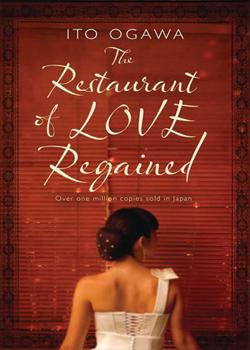
By Ito Ogawa
Translated by David James Karashima
Alma Books (2012)
ISBN-13: 978-1846881800
Review by Laurence Green
Right now, Japanese iyashikei (healing) books in English translation are all the rage. Usually involving libraries, cafes and cats - or some combination of all three - they are typically short (around 200 pages or so) and offer up simple, calming stories that act as a kind of palliative tonic to the stresses and grind of day to day life. They are invariably about restoring a sense of meaning or purpose to modern lives that have become aimless and loveless, and for both Japan and increasingly the rest of the world, it’s easy to see why this kind of narrative has become so overwhelmingly popular. It’s fast food literature for a reading populace trying to fall back in love with reading.
But all of this is, in fact, nothing new. Back in 2012, the English translation of Ito Ogawa’s The Restaurant of Love Regained was released - already boasting millions of copies sold in its original Japanese version - and in many ways it lays the groundwork for everything that would follow. Protagonist Rinko returns home one day to find her flat completely emptied out - all her belongings (and boyfriend) are gone. She returns to her family home, and her estranged mother. Attempting to restart her life, she opens a quirky little restaurant, catering to customers’ personal tastes and whims; we are introduced to a number of them and learn how food can seemingly heal any heartbreak - Rinko’s included.
So far, so good, but it’s what the novel chooses to do with this premise that starts to send your head spinning. The blurb cheerily compares the feel to Banana Yoshimoto’s Kitchen and Laura Esquivel’s Like Water For Chocolate - and certainly it shares both their food thematics and the magical-realist quirkiness in the extreme. But whereas Yoshimoto’s beloved classic achieves an achingly hip coolness, The Restaurant of Love Regained unfortunately trips over the line into a bizarre mix of over-ripe kitschness and a constant sense that it is trying to be ”weird” just for the sake of it. Sex, foreign lovers and outright shock factor are all waved around as a kind of spice for the dish, but without ever actually feeling properly present. Rinko’s Indian boyfriend remains precisely that - an “idea” of India that is ultimately faceless and nameless.
In Like Water For Chocolate, the idea of food taking on the emotions and feelings of the one cooking. it is richly developed and interwoven into a cultural texture that feels earnest and meaningful. And that’s not to say that Ogawa’s text doesn’t achieve this in places - in many ways it strikes a good balance between a more literary tone and something wholly mass-market, good for dipping into on the morning commute. The customers that come into Rinko’s life all manifest as bite-sized short stories within the wider narrative of the novel - a technique many subsequent “healing” novels have emulated. All have their “heartache”’ healed by Rinko’s food, and we learn - supposedly - something about life in the process. This is invariably one of the stumbling blocks of these kinds of works - how didactic and tutelary they end up feeling, the sense that a ‘life well lived’ is something prescriptive and waiting inside everyone, ready to be unlocked. The novel offers fable-like tales highlighting meaning amidst emptiness, but are they really translatable to our own messed up lives?
And this is where I feel The Restaurant of Love Regained finds its greatest failing - the almost overwhelming sense of bathos, namely, abrupt transitions between the trivial and mundane to the serious and emotional. It is where kitsch moves beyond a cloying sweetness or sense of sideways humour, to a full on wringing of the emotions through artificial means. To say too much would spoil the plot’s final denouement, but suffice to say, animal lovers will likely find themselves traumatised by the ending of the novel - and the worst part is that this ending is no doubt intended to be deeply meaningful, poignant and instructive in a “circle of life” kind of way. But instead, to me at least, it came across as gross, cloying and the epitome of ‘now you are going to cry’ artifice.
This kind of forced emotionality has only become more popular of late - and it’s easy to see why. In a world mediated through Instagram and endless day-to-day weariness, anything that can make us “feel” something comes across as more real than the greyness of normality. But this is all the more reason to properly “earn” this feeling, not just inject it intravenously via on demand delivery. Ogawa’s book constructs a world that is the colourful, wacky antithesis of modern Japan - it is the textual equivalent of the ‘let’s escape the rat race and run away to the countryside’ myth that sucked in so many post-COVID. But it remains just that - pure fantasy. Some will love the gustatory world Ogawa conjures up to meet this need. For others, this world’s force-fed emotionality will remain the fundamental stumbling block.
The best thing we can say about The Restaurant of Love Regained is that it’s certainly memorable. Just not always in the best of ways…