

Mina’s Matchbox
By Ogawa Yoko
Translated by Stephen Snyder
Vintage (2025)
ISBN-13: 978-1529933536
Review by Rio Julian
When she was a twelve-year-old girl, Tomoko lived a year that became a lasting memory. Her father had passed away, jeopardising Tomoko and her mother’s living situation. After a discussion between the two, they decided that her mother would pursue a higher education for a year that would land her a better-paying job, and Tomoko would live with her aunt in Ashiya in the meantime. Tomoko wasn’t worried with this separation, since she had rough knowledge that her aunt’s family lived a better life. The reality was beyond her expectations – the family lived in a seventeen-room Spanish-Colonial-style mansion built at the foot of Ashiya Mountain. There, Tomoko met the cast of her one-year life of grandeur. The family pet Pochiko, a Liberian pygmy hippopotamus. Her half-German uncle, who oozed elegance and competence. Her aunt, an elegant and almost professional nitpicker. Grandmother Rosa, a quintessential kind grandmother with a touch of German nostalgia. Yoneda-san, the maid who unquestionably ran the house. Kobayashi-san, the gardener who never put a foot wrong. And then there was Mina, the cherished sickly child of the family with the rustling box of matches in her pocket. With the grand new home and this cast of varying species, ages and personalities, Tomoko was sure to live a year of elegance. But of course, unforgettable as it was, the memories weren’t all bliss.
Ogawa’s use of the first-person narrator is effective. Two selves of Tomoko narrate the story – her adult self and twelve-year-old self. The twelve-year-old Tomoko predominantly takes the spotlight, taking us through the past events. The adult Tomoko takes more of a backseat, offering context and retrospective thoughts about the events. The different voices established between the two selves are heartily characterised, as twelve-year-old Tomoko often falls just short of disentangling the underlying issues of the adult cast in her grand new life. Mina even gave her a brief and direct summary of some of the residents’ troubling habits, such as her own mother’s alcohol dependency and Yoneda-san’s outbursts, which Tomoko barely acknowledged as she was taken aback by ‘this palatial house and thoughts of Yoneda-san’s three o’clock fruitcake’ (p. 12). This becomes a theme of sorts with more significant issues looming and Tomoko more often than not becoming an observer at best, which in fairness would be expected of a twelve-year-old.
The story reads as more of a recounting of memories than conventionally structured storytelling, as opposed to what the blurb suggests. Twelve-year-old Tomoko takes us through her day-to-day life for the most part without build-ups or pay-offs in the conventional sense. This makes for a relaxing read at best, but a periodically droppable one at worst. It spends a significant amount of time on the grandeur of everything, which Ogawa paints very vividly to her credit. However, there are times when you’re ready for things to start crumbling down, but generally not much follows. Tomoko’s general approach towards adult issues – that is, observing from a distance but not close enough to be a direct solver – justifies this lack of conventional pay-off, but readers need to buy into this rhythm. The book’s blurb misses the mark in this respect in my opinion – aside from the friendship with Mina, it reads a lot like this adventure probing into the family’s deepest secrets behind the sparkling façade. I dropped the book a few times before adjusting my personal expectations and starting to enjoy this rhythm.
With the recounting nature of the story, it takes its time with the tangents that Tomoko and Mina get into. At one point, they developed an intense obsession with volleyball. The Japanese men’s volleyball team were competing at the 1972 Munich Olympics, which Tomoko and Mina could only watch from the daytime rebroadcasts on television. This subplot makes for very well-executed comedic moments and a deeper dive into the lesser-presented characters. Grandmother Rosa’s nostalgia for life back home in Germany, which up to that point had been established by her struggle with Japanese characters and extravagant fondness for German effects, earns more substance with her reminiscing anecdotes.
There comes a rather abrupt and short-lived turn in the narrative however, when ‘members of a Palestinian militant group forced their way into the residence of the Israeli team in the Olympic village' (p. 175). Ogawa spends a chapter exploring the 1972 Munich massacre, largely through news reports and Grandmother Rosa’s emotional distress. I admittedly raised an eyebrow when this tragedy was brought up, but kept reading and presumed that it would place Grandmother Rosa in higher importance to the story. However, its significance starts and ends in Chapter 29.
Post-reading, I’d be willing to grant Ogawa’s inclusion of this tragedy – perhaps one could argue that not addressing such a tragic event in this setting would’ve been irresponsible. I’d even be willing to grant Ogawa’s dichotomous descriptions (and Snyder’s translations of them) of the Palestinian ‘terrorists’ and Israeli ‘victims’ as twelve-year-old Tomoko’s limited understanding and vocabulary, partly supplied by her aunt’s retelling of Grandmother Rosa’s past. However, adult Tomoko offers no nuance to this topic – which I feel should be expected given the other retrospective thoughts that she’d give on the other parts of the story – and the following chapter moves swiftly onto Tomoko and Mina’s giddy excitement for the delayed volleyball match between Japan and Bulgaria. To me, this was a heavy-handed handling of a nuanced topic that I could personally at best side-eye, considering the narrator’s constraints. I wouldn’t make assumptions on Ogawa’s personal views, rather recognise that perhaps it was a responsibility for her to acknowledge the tragedy given the setting she wrote in.
Unforeseen moral deliberation aside, the last stretch of the novel is a long-awaited turn of pace. The underlying issues that directly affect Mina’s world are addressed in a rather concise manner from Chapter 31 onwards, yet Ogawa’s execution is gentle and meticulous. Tomoko’s proactiveness to get to the bottom of her uncle’s absences leads to a very bittersweet resolution that Ogawa puts together very poignantly. Mina’s turning point is also not the sweetest. The matter of the Young Man from Wednesday ends on a white lie, but it makes for a well-executed cushion for Mina’s turning point – she’s had her last matchbox, so no matter how crafty a writer she is, now she has to voyage out there herself. The death of Pochiko coincides with Mina’s turn of luck with her health, and all we get from her is Tomoko’s reading of her expression at the pet hippo’s funeral. From Mina’s last story however, we get to see her biggest worry: what happens after death. Nothingness? Reincarnation? Mina comes to the conclusion, which I like to think is what she gathered from Pochiko’s funeral, that ‘even when you die, you don’t disappear. Matter doesn’t vanish, it transforms’ (p. 271). From then on, without the Young Man from Wednesday delivering her matchboxes and Pochiko chaperoning her to school, Mina grows into her own person and reaches for the stars.
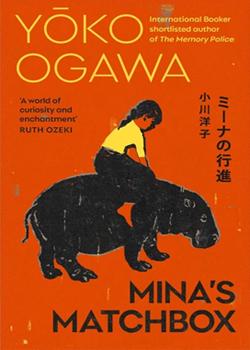
It might not make the best following act to The Memory Police, but Mina’s Matchbox has all the feel of a work that is close to the author’s heart. The meticulous painting of the settings consistently makes you breathe the air of the Ashiya mountains, surrounded by cream-coloured walls with Spanish ornamental windows. The characters are quite intense, in that you remember at least a thing that particularly characterises them just from first impressions. To me, the cover art and blurb don’t quite do the story justice – Pochiko isn’t as central as the mythically-coded cover suggests, and the family’s ‘collapse’ isn’t as urgent as the blurb suggests. The recalling of a treasured time in the past is what it succeeds in, and that’s what I feel you should expect from this book.