One Hour of Fervour
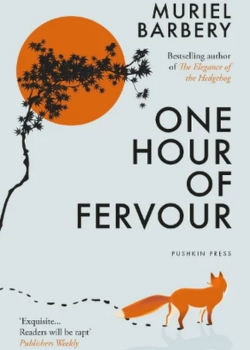
By Muriel Barbery
Translated by Alison Anderson
Gallic Books (2024)
ISBN-13: 978-1913547608
Review by Isabel Mermagen
Ueno Haru lies dying in the private quarters of a temple in Kyoto, gazing out at the precise arrangement of the garden before him and reflecting on the milestones of his life that have brought him to this place. He circles back to the epiphany, in the same temple fifty years earlier when, having left his home in Takayama for Kyoto, a vision told him he would have ‘A life devoted to art’ (p.12). Haru’s dying moments bookend the story of his years as an art dealer during which he is a key member of an artistic coterie that holds court in Kyoto. It is at one of the many parties held by this group of aesthetes and art patrons that Haru meets Maud, an enigmatic Frenchwoman with whom he begins a brief relationship. A few months after the affair has ended, Haru discovers that Maud is pregnant, but she forbids him to see either her or the child and threatens to kill herself should he ever try to do so.
This pivotal event in Haru’s life opens the gates to waves of uncertainty and ambiguity in a life that had been outwardly successful until that point: ‘Like the perpetual loop of the closed enso, that life was turning around an invisible pivot, bringing suffering and joy in turn’ (p.95). Despite the sadness at the heart of the novel, there is hope too. Haru makes it his mission to find out everything he can about his daughter who is growing up in France, whilst at the same time respecting Maud’s wishes: ‘because, deep down, he wanted to give. He realised this, accepted it, regarded it with joy. He made it the stuff of his identity as a father, and elevated it to the highest point of his conscience’ (p.108).
This could be a brief summary of the novel One Hour of Fervour by Muriel Barbery. The book is in fact a prequel to Barbery’s previous book, A Single Rose, in which Haru’s daughter travels to Japan for the reading of her father’s will. As in that book and in her global bestseller The Elegance of the Hedgehog, Barbery imbues her novels with a profound sensibility both towards the environment and those who inhabit it.
With the focus in this book on Rose’s father, Haru, Barbery gives herself full rein to explore the Japanese sensitivity towards nature and in particular, the beauty of Kyoto. The Shinnyo-do temple, where the story begins and ends, provides an anchor for the story’s protagonist, who nonetheless wears his religion lightly: ‘Since he was only a Buddhist out of respect for tradition but wanted to join everything in his life together, he had forged the conviction that Buddhism was the name his culture had given to art, or at the very least, to that root of art called the spirit’ (p.18). His daily walk around the temple complexes to the Northeast of the city ‘was to converse intimately with the invisible’ (p.18). As in her previous works, Barbery weaves the idea of a constant search for beauty throughout One Hour of Fervour and the author’s obvious admiration for Japanese art and architecture leaps off every page, forged, no doubt from her own experience living in the ancient capital.
I was struck by the way in which Haru and his friends hold court to discuss art and poetry, get drunk and take lovers during regular gatherings at the house of the patron Tomoo and how much it almost resembled courtly gatherings during the Heian period. These friendships remain a constant for Haru throughout the novel and support him in his grief at not knowing his daughter. ‘He had chosen these men and women, these artists and merchants, these joyful servants of the spirit. He looked carefully at every one of them, imagined introducing them to Rose, invented happy years where they would come to know one another’ (p.85).
They also provide a prism through which time passes, encompassing the deaths and natural disasters that they experience over Haru’s lifetime. The friends are impacted by the Kobe earthquake of 1995 and by the Tohoku earthquake and tsunami of 2011. These events also make Haru aware of his own mortality: ‘He’d always believed he wasn’t afraid of death, and now he realised that wasn’t true. To disappear without Rose ever knowing him: this awoke the possibility of his own annihilation’ (p.144).
Barbery’s writing also evokes a constant sense of disassociation where it feels as though Haru is sleepwalking through his life in Japan whilst his other life (i.e. that of his daughter) is taking place on the other side of the world. The colourful cast of characters, both Japanese and European enter and depart the stage without really driving the plot, but each leaves their mark on our protagonist and provides a substitute for the family from whom he is either willingly separated (in the case of his parents and siblings), or for the daughter who is denied him.
Barbery’s language (admirably translated by Alison Anderson) can feel at first like a barrage of philosophical musings interspersed with mystical Japanese imagery that some might argue teeters on the brink of cliché. However, there is a sense of “otherness” in the writing that perfectly mirrors the reminiscences of the enigmatic hero who has lived all his life for art, beauty and love.