

Torikaebaya Monogatari: A Japanese Tale of Gender-Swapped Siblings
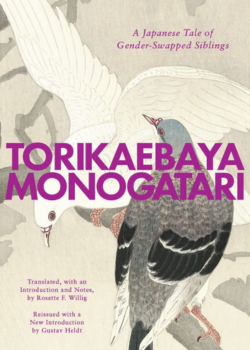
Author unknown
Translated by Rosette F Willig
Stanford University Press (2026)
ISBN-13: 978-1503646544
Review by Thomas Caffrey
Any novel of the Heian period (794-1185) will inevitably be compared to The Tale of Genji. Rosette F. Willig’s translation of the 11th century Japanese novel Torikaebaya Monogatari (author unknown) gets comparisons out of the way early: in a lively and contextually rich introduction, Gustav Heldt immediately tackles the Genji-shaped elephant in the room. Yes, like The Tale of Genji, this is a deep, complex novel with distinctive and memorable characters. But no, it is nowhere near as long, nor as canonical as Lady Shikibu Murasaki’s classic.
What Torikaebaya Monogatari is, however, is a boundlessly entertaining and surprisingly forward-thinking novel of intense psychological complexity. The narrative centres upon a brother and a sister, born to the high-ranking politician Sadaijin. His children pose a unique problem: while they are peerless in most ways, his daughter seems a prototypical tomboy, given to archery and outdoor pursuits. Meanwhile, his son is the opposite, playing with hina dolls and hiding behind curtains. This gives rise to the title of the book, taken from Sadaijin’s exclamation ‘If only I could exchange them’ (p. 16; torikau meaning “to switch” or ”exchange”, -baya meaning “if only I could”), prefiguring the central drama of the novel. Willig’s translation, originally published in 1983, was first released as The Changelings, thereby sidestepping an awkward literal rendering of the title, which could run thus: The Tale of Had They Been Exchanged or The Tale of If They Were Switched.
The drama of the tale is generated by the siblings’ exchange of identities: the perceptibly feminine “son” takes their apparent sister’s name and lives as the noblewoman Naishi no Kami. At the same time, their sibling becomes Chunagon, an ostensibly male member of the court. As brother and sister mature, their biological identities clash with their social identities, resulting in moments of sustained tension (Chunagon hides every month for the duration of his period, and later falls pregnant for much of Book Two). By the tale’s ending, the two have swapped places once again and are seemingly content to live as their assigned-at-birth gender.
These narrative turns render Torikaebaya Monogatari a difficult book. Because the siblings’ shifting gender identities resist tidy categorization, the novel is tricky to discuss without falling into endless explanation and exposition. Willig manages to render a sometimes-confusing story both lucid and exciting, punctuating the text with short, indispensable footnotes. These explain allusions, suggest further reading, and enliven the overall experience of Torikaebaya Monogatari.
An example of the necessary contextualization Willig performs: Japanese monogatari typically refers to characters not by name but by rank (which naturally changes throughout the course of most monogatari). The Torikaebaya doubles down on this complexity by presenting readers with characters who not only change ranks, but also swap places and genders. Willig’s footnotes brilliantly keep track of these changes for the reader, while her decision to continuously refer to most characters by a single name makes for a more approachable read. This pays dividends: Book Two ends with the characters exchanging places yet again, meaning that who once was Chunagon is now Naishi no Kami (the inverse is also true). Willig makes these twists navigable: not an easy task.
While it is tempting to characterize Chunagon and Naishi no Kami as straightforwardly trans characters, this reading is complicated by the tale’s conclusion, which finds the siblings happily returning to their birth genders, seemingly for good. Furthermore, while the narrative alludes to feelings of gender dysphoria, these mentions are muddled by the insistence that the two siblings were cursed by a tengu in their past lives: ‘in previous lives, their paths were crossed and in retribution [a tengu] changed the boy into a girl, the girl into a boy’ (p. 149). Still, while the story does not neatly cohere to contemporary categorizations of trans literature, it remains an important precursor: Torikaebaya Monogatari foregrounds gender transition(s) with empathy and dignity. While the tale does have a tragicomic register, it is not at the expense of Chunagon and Naishi no Kami, but rather their friends and rivals.
Further to this, when Chunagon’s friend and rival Saisho begins to make clear his desires for Chunagon, it is impossible to read his motive as anything but homoerotic; Saisho knows nothing of Chunagon’s queer gender identity at that point. Likewise, Naishi no Kami’s close relationship with the Imperial Princess is suffused with quasi-lesbian desire. Gregory M. Pflugfelder argued against a neat classification of the Torikaebaya as a lesbian text in 1992, writing for Monumenta Nipponica. Pflugfelder reminds us that just as readers of The Tale of Genji must remain cognizant of the fact that courtship standards of Heian Japan are contextually specific and rooted in a particular time and space, so too must we recognize that depictions of sex and gender in Torikaebaya Monogatari pre-date modern sensibilities.
And yet, some aspects are strikingly modern, such as the tale’s presentation of gender as performance. When Chunagon becomes pregnant by Saisho, he is forcibly reconditioned as a woman: ‘he plucked his brows and blackened his teeth, making him look like a woman’ (p. 117). When the siblings reassume their birth genders, it is through action and adoption of gendered signifiers. More powerful yet however, are the doors left ajar by the tale: Torikaebaya Monogatari shows Heian Japan as a place where sex and gender can be fluid and unfixed: these are learned prospects.
There are endless ways to read this text. In the introduction, Willig points to Torikaebaya Monogatari’s tragicomic register, which rewards comedic as well as serious interpretations of the story. Likewise, it can be read as a precursor to trans fiction, a landmark queer text, or something of a ghost story (owing to the shadow of the tengu that lingers over proceedings). In any case, no matter what reading prevails; Torikaebaya Monogatari is well worth reading, and this new release deserving of both attention and support.