

Exhibition – Kyotographie. Kawada Kikuji x Iwane Ai
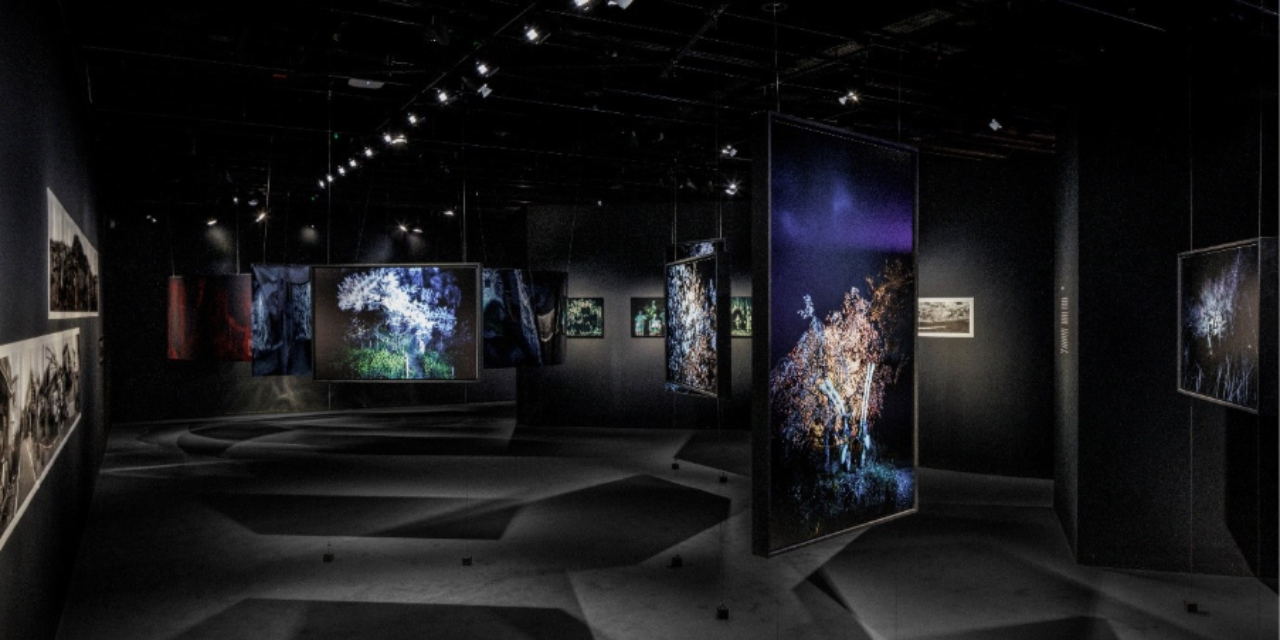
at Japan House London
(3 June-18 October 2026)
Review by Vittorio Cimino
Photography is often described as the art of capturing a moment. In Japanese, however, the term suggests something more complex. Shashin (写真) combines sha (写), meaning “to copy” or “to reflect”, and shin (真), meaning “truth” or “reality”. Commonly translated as a “copy of reality”, the word nevertheless raises a question: can reality ever truly be copied, or does photography instead reveal aspects of truth that might otherwise remain unseen?
This tension between perception and reality lies at the centre of Kyotographie, presented as the first photography exhibition at Japan House London, organised in partnership with Kyotographie. The exhibition brings together the work of Kawada Kikuji and Iwane Ai, two artists whose practices span different generations of Japanese photography.
Kawada Kikuji is widely regarded as a key figure in post-war Japanese photography. His work is closely tied to the social and psychological aftermath of the Second World War, particularly the enduring presence of the atomic bomb in Japan’s collective memory. His resonance in Japanese photographic culture started in 1960, when he, together with Sato Akira, Tanno Akira, Tomatsu Shomei, Narahara Ikko, and Hosoe Eikoh, founded the VIVO collective, an influential group of emerging photographers that helped reshape photographic practice in Japan. Internationally, he gained visibility through the 1974 exhibition at the Museum of Modern Art in New York. Later, he received a lifetime achievement award from the Photographic Society of Japan in 2011, confirming his lasting influence on the field. His photography does not offer straightforward documentation and resists fixed interpretation, instead assembling fragments, textures, and layered surfaces that privilege suggestion over description. In this way, history in Kawada’s work is not confined to the past but continually re-emerges in unstable and partial forms within the present.
In contrast, Iwane Ai’s practice is grounded in sustained observation and encounter, with a particular focus on communities often absent from dominant historical narratives, such as Japanese diasporic communities in Hawai‘i, where histories of migration and settlement have produced layered cultural identities. Works such as Kipuka (2018) reflect this interest, tracing everyday life among Japanese immigrants and their descendants. Originally trained through editorial and magazine assignments, she has since developed an independent practice in which domestic interiors, portraiture, and small gestures emphasise continuity as something lived and sustained in daily routines rather than formally inherited tradition. Her work has been widely exhibited, including at the Tokyo Photographic Art Museum and internationally.
The exhibition stages a quiet but sustained dialogue between Kawada and Iwane, allowing their practices to speak across time, geography, and photographic language. The visitor is invited into the carefully reconfigured exhibition space of Japan House London, where Kawada’s work is encountered first. Here, it is possible to appreciate Chizu (The Map) (1965), a foundational series later recognised as one of the most significant photobooks in post-war Japanese photography. Its fragmented urban imagery evokes the lingering traces of Hiroshima’s devastation through abstracted surfaces and disrupted spatial perception. Alongside this is a selection from Los Caprichos (1968-1981), a series of urban photographs marking a decisive shift in Japanese photographic practice and expanding the possibilities of form, sequencing, and interpretation.
The exhibition then leads into the work of Iwane. Kipuka (2018) explores Japanese communities in Hawai‘i with connections to Fukushima, continuing Iwane’s long-term engagement with migration, memory, and the everyday textures of diasporic life. This is followed by A New River (2020), made in the Tohoku region during the Covid-19 pandemic. The series combines nocturnal landscapes of cherry blossoms with folkloric and supernatural figures, unfolding between dissolution and emergence, and suggesting fragility, transition, and renewal. The exhibition opens a field of resonance in which distinct photographic approaches intersect, overlap, and at times subtly unsettle one another. It resists a single overarching narrative, proposing instead a layered understanding of how memory, history, and lived experience shape perception.
The strength of the exhibition lies in this exchange. Kawada returns to the traces of history and its persistence within the present, while Iwane focuses on lived experience and the continuity of community. Together, their photographs suggest that reality is never singular, but formed through memory, place, and perspective. What emerges is not a unified account, but a set of overlapping viewpoints that resist simplification. This curatorial approach reflects the broader ethos of KYOTOGRAPHIE, an international photography festival founded in Kyoto in 2013, which consistently presents photography through slowness, attention, and exchange. Photography is treated not only as documentation, but as a space for reflection in which images prompt questions about how reality is constructed and understood. Kyotographie at Japan House London frames photography as a way of questioning how the world is seen. Meaning is not located in any single image or moment, but unfolds through accumulation and sustained viewing. Photography becomes less about fixing certainty than about holding complexity in view.