

Tsubaki Stationery Store
By Ogawa Ito
Translated by Cat Anderson
Hutchinson Heinemann (2026)
ISBN-13: 978-1-529-15503-7
Review by Rio Julian
Sat in the forested area of Kamakura was the Tsubaki Stationery Store, a store naturally stocked up with stationery but also the townspeople’s go-to for scribing services. Amemiya Hatoko, more affectionately known as Poppo, had little choice but to run the store after it was left unmanned; her predecessor-grandmother had passed away and her Aunt Sushiko followed shortly after. Despite having sternly distanced herself from the so-called scribing tradition of the Amemiya line, Poppo had practised the trade from a young age. As a scribe, her skills weren’t to be questioned – her predecessor had autocratically hammered in all the knowledge needed for her to shoulder the family’s calling. Thus, despite reluctantly inheriting the store, Poppo kept being relied on as the townspeople’s infallible bearer of bottom-of-the-heart sentiments towards people of significance in their lives. Through this line of work, Poppo amassed memorable encounters that’d open up her world in ways she could’ve never expected.
Ogawa’s character work in this book is exceptional. Poppo makes for a very interesting narrator, which always counts for a lot in stories told in the first person. She’s perfectly pleasant in conversations, but always keeps a certain distance, barely anyone enters her world as a regular. A quirky byproduct of her personality is she doesn’t often bother to remember people by their names in her personal thoughts, rather addresses them by what she deems those people are best remembered by: Auntie Fish from the local fishmonger, Little Kokeshi whose bob cut reminds her of a wooden kokeshi doll, Lady Calpis whose outfit’s colour coordination is like that of a Calpis bottle. At the same time, Poppo’s profession as a scribe demands her to be exceedingly empathetic to the extent that she can embody the addresser of the letter. This seems to go against her relatively-distant disposition, and yet she performs the work with elegance every time. The negotiation between her personality and the nature of her work is superbly written by Ogawa and carries a heavy load in maintaining the magic of the story.
The exceptional character work by Ogawa doesn’t stop at Poppo. The characters around Poppo’s life are treated with just the right amount of refinement regardless of the number of pages they take up. A regular in Poppo’s life is Madame Barbara, an eccentric old lady with a youthful soul and a hundred boyfriends. She appears very frequently and is understandably memorable as a result, but Ogawa’s early descriptions of her carefully applying her lipstick, riding on the bike side-saddle and having her ‘young man’ as her lock screen are evocative. Ogawa excels at creating these little touches from a first impression that paint a vivid picture in the reader’s mind. We first see the Baron, who doesn’t appear as often, calling out to Poppo by addressing her with an ‘oi’ and flapping his letter carelessly. We immediately have this picture of an unreserved man who has seen a good deal. Then, as the story progresses, we get to see that he means well and has a refined taste for food and clothing, expressed in that square assertiveness that older men typically have. Another instance of this expertise of Ogawa’s, perhaps the most impressive instance in my eyes, is the addition of the Morikage father-daughter duo. They only appear in the last stretch, yet the first impressions are strong and what follows with them warms the heart. In about thirty pages, Ogawa manages to capture the pleasantness, complexes and hardships of the Morikages without anything feeling contrived or rushed. The daughter’s innocent affection for Poppo and the father’s awkward yet tender nature conclude Poppo’s growth in that stage of her life, opening a new chapter that stretches past the book’s ending.
Poppo’s intellectual background and the setting in which the story takes place facilitate detailed expositions on Japanese cultural items, such as language nuances and ceremonial customs. Anderson’s translation shines in these instances where knowledge of the nuances in the Japanese language is crucial in nailing the different tones in which something is said or written. Personally, with my intermediate-at-best Japanese language capacity, grasping these nuances was an added sense of satisfaction which I’d imagine people of my proficiency would share. Similarly, the ceremonial customs meticulously explained by Poppo are handled in a demystifying way by Anderson, making my experience as a reader more satisfying having precipitously acquired new knowledge. Imagery is used sparingly, presumably neither Ogawa nor Anderson was apprehensive about the word count used in detailing these customs. The result is a story rich in Japanese culture, new knowledge to acquire every few pages for the curious.
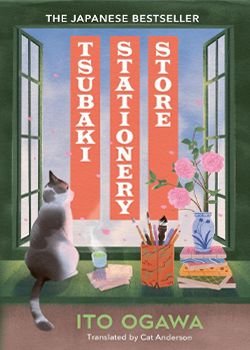
The cover design may suggest a story of a day-to-day in a relaxed atmosphere, and I wouldn’t deny that description, but I feel as though the flow of the events may feel snappier than you’d expect. Without any intent to oversimplify the story, I think there’s a rhythm in which it progresses for the most part; Poppo receives a scribing request, she completes it, she spends time off-work, she receives another request. Each request offers a different challenge and we get to see Poppo’s thought process behind her approach towards completion. It’s by no means fast-moving and certainly doesn’t sacrifice detailed imagery and interiority, but the events are knitted together quite compactly. Coupled with Poppo’s qualities as a narrator, it was harder for me to stop reading this book in each sitting – I’d always want to keep reading.
My favourite parts of this book are the letters, the finished letters that Poppo shows after completing each request and her predecessor’s past letters towards the end. The job of a scribe is explored so profoundly throughout this book. So much consideration goes into the completion of one letter, down to the type of ink and paper it’s executed with. Poppo’s process in embodying the addresser of the letter always feels satisfying and almost magical, considering she lacks a conventional social life – she has no immediate family, no friend group of her age, no romantic pursuits. And yet, Poppo never fails to relate to her customers and the letters she produces prove that. One driving force behind this prowess, perhaps unbeknownst to Poppo, is her ever-debated longing to understand her late predecessor. She doesn’t generally view her predecessor in a positive light, yet she keeps recalling their memories together for one reason or another; sometimes it informs her work, other times she just reminisces. Her predecessor’s letters that she finally gets to see make for a beautiful end to this inner debate that she’s always had, as she finally understands her predecessor’s show of affection and the bittersweet truths behind their situation.
This book is like a nice touch, but everywhere. Slightly contradictory, as ‘a nice touch’ implies that special attention is given to a particular thing that no one would otherwise notice, but this book feels as though that type of attention is given at every turn. Each letter feels so meticulous and personal, like visiting a memory that we never had. One thing that would perhaps play against this book is if the reader has no interest in Japanese culture – there’s a lot of it to read through. Otherwise, it’s a book that rewards pensiveness with vibrant characters and a homely setting.