

A Tiny Speck of Black and then Nothing
By Emily Midorikawa
Manilla Press (2026)
ISBN-13: 978-1-78658-479-3
Review by Isabel Mermagen
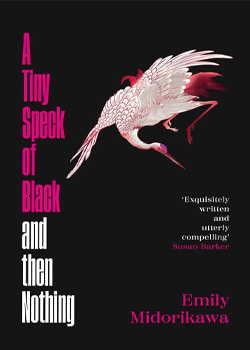
Like Anna, the protagonist of Emily Midorikawa’s debut novel A Tiny Speck of Black and then Nothing, I remember the sense of disorientation and trepidation when I first arrived in Japan for a work placement as a green and callow young woman. My adventures were nowhere near as sinister and eventful as Anna’s, but I had friends who worked as hostesses and who were more familiar with the seedier side of Tokyo nightlife. This novel sets the scene in Osaka, where Anna has arrived to work as an English teacher. Her motivation for coming to Japan seems to be to learn more about her half-Japanese heritage, but there is always the sense that she might also be searching for her mother who we learn fled the family home when Anna was nine years old. The sense of mystery surrounding Anna’s mother’s disappearance is echoed in the Japanese fable that she remembers her mother recounting when she was little, that of The Crane Wife. In the story, a poor and lonely old man comes across a wounded crane. Rather than killing the bird and taking it to market, he decides to nurse it back to health until it flies away. Not long after, a beautiful woman appears at his door and offers to weave fine cloth for him to sell on the condition that he does not watch her weaving. Of course, the inevitable happens and when he spies the woman, transformed into the crane, weaving her feathers into fabric, she takes flight into the sky, ‘gradually fading to a tiny speck of black and then nothing’(p.22).
This theme of disappearance and mystery continues as Anna befriends Loll, an enigmatic British woman working as a hostess at the “Moonglow” bar in Osaka. Loll’s glamour and mysterious comings and goings seem to fascinate Anna and contrast with her own humdrum experience as an English teacher. There are shady clients, a jade stone necklace and hints that Loll may have a self-destructive streak. When Loll finally disappears, Anna takes it upon herself to find out what has happened to her friend, drawing her deeper into a world whose very real dangers she does not fully understand.
There are various motifs that appear in the book alongside the aforementioned crane, and these are illustrated by brief excerpts from fictional publications. These interludes provide a welcome relief from the relentless intrigue with titles such as ‘New Horizons: A Survival Guide for the ‘Gaijin’' (p.7) and ‘Modern Japan: A Guide to Japanese Etiquette and Culture’ (p.35). I wondered if these interludes would help those readers who might be less familiar with Japanese cultural norms, but I think they also serve to allow the main story to zip along without getting bogged down in too much cultural explanation.
Ultimately, Midorikawa’s novel succeeds in depicting a neon-drenched and vibrant Osaka, whose seedier corners seem impenetrable to the brave but naïve Anna. The author also eloquently describes that struggle to find one’s way in a land with unfamiliar customs, transient friendships with other foreigners with whom one often has little in common, and the tension that comes with often being on the “outside”. The story continues at a fair lick, although I found the speed with which Anna and Loll become friends and then flatmates seemed rather rushed. There is also a huge red herring and a somewhat improbable coincidence that solves another mystery, but I love a good thriller and confess the suspense kept me hooked until the very end.