Imperial Animations in Transpacific Contemporary Art
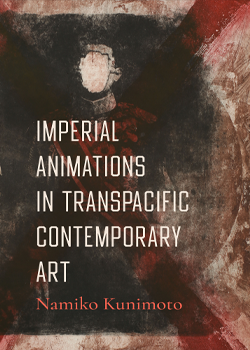
By Kunimoto Namiko
University of California Press (2026)
ISBN-13: 978-0520421592
Review by Laurence Green
What would you do if everything you read in the history books growing up turned out to be incomplete, or perhaps even plain wrong? What if the fairly recent past, still in living memory for some, offered up one narrative of your country - but everywhere you travelled in the world, that narrative seemed at odds with what everyone else seemed to think. What would you do, and how would you know what to believe? Could contemporary art - of all things - help you envision a new way, a different way, of seeing the world. To ask the most difficult questions about your country?
Imperial Animations in Transpacific Contemporary Art explores how the legacy of the Japanese Empire continues to shape the modern world, how after echoes of Japanese colonialism have perhaps never truly died away. Through powerful contemporary artworks from across the Pacific, Kunimoto Namiko reveals how artists confront the enduring trauma of colonialism and expose its influence on everything from Japan's post-war liberalism to the global resurgence of authoritarian and fascist politics.
Central to the book is the idea of animation, not only through digital media and performance - works that are not of the anime/manga world, though feel distinctly adjacent to it - but as a force that brings hidden histories to life, making the structures of empire visible in the present. Linking imperialism to today's digital culture, racial injustice, land struggles, and systemic violence, the book argues that art can challenge inherited power structures and inspire new ways of imagining the future. Reading Kunimoto's book is like opening a door on another version of history - except everything described in these pages actually happened, it's just you were probably only half aware of it. History books become battlegrounds themselves - as has been well documented in Japan’s case, where the treatment of WW2 in school textbooks has often presented circumscribed discussions of Japan’s role in the Pacific arena.
Moving through a series of case studies, running themes emerge, with figures like Abe Shinzo coming under particular fire, as the book touches on links to ultra-conservative groups in Japan such as Nippon Kaigi. Likewise, the Comfort Woman issue dominates the first chapter. The book's focus on the art of Korean duo Kim Seo-kyung and Kim Eun-sung and their work A Statue of Peace is a gripping treatment of the subject, going beyond the typical narratives heard in global news media that remain rooted in the diplomatic and political angle. Familiarity with the topics addressed is useful, not only to allow the reader to dive straight into often thorny issues armed with some foreknowledge, but also to realise how liberatingly fresh Kunimoto’s bold approach is, not only in its bringing together of often disparate disciplines of inquiry, but constantly asking us to see these as questions affecting communities far beyond Japan’s own borders.
Even sacrosanct auteurs like globally revered filmmaker Ozu Yasujiro are not immune from critique - and the book feels like it is asking us to continually challenge any and all preconceptions we might have. How have post war narratives both in and outside Japan changed our views of creators that were actively involved in the production of propaganda? Where do we draw the line around Freedom of Speech in relation to art? The case study of the censorship surrounding the 2019 Aichi Triennale and what happens when well-organised, vocal efforts from far-right groups force organisers to shut down, cancel or close showings of ‘controversial’ works is shocking, but also sadly, not surprising. Elsewhere, there is an odd whimsy and dark humour to the work. Yasuka Goto’s manga-esque drawings trace fascinating trajectories back to both Barefoot Gen, one of the most famed of all depictions of the atomic bombing of Hiroshima, and Fujita Tsuguharu, a celebrated figure in Japan as a pioneer in bringing Japanese aesthetics to Western painting, but also seen - as Kunimoto’s book goes on to detail – as someone deeply involved in WW2 propaganda efforts.
The tone can be strident at times, and its political leanings are made plain, particularly in the epilogue, but it is hard to deny the continual eye-opening exposition packed into just under 140 pages. In this sense, the book is less a piece of history about art, but rather one that uses art as a way in to unpacking legacies and (often disputed) histories of war - and the braveness of this approach is to be applauded. This is firmly an academic treatment, not an art catalogue; the descriptions of the works, as lucid and compelling as they are, can only get you so far. But the case studies included, while obviously only a scratching of the surface of what could potentially have been included, should arguably be seen more as a kind of a curation or provocation, one in which the future outlook is ever-evolving and animating in real-time. Some will be familiar, others new but all are fascinating, and the colour plates in particular will have the reader scrambling down the rabbit hole in search of further work from each of the artists.
Succinct, and never dull, this is a relentlessly ambitious, fiercely intelligent book. Holding nothing back in clinically dissecting key aspects of Japanese imperialism and the legacy of WW2, Imperial Animations in Transpacific Contemporary Art sets a bold new template for what can be done when controversial subjects are approached with an eye for detail, great storytelling and a desire to overturn received narratives. The Japan (and by extension, the world) this book presents is far from a pleasant one, but the line of inquiry put forth here is more vital now than ever before. The past, as this book makes plain, continues to define the future - will we go into it with our eyes open or closed?