

Exhibition - NIGO: From Japan with Love
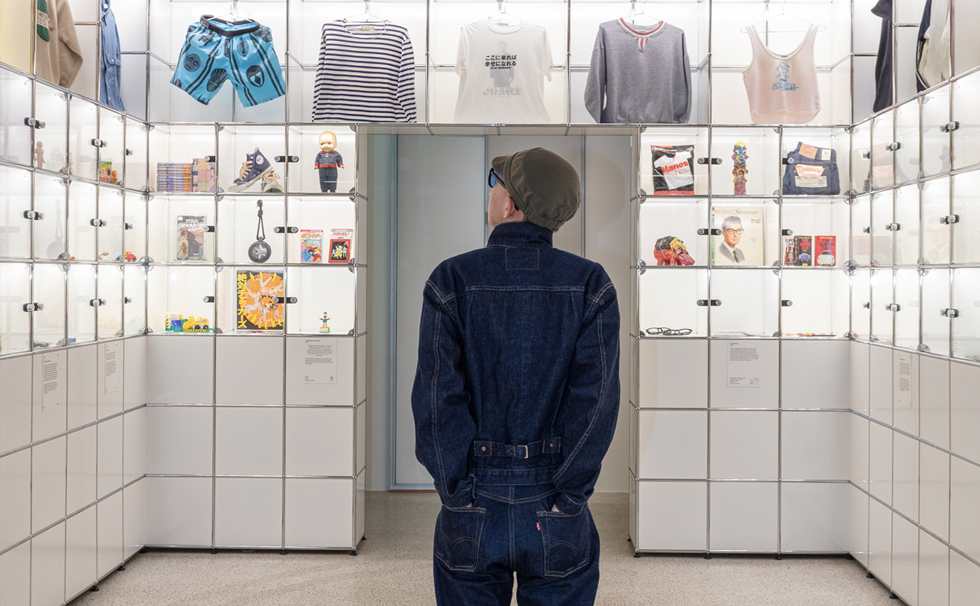
NIGO at the Design Museum. Photo Luke Hayes
at Design Museum
(1 May-4 October 2026)
Review by Arichi Meri
The exhibition NIGO: From Japan with Love, currently on at the Design Museum is the first retrospective outside Japan of this muti-talented Japanese designer. His career began from a small street-fashion shop in the backstreet of Harajuku in Tokyo and within 30 years he became a global trend setter collaborating with luxury brands such as Louis Vuitton and Kenzo Paris. The exhibition was curated by Esme Hawes alongside assistant curators Fiona McKay and Rosa Abbot, and accompanied by a richly illustrated catalogue. 700 iconic items from NIGO’s personal collection of vintage clothing and fashion items he created with friends and international collaborators are displayed in chronological order in the spacious exhibition area.
But who is NIGO?
He was born Nagao Tomoaki in 1970 and studied at Bunka Fashion College in Tokyo. Apart from being a successful fashion designer, his activities stretched to music industry as a disc jockey, rap & hip-hop group member, record producer, and entrepreneur. His multi-faceted creative talent is clear to see in the wide variety of objects in this exhibition.
The exhibition starts with a recreation of NIGO’S bedroom from his teenage years which already shows his fascination with American vintage collectables. The display of small toys and memorabilia in the next room shows NIGO’s attachment to everyday objects which most of us would throw away as adults. Is he a collector? Or a hoader?
NIGO began collecting vintage clothing as teenager, as he was fascinated by American fashion and music of 1950s. One of those items that demonstrates the distinctive American GI fashion is what is termed as sukajan, sobriquet for Yokosuka jumper. GIs stationed in the port of Yokosuka commissioned these American baseball style jackets with Japanese motifs such as Mt Fuji embroidered on the back as souvenir. They became vintage collectable items for their scarcity and unique identity.
In 1993 NIGO founded his first fashion brand A Bathing Ape which came to be called BAPE. The face of an ape on T-shirt was designed by his friend and graphic designer Nakamura Shinichiro inspired by the film The Planet of Apes. It is hard to understand why such strange name and the image became desirable merchandise. It is interesting to note that the secret of NIGO’s success in his early business was the small run of his clothing, the idea of limited edition that created the hype among his followers. A lesson to entrepreneurs?
Another impressive aspect of his career is the development of new ideas born often from collaboration with his friends. By late 1990s, NIGO made connection with the record label Mo’ Wax through his music activities and managed to open A Bathing Ape boutique in London in 2002. The Union Jack neon sign proudly displayed in front of the boutique was the symbol of NIGO’s shift into the international scene.
During the 2000s the rapid expansion of BAPE saw the openings of BAPE Gallery, BAPE Cafe, BAPE Kids, BAPE Cuts (Hair dressing salons) as well as live music events and BAPE Pro-wrestling tours. One of the most interesting developments during this period was the creation of BAPESTA sneakers which embodied the idea of “collectable footwear”. The sneaker was similar to the Nike Air Force 1 but instead of the Nike logo it had a BAPESTA logo.
Amid these frenzied activities NIGO stopped designing for BAPE and collaborated with the American musician and fashion designer Pharrell Williams to launch a new brand Billionaire Boys Club and Ice Cream footwear in 2003. He announced the “death” of BAPE and completely disassociated himself by 2013.
2010 NIGO launched his second fashion brand HUMA MADE which continues the theme of American vintage wear. The Hawaiian aloha shirt with motifs of McDonald’s hamburgers and fries instead of usual flowers was the uniform of McDonald’s employees in Hawaii but it became a cool vintage in NIGO’s eye. This range also revealed NIGO’s awareness of the environmental concerns, and he used figures of endangered animals such as polar bear with the writing of HUMAN MADE to attract attention. HUMAN MADE is still a popular brand selling street fashion all over the world.
By 2021 NIGO took on the role of Artistic Director of Kenzo Paris and started to incorporate elements of traditional Japanese style. The stunning electric blue outfit created for the American rapper Kid Cudi to wear for the Met Gala has a cape lined with Kenzo flower motifs, - a reminiscence to haori men’s jackets with distinctive lining dating back to the Edo period (1615-1868). During the time of strict social class rules enforced by the Tokugawa Shogunate, the sumptuary laws prohibited merchant class wearing expensive silk garments, yet affluent merchants lined their jackets in silk invisibly inside and flashed it in intimate settings.
NIGO’s friendship with Pharrell Williams resulted in Louis Vitton’s men’s wear collection in 2025. There are many references to their friendship in this collection such as the extra-ordinary Louis Vitton Lobster wearable wallett which was inspired by their love of fishing. In one particular fishing trip, they caught a lobster and the design derives from that memory. The bag is certainly a conversation piece but is there a fine line between a luxury unique collectable and kitsch?
The last but not the least, the exhibition concludes with a stunning life size glass tea house made especially for the exhibition with 25 tea bowls displayed inside. In his 50s NIGO has rediscovered the sophisticated simplicity of the traditional Japanese aesthetics in tea ceremony, and rustic beauty of local ceramics. He travelled around Japan visiting different kiln sites and studied the variety of regional styles. The calmness of this section is totally unexpected after the concentration of vibrant colours and the buzzing mood of the previous rooms. 25 handmade tea bowls in monochrome hues displayed in the tea house convey his insatiable appetite for new knowledge. Is this the ultimate destination he reached In his life? Or what next?
The chronological structure of the exhibition works well to guide even a complete novice of street fashion to realize the reputation of NIGO in the niche market, and unexpected aspects of this exhibition present a visually absorbing experience of discovering the incredible diversity of NIGO’s activities.