

Sympathy Tower Tokyo
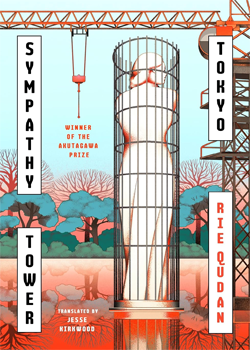
By Qudan Rie
Translated by Jesse Kirkwood
Viking, Penguin (2025)
ISBN-13: 978-1405972062
Review by Rio Julian
Sara Machina was an exceptional architect who took on the conception of a grand tower in futuristic Tokyo, ‘Sympathy Tower Tokyo’. Not only was it going to bear as much physical significance to Tokyo as the Eiffel Tower to Paris, but its groundbreaking function was also to be considered: it would provide ideal living conditions to the ‘Homo Miserabilis’. Homo Miserabilis was a term coined in this AI-censored era to refer to people who had committed a crime, proposed by a happiness scholar to value those who had no option but to go down that path. As a victim of rape, Sara was in two minds about the idea of letting this tower be built. She was given the responsibility for making it happen, yet she herself was never on board with it – more specifically, she had never been on board with the changing of language by humans’ ever-changing emotive responses towards words and their meanings. Sympathy Tower Tokyo would be the culmination of that very phenomenon and Sara Machina found herself drawing its path towards existence, moral qualms notwithstanding.
Before examining the text, there is admittedly some unfortunate extratextual housekeeping to deal with. This book drew quite a bit of controversy, with the author Qudan Rie’s admission to using AI in the writing of the text. Questions were justifiably raised about the ethicality of Qudan’s creative process, as the AI workflow would have constituted the taking of people’s posted work as datasets that the AI model would draw from. In the interest of treating the book fairly and avoiding preconceived notions, I avoided researching the controversy despite being aware of it during my reading period. Post-reading, I personally found that two things were valid: that Qudan’s AI-incorporative approach was unbecoming, and that the public reception was slightly off-target. Qudan’s use of AI-generated text within the book is in the form of chatbot answers à la ChatGPT, which she could very easily have written herself and yet decided against. Moreover, Qudan wasn’t at all reserved in sharing her relationship with AI as a creative, as she mentioned making ‘full use’ of the LLM bot to conceive the story and claiming that it amounted to 5% of the text. For reasons mentioned, my personal worldview deems this approach ignorant at best and enabling at worst. Although, with that considered, the AI text included in the book effectively carries little weight within the narrative. The narrative itself frames an AI-dependent society negatively, which wouldn’t be expected if this book were the pro-AI narrative like the headlines might have led the public to believe. Thus, I see it as being understandable for the public not to engage with this book as to steer clear from enabling AI into creative spaces, but I maintain that this book offers more than a gimmicky narrative with a written-by-AI novelty.
With that addressed, I’d like to establish the focus of my reading of the text. This book undoubtedly has value in an international context, seeing as it received an English translation from one of the biggest publishing houses. Presumably though, with the book’s probing of the changes in the Japanese language and how the masses are portrayed in the eye of a changing society, this book may well offer a comprehensive commentary on the Japanese society. This, I’d like to assert as a person who has no lived experiences of the Japanese society, is not within my scope in this review. I will instead be concerned about the setting, themes and narrators.
Although the narrative is set in a futuristic Tokyo, Qudan focuses on stretching the reality of an AI-dependent world rather than painting a high-tech imagery of the city. In this setting, seemingly every person has a language-monitoring unit installed in the brain, interjecting each person’s speech in order to bend it the way the AI deems societally acceptable. The use of an AI chatbot (referred to in this world as ‘AI-built’) is also constant – not that this is a futuristic phenomenon anymore. People born into this status quo are hence seemingly less experimental with their imagination and more attuned to the vocabulary censorship, veering them towards physicalism and a world where language has been bastardised in the name of sympathy. Though I’d have liked to see more of the lived experiences of those actively opposing the tower and how this AI dependency affects them, Qudan manages to sell the plausibility of this reality satisfactorily given how compact and character-focused the narrative is.
Thematically, I see the narrative’s questioning on ethics as discussion-inducing and not solution-proposing. Qudan sheds light on society’s ever-changing relationship with words and meanings, supercharged in the setting of AI censorship and global interconnectedness. People are more alarmed than ever to possibly offend others by the use of language in order to conserve their livelihoods, slowly erasing any hope ‘that words are ever going to help us truly understand each other’ (p. 123). With this performative sympathy strongarmed by AI censoring, Qudan questions the ethics of compliance through Sara, a victim that feels helpless against but is marginally capable of raging against the status quo. I find this very engaging and relatable, painfully illuminating by framing it within a narrative, but also unfortunately slightly ironic given Qudan’s stance on AI in creative spaces.
A shoulder brush of sorts to Sara Machina’s noncommittal ethos comes in the form Max Klein, an American ‘third-rate journalist who lacks the difficult but necessary skill of writing the truth without hurting people’s feelings’ (p. 84). Qudan provides a narrator with a disconnect from the reality of the futuristic Tokyo, comedically attached with a stereotypical East Asia fetishist identity of a white American male: superficial Japanese fascination, sex tourist, repulsive odour. Max Klein’s straightforward disposition directly collides with the so-called Japanese avoidance of individuality – how the Japanese never confuse ‘how they actually feel with what they’re required to say’ (p. 97). With that said though, Max does not actually challenge Sara’s ethos behind the conceiving of the tower – rather, he challenges Sara’s regret in taking part. I personally found this to be a missed opportunity for an interesting conversation as neither Sara nor Max bought into the tower’s concept for their own reasons, yet Max only got to meet what was left of Sara after the tower had been built. Max’s outsider perspective and brash personality could’ve played a bigger role than simply echoing Sara’s exact words in an article, I feel.
The centrepiece of the narrative is carried by the main and most interesting narrator, Sara Machina. Qudan centres on a direct victim of language’s inadequacy and society’s compliance, as Sara was a victim of rape whose words weren’t capable of bringing about justice to her rapist. Her position clashed with the happiness scholar’s Sympathy Tower idea, where criminals like her rapist would be provided with ideal lives. She found herself ‘repelled by the incursion of the Sympathy Tower’ (p. 3), and yet her passion for structures and workmanship that she boiled down to ‘her desire for control’ (p. 53) made it a given that the tower was inevitable. Sara continuously wrestled with her ethos and desired any justification for its existence, eventually landing on Takt’s naming suggestion of ‘Tokyo-to Dojo-to’. To her, the name essentially cleansed herself of any association with what ‘Sympathy Tower Tokyo’ represented, though it ultimately didn’t stop the masses from reacting to the tower however they pleased. Through Sara’s moral qualms as the architect, Qudan thoroughly verbalises the feeling of helplessness from the idea that being understood is only possible insofar as meaning remains stagnant. Qudan perceptively shows that language will always be inadequate to foster mutual understanding, but it’s also the very and only thing on which society bases its functionality and defines its parameters of acceptability and punishment.
A short book that, for reasons good and bad, feels to me longer than it is. It’s bulky on ethical questions regarding language in relation to compliance and punishment, yet its narrators aren’t captivating enough for me not to drop this book a few times despite its length. Coupled with tangential speeches and Qudan’s AI use, I suggest engaging this book primarily for its intriguing subject matter.