The Frozen Sun
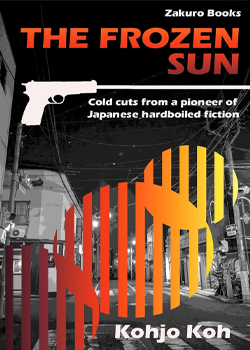
By Kohjo Koh
Translated by Alexis Brown
Zakuro Books (2026)
ISBN-13: 978-1066682706
Review by Irina Karpukova
Before hardboiled fiction had established itself as a distinct tradition in Japan, a second-year student at Tohoku University in post-war Sendai was already attempting to write it. Kohjo Koh’s ‘Near X Bridge’ placed first in a 1955 competition run by the mystery magazine Hoseki and drew praise from Edogawa Ranpo. Yet Kohjo Koh -born Nyui Yoichi in Hakodate in 1935 - did not simply reproduce an American detective formula in Japanese dress. The ten stories gathered in The Frozen Sun show him discovering what the hardboiled method could reveal about Japan itself: its ruined cities, port economies, night districts, provincial power structures and people struggling at the edges of legality and survival.
Kohjo studied English literature at Tohoku University, wrote his graduation thesis on Ernest Hemingway and read Dashiell Hammett and other American hardboiled writers in English-language paperbacks obtained through his father and Sendai’s second-hand bookshops. He also practised fencing while at university and, after graduating in 1957, joined the Hokkaido Shimbun, with his first posting in Kushiro. These experiences became part of the geography and physical vocabulary of his fiction. His fencing background gives ‘The Bet’ its technical confidence; his years in eastern Hokkaido supplied much of the observed geography and social detail of the fiction - fog, fishing boats, port nightlife and local violence. In later interviews, Kohjo described hardboiled writing less as a set of genre fixtures than as a matter of style and vision: concise, resistant to explanation, driven by verbs and focused on external action. This emphasis shifts the centre of gravity away from the puzzle-centred priorities of honkaku mystery. His question is rarely only who committed a crime, but how a body moves, hesitates or breaks under pressure.
The Frozen Sun is a newly configured English selection rather than a direct translation of Kohjo Koh’s 2008 Japanese volume. Its arrangement is revealing. The first five stories are independent works that map different social environments; the final five centre on Shiga Yuri, bringing the earlier Yuri stories together with ‘Drawing a Cross in the Sand’, newly written for this English collection. The first half is broadly chronological, while the final section is organised around Yuri rather than strict publication order. The first half maps a society; the second follows a woman, while the geographical field gradually expands from Sendai and Hokkaido beyond Japan, towards India and the Basque Country.
The early stories demonstrate how flexible Kohjo’s understanding of hardboiled fiction already was. ‘Near X Bridge’ sends a student through the damaged underside of post-war Sendai in search of a hospital companion’s sister. ‘Cold Rain’ comes closest to the recognisable private-eye story, though its investigator is a markedly less empowered figure than many of his American counterparts. ‘To the Lone Prairie’ turns eastern Hokkaido into a Japanese frontier, not by reproducing the familiar iconography of the American West, but through ports, suspicious shipwrecks, dangerous local interests and an immense landscape capable of swallowing a man. In ‘La Cucaracha’, American influence is no longer merely literary: it is embodied in the unequal relationship between a drug-dependent Japanese woman and an American serviceman, within the social and economic asymmetries of the Occupation.
‘Inferno’ is more radical. There is scarcely a detective plot at all; it has, in effect, a collective protagonist: a group of delinquent boys trapped inside a cinema surrounded by police. Character emerges collectively through movement, bravado and fear. As the boys prepare to turn the screening into cover for their escape, ‘Things are hotting up. That bedroom scene’s the perfect cover’ (p. 33). The phrase turns brutally literal as manufactured heat on the screen gives way to real fire, panic and a crush of bodies. The cinema, designed to contain fictional violence, becomes the instrument of actual chaos.
This movement between heat and cold forms a kind of thermal dramaturgy across the collection. Flame gives way to cold rain, summer heat to snow and ice, and later to the dust and glare of India. Weather is never detachable scenery. Rain becomes needles in the light; fog erases distance; ice controls the speed and danger of pursuit. Kohjo does not usually tell us that a character feels isolated or terrified. He supplies the physical conditions of isolation and terror. His landscapes are sensorial without becoming ornamental: a wooden footfall, the slight lift at the corners of the lips in a smile, a pale face reflecting flames or a road briefly constructed by headlights can carry the emotional work that another writer might assign to a paragraph of explanation.
‘The Bet’ brings this method to its most moving concentration. During a fencing match, Akiyama suffers the injury that will shape the lives of Okada Kenichi and Shiga Yuri. While he is being taken to hospital, he asks what lies beyond the window: ‘“Okada…” Akiyama said again. “What do you see?” “Tanabata,” Okada said, not turning from the window this time. “How is it?” “Dirty and covered in dust. It’s the last day of the festival after all”’ (p. 143). Nothing is explained. The festival continues outside the ambulance, visible but already beyond Akiyama’s reach. The omission may be Hemingwayan, but the seasonal and emotional charge belongs unmistakably to Sendai.
Yuri subsequently becomes the collection’s most compelling continuity. Beautiful, elegant and persistently unreadable, she is introduced as the enigmatic centre of a university tragedy, then reappears amid cinematic publicity, blackmail, international crime and political undergrounds. In ‘The Frozen Sun’, Kohjo writes: ‘A hazy orb shone in one corner. The afternoon sun, frozen in the sky, as cold as the moon’ (p. 154). Yuri herself can be read as another frozen sun: luminous enough to command every scene, yet withholding warmth. This should not reduce her to a conventional femme fatale. Across the sequence she acquires increasing agency, moving from the enigmatic centre of other people’s actions to increasingly elaborate criminal and political action of her own. Yet she remains largely mediated through the men who remember, desire or survive her, a perspective that preserves her opacity even as her agency expands.
The widening geography of the later stories gives the collection a new imaginative scale. ‘Father and Sons’, built around the legendary suitcase containing Hemingway’s lost manuscripts, turns literary inheritance into contraband and allows Kohjo, who wrote his graduation thesis on Hemingway, to treat a major literary forebear with both homage and irony. ‘Drawing a Cross in the Sand’ relocates Yuri to India, weaving stepwells, local customs and desert history into a criminal plot that gradually gathers momentum. ‘Distant Days in a Far Off Land’, Kohjo’s first new short story in thirty-seven years, offers a retrospective coda to Yuri’s life through the memory of a Japanese doctor and the history of Basque resistance under Franco. If Sendai and Hokkaido draw their force from places Kohjo knew at first hand, the later international settings show his fiction moving outward into a broader historical and geographical imagination. They also reveal the extraordinary distance travelled by a character first created in 1958.
Alexis Brown’s translation preserves the verb-driven energy that Kohjo regarded as central to hardboiled prose. His English sustains a broad and active vocabulary of movement, impact, bodily reaction and shifts in position, preventing laconic prose from becoming monotonous. Brown, whose other translations include work by Edogawa Ranpo and Sakaguchi Ango, is particularly well suited to introducing this formative chapter of Japanese hardboiled fiction to English-language readers. He also tends to favour immediately legible English for references to material culture, keeping explanatory intervention unobtrusive and the narrative moving. The resulting momentum is an appropriate fit for a writer who himself compared hardboiled prose to boxing, likening his ideal style to a boxer keeping an opponent against the ropes.
Taken together, these stories reveal not an imitation of American hardboiled but an early Japanese reworking of its methods. Across Sendai, Hokkaido and the later international settings, Kohjo Koh makes compression, external action and omission responsive to particular landscapes, social pressures and historical memories. The Frozen Sun therefore matters not only for its place in the history of the genre, but for the vitality with which these experiments still read today. In Alexis Brown’s translation, Kohjo’s fiction reaches English-language readers not simply as a newly accessible chapter of literary history, but as prose that remains immediate, mobile and alive.