Hiroshima, 8:15
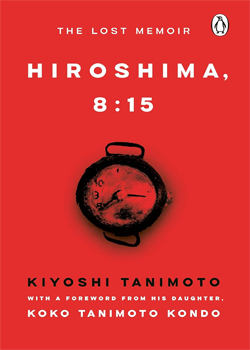
By Tanimoto Kiyoshi
Ebury Press (2026)
ISBN-13: 978-1529992731
Review by Isabel Mermagen
In 1947, whilst the details were still fresh in his mind, Methodist minister Tanimoto Kiyoshi carefully wrote down, in English, all that he had seen on that fateful August day in 1945 when the United States dropped the first atomic bomb on Hiroshima. The book starts with an introduction by his daughter, Kondo Tanimoto Koko, herself a survivor of the bomb (hibakusha) and a renowned peace activist in her own right: ‘Nearly eighty years have passed since it was written, but it remains as powerful and as urgent today as it was then’ (p. x). This manuscript was lost until its discovery four years ago in Yale’s rare book and manuscript library by the grandson of John Hersey, the author of the famous New Yorker article entitled ‘Hiroshima’, in which Hersey had interviewed six survivors of the blast, among them Tanimoto. As the numbers of the hibakusha and their testimonies dwindle, this book serves as a visceral reminder of the horrifying impact of the use of nuclear weapons.
Perhaps because it is written in English, rather than Japanese, Tanimoto’s eyewitness account of the immediate aftermath of the atomic bomb dropped on Hiroshima is written in a simple and matter-of-fact style that merely strengthens the impact of its description of unimaginable devastation and suffering. Thirty-six year-old Tanimoto Kiyoshi was helping a neighbour move some possessions in the outskirts of the city on the 6th August 1945 when at 8:15 am an atomic bomb was detonated in the sky above Hiroshima. From his location over two miles from the epicentre, Tanimoto describes seeing a sharp flash of light and felt ‘a strong blast of wind’ (p. 6). Despite being uninjured himself, Tanimoto soon comes across more and more people with terrible injuries and more houses on fire or with extensive damage. Tanimoto expresses his bewilderment at how an air raid could have wreaked so much devastation: ‘Until then, Hiroshima had been bombed twice by enemy aircraft but only on a small scale. When bombs had been dropped, there had been much loud noise from the aircraft. However, only ten people were killed at that time. But many people had been injured in this bombing and yet there had been no great waves of bombers’ (p. 8). Questioning his own senses, Tanimoto seeks a vantage point to look out over the city to see the extent of the devastation: ‘I was terribly afraid. It was then that black drops of rain, as big as blackberries, began to fall’ (p. 8). Fearing for his family and for his church, Tanimoto heads back into the city, passing on his way an endless procession of injured people heading to the hillsides from where he has just come. He describes the strangeness of seeing so many without clothes and the burns on parts of their bodies that had not been protected by caps or clothing: ‘All faces were pale and without expression. No one was crying or yelling. People were following one after another in silence. It seemed like a procession of ghosts’ (p. 10). Tanimoto miraculously is reunited with his wife and child but the reunion, incredibly, does not bring him any joy. Rather, he feels indignant that a church member calling on his parsonage should be killed, whilst he and his family are spared. Thus follows Tanimoto’s quest to find and help as many of his church members amidst the carnage of the wrecked city.
Whilst the relentless horrors that Tanimoto encounters in the immediate aftermath of the bombing are shocking, they are described in a dispassionate manner, reflecting the basic need to rescue or help as many survivors as possible. Tragically, many of those who are initially rescued subsequently died of their wounds or even later succumbed to radiation sickness. Even the author suffers from ‘The Atomic Disease’ but survives. Tanimoto’s quest evolves as his account continues, and his focus later turns to finding information on his church members and holding his first religious service to the eventual seeking of funds and materials for the reconstruction of his church. Amidst all the suffering, he notes that no-one expresses resentment towards the Americans who had dropped the bomb. His description of Emperor Hirohito’s radio address to the nation in which he announced Japan’s surrender on the 15th August, meanwhile, deals a body blow to the population. Tanimoto writes: ‘The Emperor’s broadcast had crushed our fighting spirit much more than the atomic bomb’ (p. 66).
Tanimoto’s Christian faith never waivers and he even comes to see Hiroshima’s suffering as divine retribution for Japan’s role in numerous military aggressions during the war, including atrocities committed in Nanking and Manila: ‘We were not only unable to stop this aggressive war – had we not also approved of it? The terrible disaster inflicted upon our fellow countrymen on August 6 was a heavy blow that we well deserved’ (p. 144).
As we accompany Tanimoto on his journey from the ruins and see the horrors through his eyes, we also witness how this deeply Christian man evolves into one of the key advocates for the anti-nuclear movement in Japan and see his determination that the world should never forget what happened on that fateful day. Tanimoto died in 1986 at the age of seventy-seven. Hiroshima 8:15 is a worthy legacy and reminds us that whilst fewer hibakusha remain to share their experience, the taboo of using nuclear weapons must not fade with them.