Japanese Spy Gear & Special Weapons
By Stephen C. Mercado
Pen & Sword Military (2025)
ISBN-13: 978-1036107987
Review by David Rodenko
In May 1950, Iwase Kiyoshi received a letter offering a well-paid job. It came from his wartime superior, Yamamoto Kenzo, who had headed the Noborito Institute’s counterfeiting section. The job took Iwase to Yokosuka, where his work included making false documents for American covert operations (pp. 101-104). That change in Iwase’s employment raises one of the most interesting questions that the book offers. What became of the knowledge and people the Imperial Japanese Army (IJA) employed in its clandestine war?
Readers of Mercado’s The Shadow Warriors of Nakano would likely already be familiar with American recruitment of former IJA workers (2002, pp. 223-227). Japanese-language readers could also access studies and memoirs on Noborito. Among them were Saito Michinori’s Boryakusen (1987), Ban Shigeo’s Rikugun Noborito Kenkyujo no shinjitsu (2001), and Rikugun Noborito Kenkyujo ‘himitsusen’ no sekai (2012), edited by Yamada Akira and Meiji University’s Noborito Museum. Japanese scholarship has also looked at veteran recruitment by the Americans. For example, Tsukamoto Yuriko’s work on former Noborito personnel’s postwar lives includes the American employment of former Second and Third Section personnel at the Government Printing Supplies Office (GPSO), a forgery workshop in Yokosuka. Mercado draws on such research, American archives, and the accounts of Japanese veterans to narrate the history of the Noborito Institute. This includes its wartime activities, the various paths its personnel took after 1945, from American service to careers in Japanese industry, and the memory of Noborito.
The first six chapters cover Noborito’s origins, wartime projects, and the destruction of evidence in 1945. In 1942, Noborito was renamed the 9th Army Technical Research Institute (ATRI) (p. vii). It was developing equipment and training Japanese units in its use (pp. 4-5, 12). One example of their work was the microwave ‘death ray’ project, which absorbed resources but never overcame the power and range problems (pp. 23-28, 96). By contrast, the balloon-bomb project saw operational use. In March 1945, one reached the United States, and interrupted operations at Hanford’s reactors for a short time (p. 53). Another killed Mrs Mitchell and five children in Oregon (p. 78). Another project involved testing poison on prisoners in China (pp. 32-33).
The most compelling pages concern counterfeiting. Oshima Yasuhiro’s recollection shows the risk of carrying false documents. Once a forgery was discovered, it could cost the bearer his life (p. 67). Shorindo, the Canton branch of the IJA’s Matsu Agency, used forged Nationalist Chinese banknotes to purchase gold, tungsten, petrol, and petroleum (pp. 62-64). The book shows the purchases financed with counterfeit money and the plans to provoke inflation (p. 56); however, their broader effect on China’s currency remains unclear.
As the war approached its end, Noborito moved personnel and equipment within Japan to conduct its wartime work (pp. 70-72). Mercado also documents the destruction of incriminating evidence (pp. 81-82). Ross Coen’s Fu-go (2014) recounted postwar denials of plans concerning biological payloads in ATRI’s balloon bombs. According to Coen, the Compton report found no ground to disbelieve them (pp. 191-193). Mercado questions those denials (pp. 94-95). He quoted Kusaba Sueki’s recollection of biological-payload research which was directed against ‘animals and plants’, and an order not to use such payloads (p. 53). That account does not establish the actual use in balloon attacks. Separately, Mercado uses the sequence of entries in a 1945 destruction order to cautiously suggest the possible development of such payloads against people (pp. 81-82).
The following three chapters trace Noborito’s personnel through the occupation and their later careers. Mercado explains the move into, and terms of, American employment. For example, in 1948, American officers offered paid cooperation to Yamamoto, along with protection against his prosecution for war crimes if demanded by the Soviets or the Chinese (pp. 101-102). His case fits a pattern, where former officers obtained protection from the Americans, as described by Richard J. Samuels in Special Duty (2019, pp. 81-85).
Former associations were carried over to the GPSO. Paper, fibers, and ink were analysed by Okada Masayuki. Iwase copied the North Korean military notebooks. Ban Shigeo turned to the recruitment of veterans who were skilled in photography and secret writing (pp. 103, 107-108). Mercado connects their particular skills to later employment by using veteran accounts and Japanese research, including Tsukamoto's (pp. 153, 155). He describes the Second Section veterans’ likely operational contribution in conditional terms (p. 108). Mercado notes that, to his knowledge, no US records concerning the postwar projects with Noborito veterans had been released (p. viii).
Noborito’s relationships also carried over into civilian life. For example, Ito Kakutaro, who had overseen paper development in the Third Section, helped Oshima, his former subordinate, find work at the Meiwa Printing Company (p. 116). Walter E. Grunden, in Secret Weapons and World War II (2005, pp. 203–204), also follows wartime engineers into postwar railways and electronics. Mercado’s work places Noborito within this pattern of wartime expertise finding civilian uses. For example, Okabe Kinjiro, a microwave ray project consultant, later helped develop microwave ovens (pp. 21-22, 117). The book also shows hardship and, for some, dread of exposure (pp. 120-122).
The book follows the personnel beyond their technical work. Compared with the account of American recruitment in The Shadow Warriors of Nakano (2002, pp. 223-227), this book adds details of everyday life in San Bruno. Mercado describes government-rented flats and journeys to work by military bus. The reader will find that the Japanese could ‘mingle’ with Americans living nearby, although discussion of their work remained forbidden (p. 109).
The final chapter investigates the recovery of Noborito’s history and campaigns to preserve surviving buildings and establish Noborito’s museum. Nevertheless, public commemoration was present alongside continued silence about parts of the past. For example, an early draft of Ban’s memoir had included an account of his 1948 encounter with American intelligence. However, it was later removed (p. 126). Thanks to commemoration, some finally expressed relief at no longer having to remain silent (pp. 126-129).
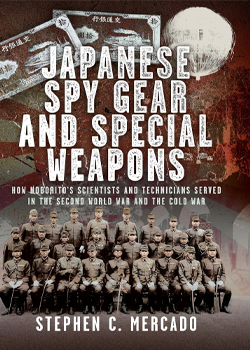
The book’s cover reflects Mercado's focus on both people and their work. One can see banknotes, a balloon, a wartime group photograph, and a Rising Sun Flag in the background. Inside the book, the eight-page plate section expands the study through photographs. Mercado’s own shots are particularly useful. Two photographs taken in 1995 show two Noborito buildings that were later demolished and therefore preserve a view of the institute’s physical setting. An archival site plan and a drawing relating to the ‘death ray’ project (p. 98) complement the pictures.
Overall, Mercado had outlined Noborito's history in his 2004 article ‘The Japanese Army’s Noborito Research Institute’. According to the author, the current book is the first in English devoted to the institute (p. viii). For English-language readers of Japanese military and intelligence history, this is a useful synthesis. It connects Noborito’s wartime projects, its personnel’s postwar careers, and the recovery of the institute’s history. Nonetheless, as Mercado writes, ‘much about Noborito remains in the shadows’ (p. viii). Consequently, the book lays a foundation for future research on this subject.