

This Little World: A New History of Tudor and Stuart England
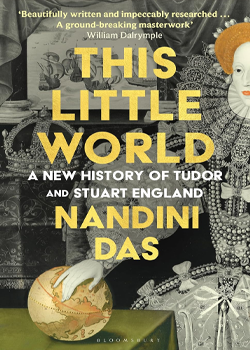
By Nandini Das
Bloomsbury Publishing (2026)
ISBN-13: 978-1526669650
Review by Thomas Lockley
I originally set aside three weeks of my summer to read This Little World: A New History of Tudor and Stuart England by Professor Nandini Das of Exeter College, Oxford. Instead, I finished it in three days. I simply could not put it down.
Having read countless books about the Tudor age and the early Stuart era, I must confess that I approached yet another “new history” of this heavily saturated period with a dose of misgiving. However, because I have always enjoyed Das' work, I readily accepted the invitation to review it.
Perhaps my initial hesitation was why I allocated so much time to it, but I need not have worried. Das approaches her topic in a uniquely refreshing way. Each chapter centers on two main protagonists, few of them aristocrats or royalty, and each with a fascinating tale to tell. Around them, Das reveals a host of related figures whose lives and experiences brilliantly illustrate the chapter's core themes. These themes explore, among other things, concepts of freedom, belonging, alienation, and, in essence, what it truly meant to be English at that time. Every chapter draws the reader in with historical episodes that ring with academic rigor while showcasing the craft of a master storyteller. Rarely does a history book achieve both feats as seamlessly as this one does. Reading it today as a London-born “Jappaner”, I felt these themes deeply.
Chapter 3, which focuses on language, illustrates how anyone pretending to have any kind of sophistication or scholarship at the time possessed at least a handful of foreign languages, alongside Latin. It left me wondering: how did the English lose this multilingual vigor? Did later imperial dominance, and the global linguistic authority that came with it, ultimately diminish the nation's intellectual breadth? A country that loses its foreign language ability loses the crucial capacity to view the world from different lights, angles, and perspectives. The Elizabethans possessed this facility; yet the modern nation may have lost it, as foreign languages and related skills such as interpreting are systematically cut from university and school curriculums. We would do well to reflect on a quote highlighted by Das: English was a ‘language that will do you good in England, but past Dover is worth nothing’ (John Florio, cited in Das, 2026, p. 108).
However, it is Chapter 6, ‘A Fortune at Sea’, which will most intrigue readers of this review, as its focus shifts largely to Asia and, more particularly, Japan. Das chooses as one of her main characters the navigator, castaway, and minor Japanese lord, William Adams, likely the first English-born person to set foot on the Japanese archipelago, so far from the islands of his birth.
Through warm and vivid prose, the chapter reflects upon belonging, alienation, adaptation, and the manipulation of circumstances through violence. Das masterfully examines how Adams’ life reshaped Englishness, and broader contemporary ideas of national identity, through global, and specifically Japanese, interactions.
Ultimately, Das' narrative demonstrates that the lives of mariners like Adams dismantle the oft-told myth of England as an inherently insular, inward-looking nation. Instead, she proves that Tudor and Stuart culture, economy, technology, and governance relied heavily on porous borders and cross-cultural encounters to breed innovation and vitality.
Readers might also reflect on how Adams' story simultaneously disproves the equally infamous belief that Tokugawa Japan was a completely “locked” realm. In reality, Tokugawa Ieyasu was just as open to foreign peoples, counsel, technology, and ideas as Elizabeth I and James I were. Ironically, neither England nor Japan extended this liberality to the Catholic Church or Jesuit missionaries; both nations persecuted Catholic citizens and priests relentlessly.
A book review is supposed to include something that you would like to see done better in a second edition (I hope there will be one), and in this case that is the maps at the beginning of the book. They show the protagonists' travels in England, Europe, and the world, but for some reason the routes are presented as straight lines on the maps, not as the winding voyages or progresses that they were in real life. For example, Adams' travels go in a straight line from Morocco (where he traded in early life before being washed up in what is now Oita Prefecture) to Japan, crossing through North Africa, the Middle East, Persia, the Himalayas and China. In real life, Adams voyaged to the bottom of the Atlantic Ocean before traversing the Strait of Magellan and then sailing across the Pacific Ocean. It would be nice to be able to reflect on his real route.
Leaving the last paragraph aside, This Little World deserves a wide readership and would make an ideal Christmas present for anyone captivated by global history, and ideas of nationality. I heartily recommend it.