

Sisters in Yellow
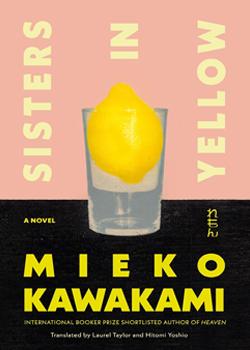
By Kawakami Mieko
Translated by Laurel Taylor and Yoshio Hitomi
Picador (2026)
ISBN-13: 978-1035024131
Review by Laurence Green
This might just be Kawakami's best book yet. An epic running to nearly 600 pages in the Japanese original, it's full to the brim with the stuff of life. Kawakami has always done social realism so very very well, it's her bread and butter. But whereas previous books like Heaven and Breasts & Eggs paired that social realism with a decidedly quirky, whimsy touch, Sisters in Yellow feels like a straight shot of hard-edged impact, often feeling more like a crime thriller at times. This thrill-ride lean toward a tale that takes in criminality as part of a wider-sweeping look at working class life in Japan - a rare, and often overlooked aspect of urban life there - is all the more compelling because its central character is nuanced in a way that their actions, as painful as they can be at times, are always understandable.
Our protagonist is fifteen-year-old Hana; she’s full of hope, but has little else going for her in her life, that is, until Kimiko bursts into her life like a spark of flame, lighting the touchpaper on a journey that seems to offer a way out of the grinding poverty of her upbringing. Together they build Lemon, a rundown bar that becomes Hana’s first taste of belonging, friendship, and easy money. For the first time, she feels normal. Untouchable. She even manages to make friends her own age. But in the shadowy alleys on the edge of central Tokyo, dreams don’t come for free, and Hana’s newfound world will test her courage, loyalty, and sheer ability to survive to the absolute breaking point.
What follows is a dizzying, but utterly believable spin into the murky depths that exist on the periphery of the Japanese underworld, criminality in its most sinister form - the kind that rubs shoulders daily with normal people, whilst on the face of it seeming completely “victimless”. It’s the world of pyramid schemes, gambling, credit card fraud and countless other kinds of money-movement that grips the characters of the novel tight in a web that seems to only stick harder the more they struggle. Money lies at the centre of it all, accumulating, piling up (never in bank accounts, always seemingly stuffed in a box at the back of a cupboard), a world where backstabbing and betrayal seems only a turn away. And always, always, the threat of discovery, an end to everything Hana has strived for.
Sisters in Yellow bites deep into the seemingly perfect mirror of Japanese modernity and reflects back an ugly truth; it’s not so perfect for everyone. Single mothers, ethnic minorities, the working classes, women in general - all have their trials and tribulations, all fight against the behemoth that is the social norm of what society says is correct and true. Hana fights hard to build her own version of the truth amid this, her own ‘sisterhood’ on her terms, but the world is primed and ready to fight back. Kawakami juggles the pacing with precision tooled dexterity - you want Hana to succeed, even though you - as the reader - know what she is doing is resolutely illegal. A void opens up in you when her money is stolen, and you feel every backbreaking hour of the labour she puts into the assorted jobs she works - both legal and less-so.
The minutiae of life are observed with laser-like focus; the hum and pulse of the urban environment written out in the fabric of dive bars and little alleyways that feels like photo snapshots from a guidebook to all the places only locals would know. Kawakami takes it all in - her writing acting like a camera lens; crisp, clinical, yet imbued with an inner passion. There are new translators on board for this book too, in the form of Laurel Taylor and Hitomi Yoshio. It's an inspired switch up, and addresses the chief criticism that surrounded Kawakami's previous English language releases - handled by two male translators - which many readers felt to be an odd choice, considering the powerful feminist tone of Kawakami's work. Sisters in Yellow (originally released back in 2023 in Japan) feels as alive in English as it does in Japanese - the language, like the content, feels vibrant, unfiltered and unafraid to tackle the rough and ready lives of these working class characters.
Playing out as the epitome of that just one more page drive that compels you to keep going from beginning to end, the sense of tension in Hana’s story never lets up, and you ultimately grow to love these characters, as faulted and frustrating as they are. The book ends with a sense of deep sadness, but paired with a weird kind of hope - ultimately, the message is a simple one, the utter messiness of humanity and our clumsy attempts to make some kind of order that is the chaos of modern life. Life is hard, but we have to live it, all the same.