

Encounters with Kazuo Shinohara's Umbrella House
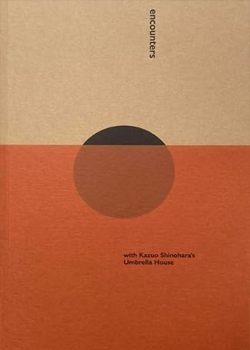
By Michaela Nettell et al.
Passengers (2026)
ISBN-13: 978-1739914127
Review by Andrew Nishiyama Taylor
Encounters with Kazuo Shinohara's Umbrella House documents a research project by London-based artist filmmaker Michaela Nettell, bringing together contemporary responses specially commissioned from 20 international contributors on the mid-century titular building. Understanding why this particular building provides a platform for the rich artistic output that the book collates requires some context.
Umbrella House, designed by the Japanese architect Shinohara Kazuo (1925-2006), was built in Nerima, Tokyo in 1961 for a telecommunications company worker, his wife and their young daughter. Measuring just 55 square meters, the design of the house, with its simple square plan topped with a large pyramidal roof, was inspired by a visit Shinohara made to Jodo-ji, a temple in Ono, Hyogo prefecture, dating from the 12th century, and typified the first phase of his career which abstracted traditional Japanese architecture into modern dwellings.
Faced with demolition in Tokyo, the house was acquired by Swiss furniture company Vitra and relocated to their campus in Weil am Rhine, Germany, between 2020 and 2022, in coordination with the Tokyo Institute of Technology. It is against this unique backdrop that Encounters explores Umbrella House's past and present through creative writing, photography, drawings, collage and transcriptions from interviews and roundtable discussion.
Shinohara was an enigmatic figure in post-war Japanese architecture, whose body of work consisted primarily single-family dwellings (he did design a few public buildings later in his career), and is best known for declaring in 1962 that ‘a house is a work of art’ in contrast to modernism's functionalist principles still prevalent at the time.
Early sections of the book contain collages by Nettell and Amsterdam-based artist Ana Ruepp exploring the outward physicality of the house, while those by Argentine artist Estefania Araujo Bianchi are a playful study of an imagined journey for the building from Japan to Germany.
As Encounters progresses, it captivates with deeper immersion in the inner world of the house, in both its former and current locations. The house was rebuilt on the Vitra campus to the original working drawings, “restoring” any modifications made during its time as a functioning home in Tokyo. Many of the book's sections in some way touch on the erasure of the marks of decades of family life in Umbrella House, bringing it to a sanitised, museum-like state, as was likely the architect's hope all along. As filmmaker Emily Richardson noted in a thought-provoking passage ‘the beautifully choreographed fictional images Shinohara created on completion of the project’, belying any sense of everyday inhabitation to come, begs the question if the move to Weil am Rhein finally makes ‘Umbrella House an artwork now’, brought closer to those original photographs.
Wonderfully diverse contributions continue with digital collages by architect Lera Samovich, poetry by US-based artist and translator Nakayasu Sawako, notes and drawings of a performance by Emily Speed, and photography of Umbrella House reimagined as an upturned fruit basket and mushrooms by Passengers curators Kevin Gauld and Julie F Hill.
The most insightful and moving portion of the book comes from the one contributor who lived in Umbrella House: the client's daughter, Kawai Emi, who also goes by the pen name Hanawa Kyoko. Told through a series of message exchanges with London-based writer Yuki Sumner, it is a far-reaching dialogue touching on the house reinforcing (but not aiding) gender roles of the time, parallels between tension in the building's structure and that within Kawai's family, and finally overcoming painful childhood memories associated with Umbrella House through therapy. The text, presented in both the original Japanese and with English translation, feels honest, raw and refreshing in a broader landscape of architectural discussion where so many voices are underrepresented.
On a similar theme of architecture and memory, the commission of a short story by Akutagawa Prize-winning author Shibasaki Tomoka will delight readers who enjoyed her novel, Spring Garden, also translated by Polly Barton (featured in Issue 68 of The Japan Society Review). Like Spring Garden, the piece, entitled Inside the House, has a strong sense of dislocation pervading the prose, directly reflecting the transient aspects of Umbrella House in fictional narrative.
Encounters rounds out with analysis of ma (temporal or spatial distance between two elements) in architecture and calligraphy by researcher Mónica Verdejo Ruiz, collages from vintage ikebana photo prints by California artist Leigh Wells, and an exploration of the importance of art in Shinohara's work by Christian Dehli and Andrea Grolimund, the Zurich-based architects who supervised the reconstruction of Umbrella House at the Vitra Campus.
The book closing with a plan and section of Umbrella House is a contrasting reminder that none of this has been a conventional architectural monograph: the first UK publication dedicated to Shinohara Kazuo is a highly enjoyable reading of his work, importantly led by female voices, which will resonate with anyone keen to explore architecture through emotion and memory, rather than technical drawings and details. In an era when post-occupancy evaluations still fail to gain traction in the architectural profession, Encounters is a powerful portrait of how residential design affects its residents and, more viscerally and less explored, how residents affect residential design - regardless of the time or space a project finds itself in.