The Japan Society Public Lecture Series: October - December 2025
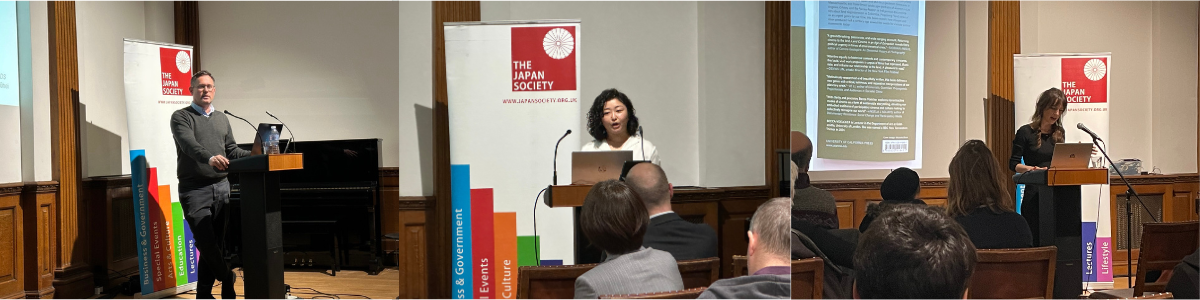
In October, November, and December 2025, we held a compelling series of lectures exploring the HIV/AIDS in Japan, Former Prime Ministers in Japanese Politics, and the History of Eco-Political Land Cinema.
We would like to thank our speakers: Dr Mark Pendleton, Professor Hugo Dobson and Dr Karin Narita and Dr Becca Voelcker along with everyone who attended the lectures. Special thanks to the Toshiba International Foundation for their support.
Below is a summary of the lectures conducted in October, November, and December 2025.
Click here for upcoming lectures and Join The Japan Society Mailing List to stay informed of future events.
|
Become a member of The Japan Society and have exclusive access to the video recording of most of the lectures and many more events in the "members-only" playlist on our YouTube channel.  |
20 October - HIV and AIDS in Japan: Labels, Bodies, and Legacies
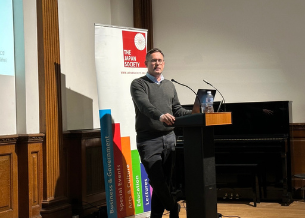
Dr Mark Pendleton’s lecture provides a critical examination of the social and political history of HIV/AIDS in Japan, a topic often overlooked in global health narratives. He begins by deconstructing the myth of Japanese exceptionalism, the idea that Japan somehow escaped the AIDS crisis that devastated other nations in the 1980s. While infection numbers were statistically lower than in the West, Pendleton asserts that the social impact was significant, evidenced in intense state-managed stigma. He explains how early media coverage labelled HIV as a foreigners' disease ( or gaijin ) which created a false sense of security among the Japanese public while fostering xenophobia and discrimination against marginalised groups, including the LGBTQ+ community and sex workers.
A significant portion of the talk is dedicated to the so-called blood scandal, known as Yakuhai AIDS, where thousands of haemophiliacs were infected through contaminated blood products despite the government being aware of the risks. This scandal became a turning point in Japanese civil society, leading to landmark legal battles that challenged the authority of the state and the medical establishment.
Pendleton highlights how activists and patients used body politics through photography, art, and the publication of personal diaries to reclaim their humanity from the clinical and often derogatory labels used by the media. By documenting these legacies of memory, the lecture illustrates how the fight against HIV in Japan was not just a medical battle, but a struggle for civil rights, visibility, and the right to live with dignity in a culture of enforced silence.
17 November - Former Prime Ministers in Japanese Politics
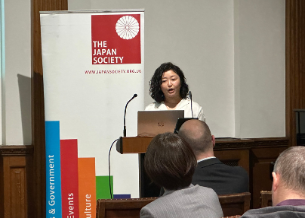
In this lecture, Professor Hugo Dobson and Dr Karin Narita explore the political afterlives of former Japanese prime ministers. They argue that while academic and public interest typically focuses on a leader's time in office, the period following their resignation is a significant, yet overlooked, phase of political life. To analyse this, the speakers introduce a typology of ten distinct roles, ranging from the exhausted volcano who retreats from public view to the still ambitious politician seeking a return to high office. This framework provides a lens through which to view the diverse ways former leaders navigate their loss of power and attempt to maintain relevance.
The speakers apply this typology to three distinct eras of Japanese history: the pre-war imperial period, the post-war Cold War era, and contemporary politics. They highlight Prince Saionji Kimmochi as the quintessential first citizen or elder statesman (genro) of the imperial era, and Yoshida Shigeru as a post-war political dabbler who mentored future leaders from his seaside retreat. A recurring theme is the prevalence of family affairs or political dynasties, such as the Hatoyama and Abe-Kishi families, where former leaders leverage their names to ensure a line of succession. This generational aspect is particularly pronounced in Japan, where many prime ministers are the progeny of previous officeholders.
The lecture concludes by identifying the political dabbler as the most ubiquitous category in Japanese politics, acting as an informal power broker even when formal factions are abolished. Looking ahead, Prof. Dobson and Dr. Narita suggest that as prime ministers serve at younger ages, their afterlives will lengthen, potentially increasing their long-term influence. They also touch upon the impending shift towards Japan’s first female prime minister and the way legacies are curated after death, as seen with Sanae Takaichi’s alignment with the late Abe Shinzo. Ultimately, the talk illustrates that a prime minister’s resignation is rarely the end of their story, but rather a transition into a new, informal mode of power.
15 December - Eco-Political Film Histories: Land Cinema in Japan and beyond
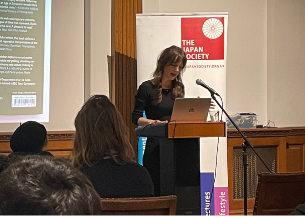
In this lecture, Dr Becca Voelcker introduces the concept of land cinema as a framework for understanding films that engage with the physical environment through the lens of social and political struggle. She argues that land is not merely a background for human action but is itself a protagonist and a site of extraction, colonial history, and resistance. By focusing on film history from the mid-twentieth century to the present, she highlights how certain directors have used the camera to document and participate in land-based activism.
A significant portion of the talk is dedicated to Japanese film history, specifically the work of Ogawa Productions. This collective is noted for its radical approach to documentary filmmaking during the Sanrizuka protests against the construction of Narita Airport. Dr Voelcker explains how the filmmakers did not just observe the farmers but lived alongside them, blurring the lines between art and life. This long-term commitment allowed them to capture the deep, seasonal rhythms of the earth alongside the violent arrival of state infrastructure.
The lecture also explores landscape theory, or fukeiron, which emerged in Japanese cinema during the late sixties. This theory posits that the mundane, everyday landscapes of cities and suburbs reflect the oppressive structures of the state. By filming seemingly neutral spaces like car parks or roads, filmmakers sought to reveal how power is imprinted on the environment. Dr Voelcker expands this discussion globally, linking Japanese practices to films from the Navajo Nation and the Middle East, illustrating a shared concern with how cinema can reclaim land from industrial or imperial interests.
Supported by the Toshiba International Foundation (TIFO)